Valuations and transactions pointed up in Q2 2026, but signals diverged
Private market values turned positive while transaction volume accelerated last quarter, though larger deals, not a broad buyer return, drove the gains.
Valuations and transactions pointed up in Q2 2026, but signals diverged
Private market values turned positive while transaction volume accelerated last quarter, though larger deals, not a broad buyer return, drove the gains.
Contributors

Cole Perry
Associate Director of Research, Altus Group

Mike Amthor
Director, Performance Analytics

Omar Eltorai
Senior Director of Research, Altus Group
Key highlights
On a recent episode of the CRE Exchange podcast, Omar Eltorai spoke with Mike Amthor and Cole Perry about Q2 2026 commercial real estate investment
The NCREIF ODCE index posted a 1.3% total property-level return last quarter, just under 1.1% from income and about 0.2% from appreciation, its eighth straight positive quarter
Dollar volume was the standout in the Q2 2026 US CRE Investment and Transactions Quarterly, up 11% quarter over quarter and 16.3% year-over-year on a trailing four-quarter basis, while deal count rose 6.7% on the quarter but slipped slightly year-over-year
Three questions shape the back half of 2026: will the rotation of invested dollars out of multifamily and toward industrial hold, do larger deals keep returning, and can cashflow keep carrying returns if investment rates hold steady?
A recent episode of the CRE Exchange podcast brought together two different reads on the US commercial real estate market. Host Omar Eltorai, Senior Director of Research, was joined by Mike Amthor of Altus Group’s US Performance Evaluation Analytics team and Cole Perry, Associate Director of the Research, to discuss the Q2 2026 results of the NCREIF ODCE index and the US CRE Investment and Transactions Quarterly (ITQ) report. Amthor had recently covered the ODCE data in depth in Altus Group’s Q2 2026 ODCE performance attribution webinar, and the podcast gave the Research Team an opportunity to connect that valuation perspective with broader transaction trends.
The NCREIF ODCE index covers appraised values of institutionally-owned core assets held in 25 open-ended funds. The ITQ covers transaction activity and spot pricing nationally, capturing closed sales of $100,000 and above, including secondary and tertiary metros.
Despite the different lenses, the two datasets pointed to a similar story in some places and a split one in others. Storage and office showed signs of resilience or stabilization across both views, while multifamily looked stronger in institutional valuations than it did in the broader transaction market.
Values rose at a light pace, carried by cashflow
On the valuation side, the ODCE index returned 1.3% at the property level in the second quarter, with just under 1.1% coming from income and about 0.2% from appreciation. “Values are moving upward, albeit at a fairly light pace,” Amthor noted. Investment rates were remarkably stable through the quarter, so sentiment did little to move values; where values rose, cashflow fundamentals did the work. That pattern has held for roughly six quarters, dating back to the rate adjustment period that ran through 2024.
Figure 1: ODCE total return by component

Transaction volume accelerated, led by larger deals
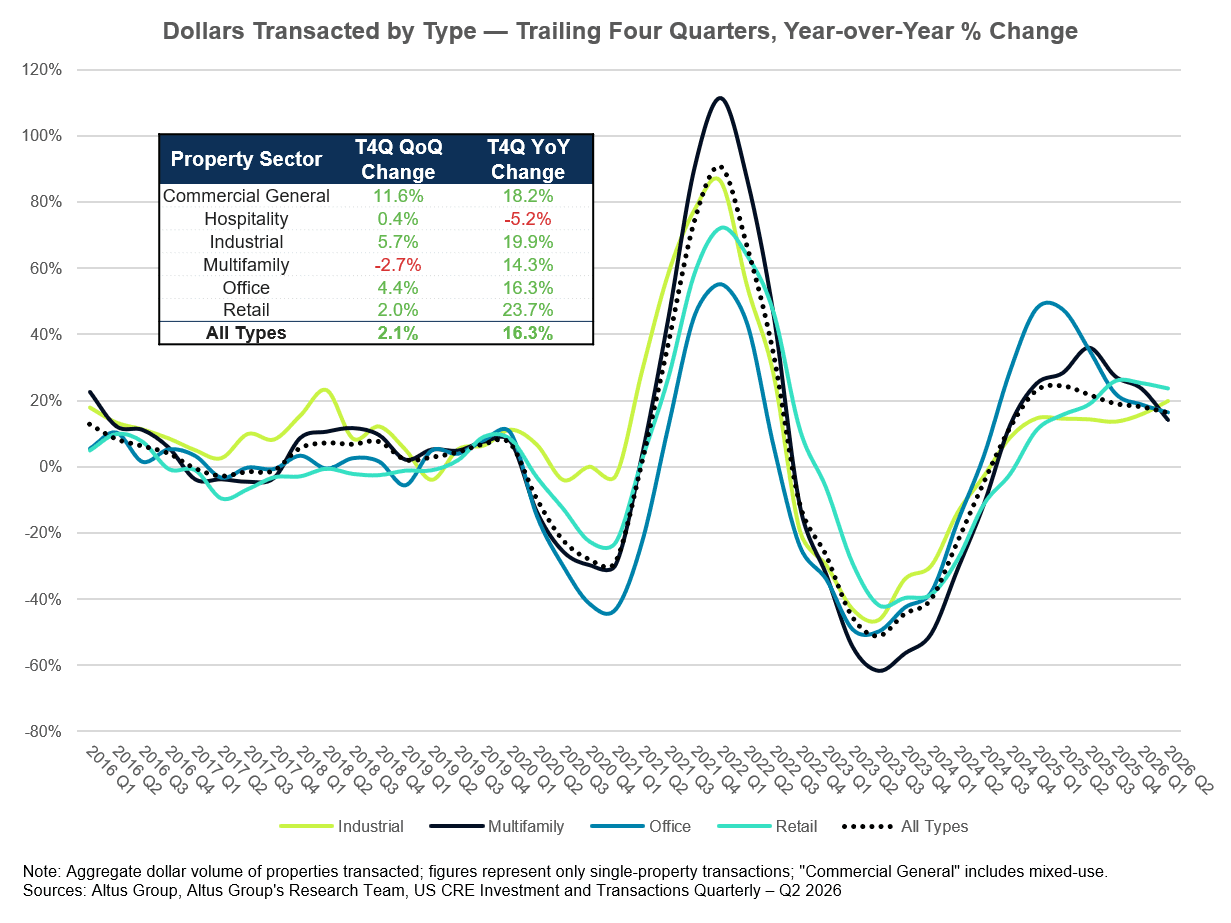
The ITQ told a more energetic story. Dollar volume rose 11% quarter-over-quarter (QoQ) and 16.3% year-over-year (YoY) on a trailing four-quarter basis, while square footage transacted was up about 12%. The gap between dollars and deal count indicated that the recovery was led by larger transactions, not necessarily a flood of new buyers.
Figure 2: Dollars transacted by type – Trailing four quarters, year-over-year % change
Storage, medical office, and even office showed the two datasets converging
For all the differences in what they measure, the returns and transaction data agreed on several fronts in the second quarter. Storage was a standout in both: it led ODCE’s niche components, and in the transaction data, spot pricing rose 24% YoY, doubling since 2020. Medical office held up in both views, carried by steady cashflow fundamentals on the valuation side and firm activity on the transaction side. Office showed early, tentative signs of stabilization in both: ODCE office appreciation clawed back to roughly flat, while transaction data showed larger office assets starting to change hands again. The clearest divergence was multifamily, still solidly positive in the return data, but the sector that ceded the most transaction share in the transaction data.
Across markets, a handful of metros pulled away from the pack
On the valuation side, Amthor pointed to a few familiar geographic themes. San Francisco rode an AI-driven wave in both office and residential, and Dallas continued to benefit from strong leasing fundamentals. Southern California industrial, three years into a correction, showed signs the decline was easing as larger-format leasing picked up, while the Sun Belt remained weighed down by a supply glut.
A new set of transaction metrics worth zooming in on
Perry introduced a set of property-level metrics covering the properties that transacted, and two were worth a closer look: transacted building age and pricing by vintage. The median multifamily asset that traded in the quarter was about two years older than a year earlier, a possible sign that newer product stayed off market while older, value-add stock changed hands. And 1980s-vintage multifamily priced about 43% above 2000s stock, likely as much a location signal as a vintage one.
The back half of 2026 hinges on rotation, large deals, and steady cashflow
Heading into the second half of the year, Perry said the rotation theme dominates the transaction outlook, with capital appearing to move out of multifamily and toward industrial and office. Office is the case worth watching most closely: the average building size of transacted properties has grown about 40% from its 2024 low, a sign that bigger assets are finally clearing. The open questions are the durability of large-deal activity, whether deal count rises, and whether the office turnaround has genuine legs.
On the valuation side, Amthor will be watching for continued cashflow to returns amid steady investment rates, sustained momentum in the recent uptick in capital spending, and a broadening of Southern California industrial’s recovery. If sentiment turns more supportive on top of steady fundamentals, the light, cashflow-led gains of the past several quarters could begin to pick up pace.
Want to be notified of our new and relevant CRE content, articles and events?
Disclaimer
This publication has been prepared for general guidance on matters of interest only and does not constitute professional advice or services of Altus Group, its affiliates and its related entities (collectively “Altus Group”). You should not act upon the information contained in this publication without obtaining specific professional advice.
A number of factors may influence the performance of the commercial real estate market, including regulatory conditions and economic factors such as interest rate fluctuations, inflation, changing investor sentiment, and shifts in tenant demand or occupancy trends. We strongly recommend that you consult with a qualified professional to assess how these and other market dynamics may impact your investment strategy, underwriting assumptions, asset valuations, and overall portfolio performance.
No representation or warranty (express or implied) is given as to the accuracy, completeness or reliability of the information contained in this publication, or the suitability of the information for a particular purpose. To the extent permitted by law, Altus Group does not accept or assume any liability, responsibility or duty of care for any consequences of you or anyone else acting, or refraining to act, in reliance on the information contained in this publication or for any decision based on it. The distribution of this publication to you does not create, extend or revive a client relationship between Altus Group and you or any other person or entity. This publication, or any part thereof, may not be reproduced or distributed in any form for any purpose without the express written consent of Altus Group.
Contributors
Cole Perry
Associate Director of Research, Altus Group
Mike Amthor
Director, Performance Analytics
Omar Eltorai
Senior Director of Research, Altus Group
Resources
Latest insights