CRE as an Inflation Hedge
Not all CRE assets hedge inflation equally. Subtype-level data shows lease rollover mechanics, not property type, determine whether rent gaps become real income.
CRE as an Inflation Hedge
Not all CRE assets hedge inflation equally. Subtype-level data shows lease rollover mechanics, not property type, determine whether rent gaps become real income.
Omar Eltorai

Omar Eltorai
Senior Director of Research, Altus Group
Key Highlights:
Commercial real estate is widely assumed to hedge inflation, but analysis across 16 property subtypes and 91 quarters of valuation data shows that protection varies significantly at the subtype level
Industrial’s inflation-hedge reputation is largely a warehouse story, with warehouse showing statistically significant rent-gap conversion while flex and other subtypes do not
Retail is split: malls convert rent gaps into income growth, but strip-center formats show no reliable evidence of the same mechanism
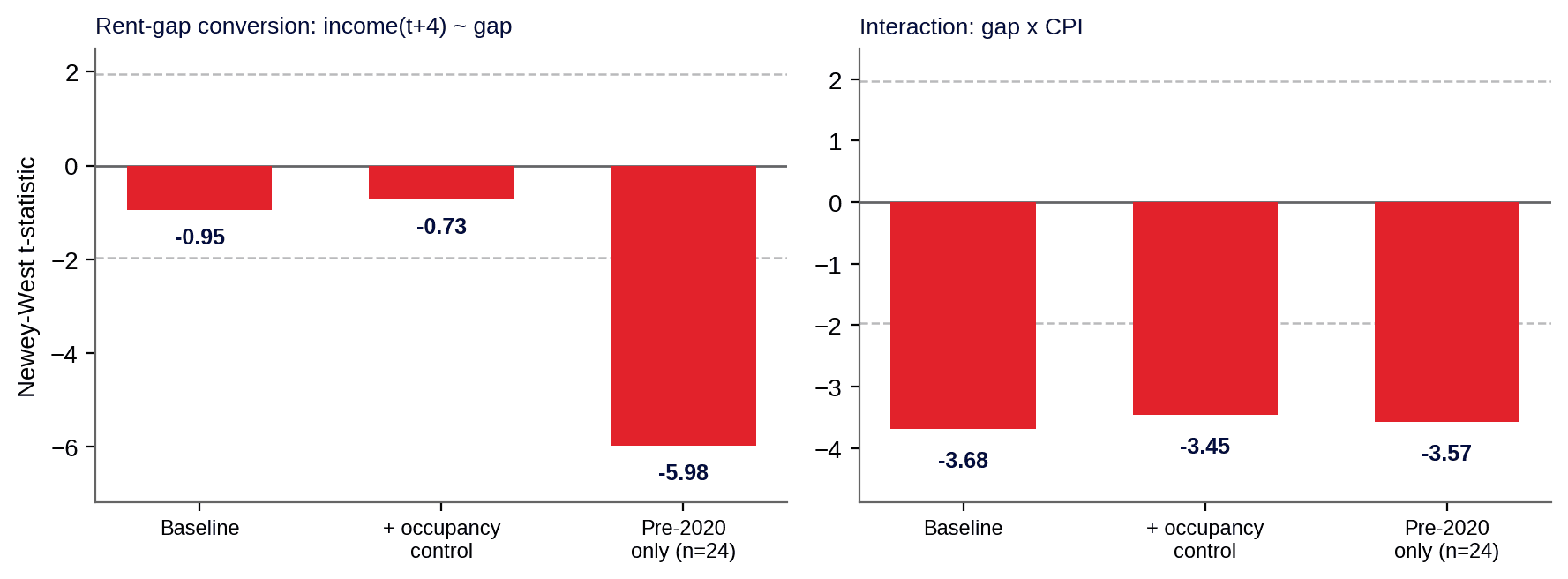
Office shows a persistently negative gap-to-income relationship that predates the pandemic and is not explained by occupancy changes
Testing the inflation hedge with lease-level data
Earlier this year, Altus Group explored why lease structure sits at the heart of commercial real estate’s inflation-protection story. The premise was straightforward: when market rents rise faster than contract rents, owners and landlords may be able to capture that spread as leases reset. But an important question remained unanswered: does that mechanism actually show in the data?
The answer is yes, but only in certain property types.
The common assumption that commercial real estate provides inflation protection is directionally correct. The problem is that investors often treat that protection as a broad sector characteristic, applying it to categories such as industrial, retail or office. In practice, inflation protection appears to depend less on the property type label and more on whether lease rollover can convert market rent growth into property income.
In other words, the existence of pricing power is only half of the story. The ability to capture it matters just as much.
To test this mechanism we used Altus Group valuation data, 91 quarters from Q4 2003 through Q2 2026, restricted to begin no earlier than 2013, where the cross-section of subtypes becomes dense enough to trust. Lease-structure fields exist for space-lease type (leases defined in square feet, not units or keys) only, which is why the test covers industrial, office, and retail, the three parent types with a rollover schedule to report, and the 16 subtypes beneath them that carry a full lease series. Then we ran the analysis at both property type and subtype levels.
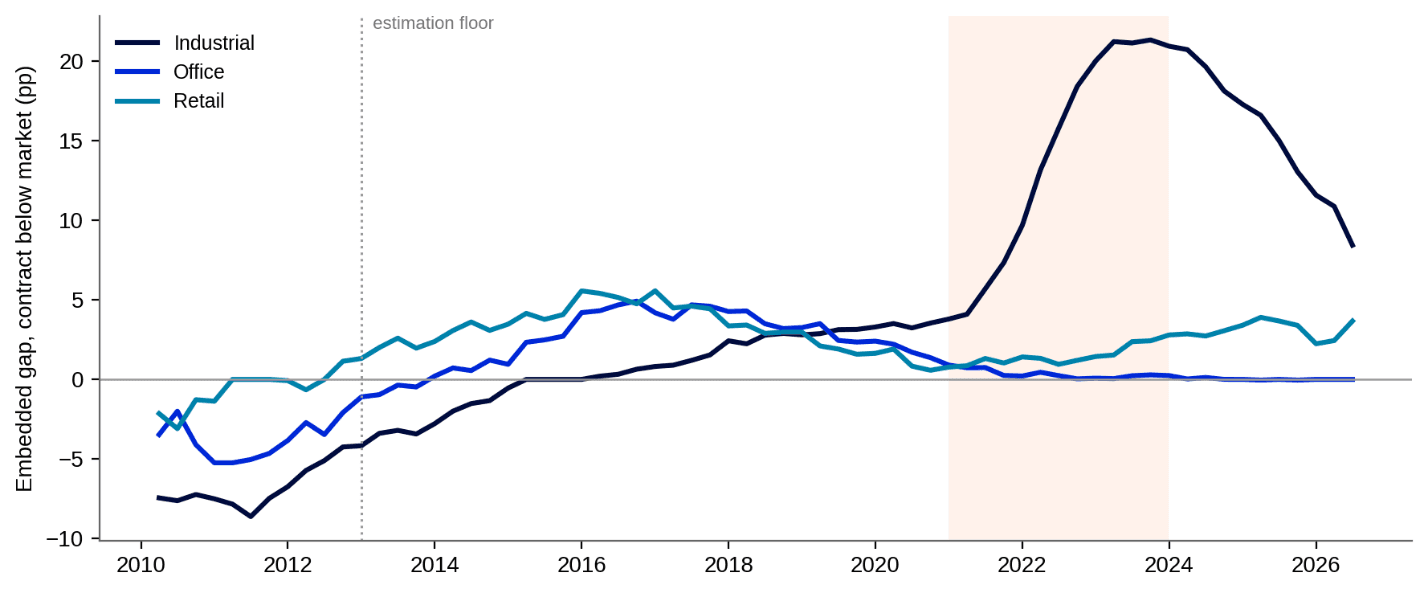
Figure 1 - Which property types carry a rent gap through the cycle? Embedded gap over time
Source: Data Altus Studio
The rent gap is only potential
As discussed in the previous article, inflation can create a divergence between market rents, and the rent tenants are already paying under signed leases. That spread can represent embedded rent growth, but it is not the same thing as realized income.
An owner or landlord only captures that spread when leases roll and reset to market. That distinction matters because many properties can appear to carry upside on paper. The question is whether rollover reliably converts that upside into future income growth.
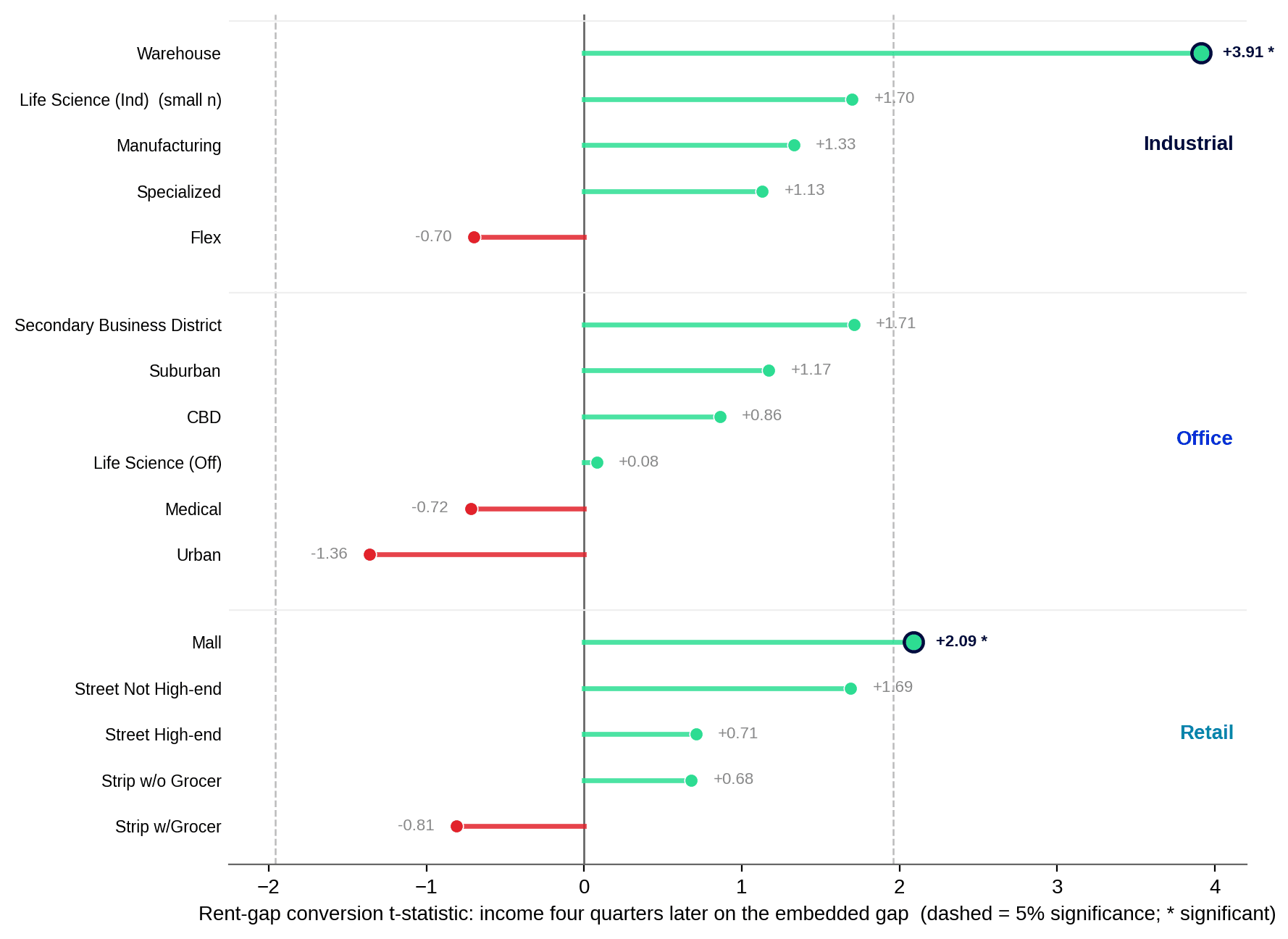
While a wide rent gap is an opportunity, it is not a guarantee. The investable question is whether lease rollover historically converts the gap into income. That conversion is visible only in select subtypes, not across entire property categories.
Industrial’s reputation is largely a warehouse story
Industrial assets are frequently cited as one of commercial real estate’s stronger inflation hedges. There is a good reason for that reputation: market rent growth can move ahead of in-place rent, creating embedded upside that may be captured as leases expire.
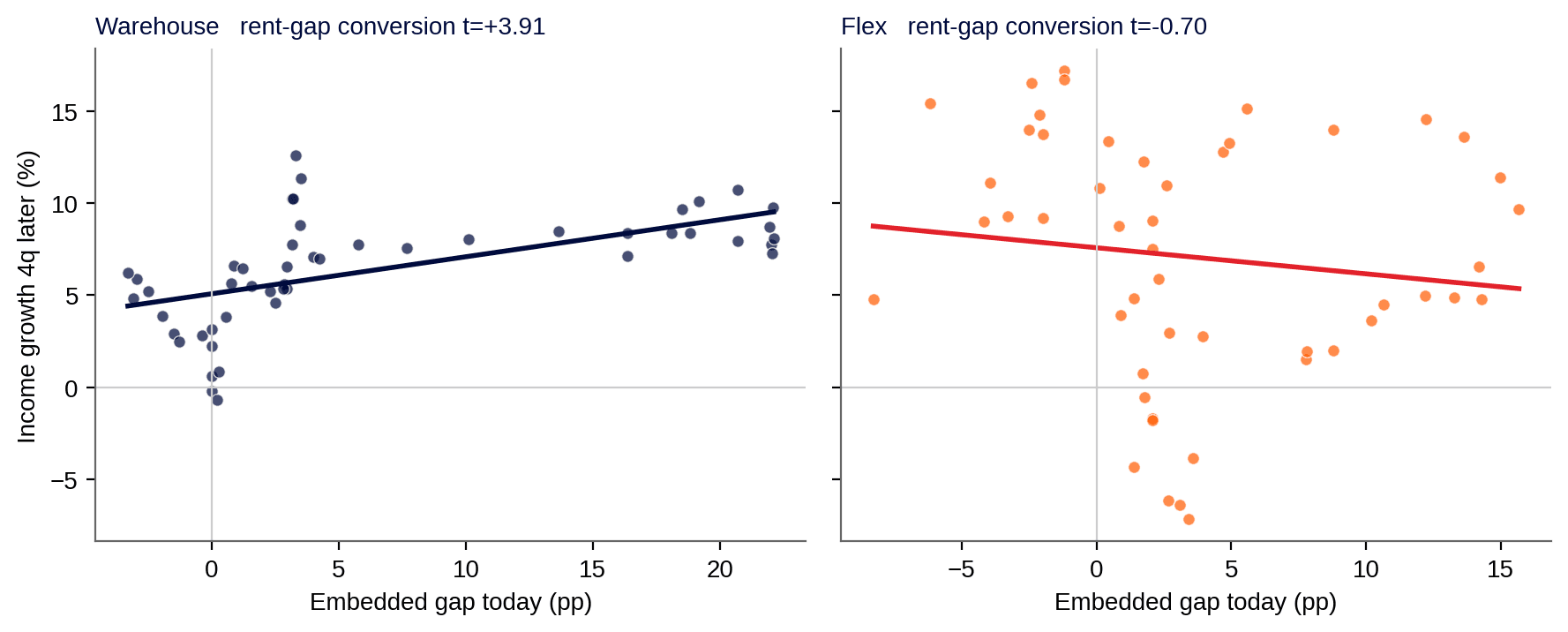
However, “industrial” is not one homogeneous category. Warehouse properties show a clear pattern in which larger embedded rent gaps are followed by stronger income growth. Industrial flex properties, by contrast, show little evidence of the same mechanism. Manufacturing and specialized industrial assets point in the right direction, but lack the same consistency.
Figure 2 - Which subtypes convert a rent gap into income? The rent-gap conversion t-statistic by subtype
Source: Data Altus Studio
Figure 3 - Industrial split: warehouse converts the gap, flex does not
Source: Data Altus Studio
The implication for investors and lenders is important. Inflation protection is not simply an industrial-sector characteristic. It appears concentrated in specific formats where leases can convert market rent growth into property income.
Retail tells a more complicated story
Retail provides a second example of why broad sector averages can be misleading. Viewed as a single property type, retail appears relatively neutral. Once individual formats are separated, however, different retail subtypes behave very differently.
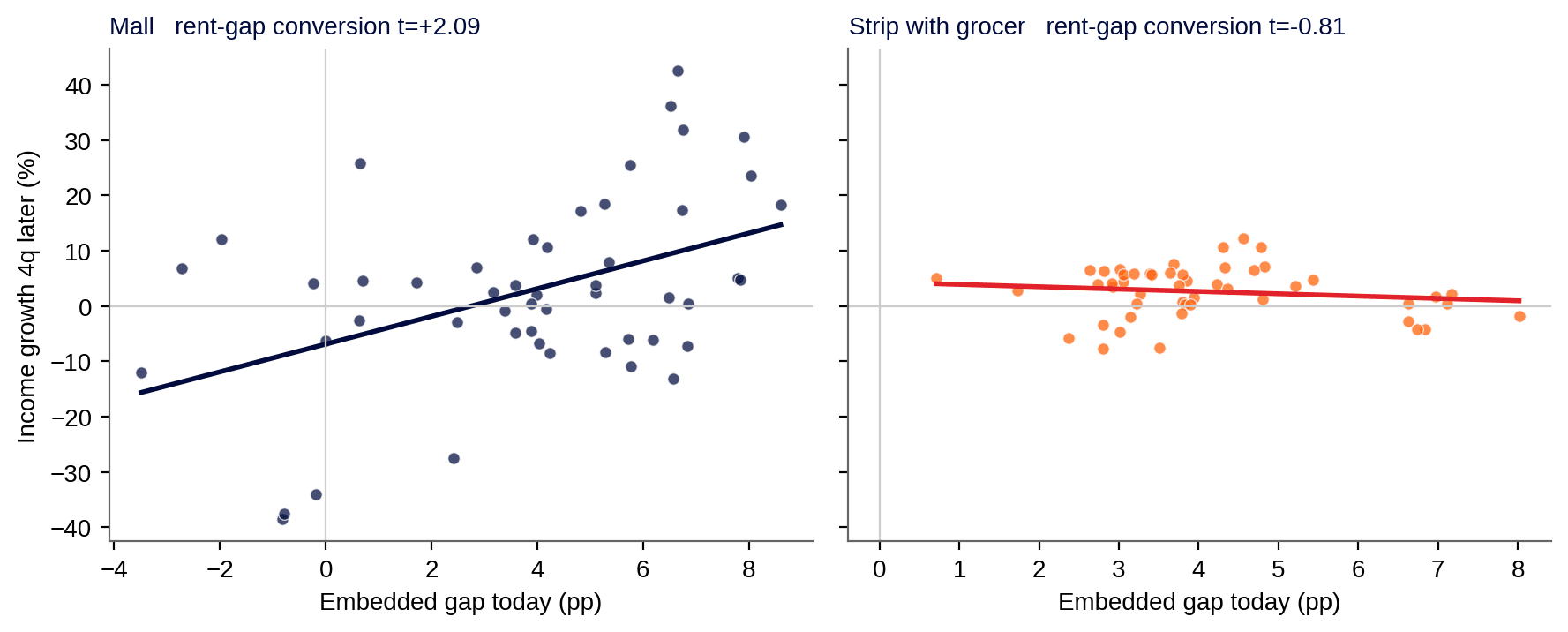
Malls demonstrate evidence that embedded rent gaps can translate into future income growth. Several strip-center formats show weaker evidence of the same conversion mechanism. Two assets may sit within the same property classification, face similar inflation pressures and even show similar market rent growth, yet only one may have lease dynamics that convert that opportunity into cash flow.
Figure 4 - Retail: mall converts the gap, strips do not
Source: Data Altus Studio
Office remains the exception
Office continues to stand apart from other major property types. While inflation can create apparent rent gaps within office portfolios, those gaps have not reliably translated into stronger future income performance. Across office subtypes, the relationship is generally weak or negative.
Importantly, this does not appear to be only a post-pandemic story. Larger office rent gaps have not consistently led to stronger income growth through lease rollover, even when controlling for occupancy changes and looking at earlier periods. For investors, that means a sizable difference between market rent and in-place rent should not automatically be interpreted as future upside in office markets.
Figure 5 - Is office's backward result just work-from-home? Nope
Source: Data Altus Studio
What this means for underwriting
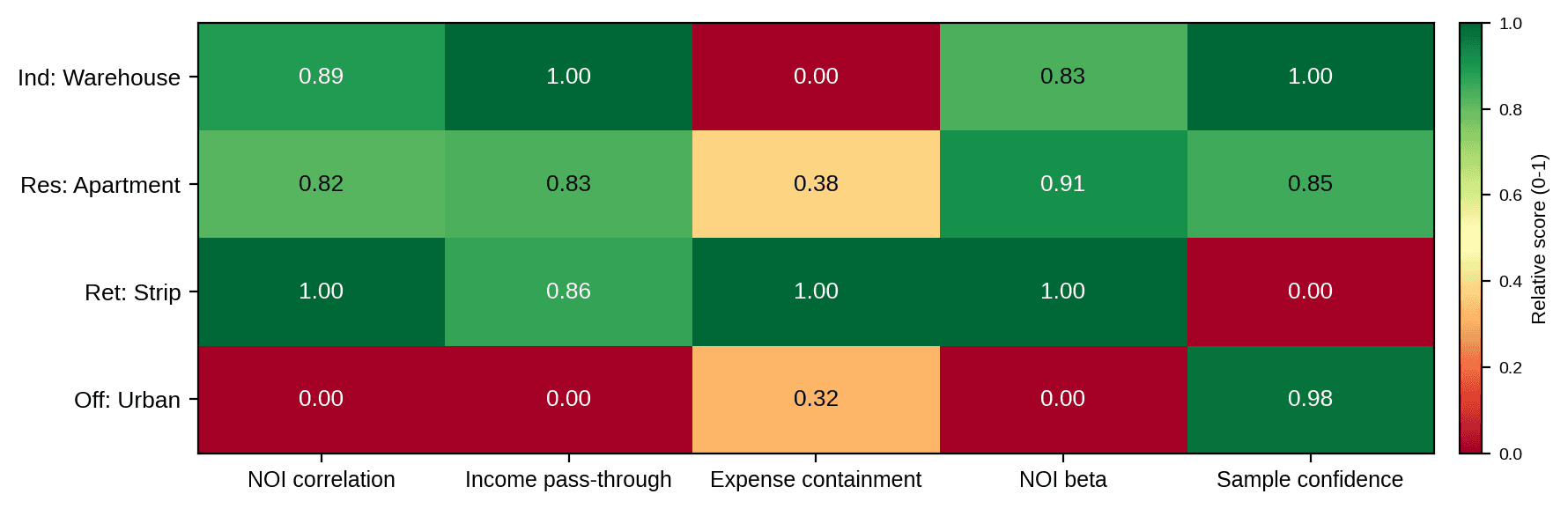
The broader lesson is that inflation protection should be evaluated through lease mechanics rather than sector labels. A property’s inflation sensitivity depends on three related questions:
Is there a meaningful gap between market and contract rents?
Do leases roll frequently enough to capture that gap?
Has that conversion historically translated into income growth?
When those conditions are present, inflation can become a tailwind for operating performance. When they are absent, inflation may never fully reach property cash flow. This makes underwriting at the lease and subtype level more useful than applying a blanket inflation hedge assumption to an entire sector.
Figure 6 - The same five hedging dimensions as a scorecard (0-1 scaled)
Source: Data Altus Studio
The takeaway
The conventional wisdom that commercial real estate protects against inflation is only partially correct. Inflation protection is not simply a function of owning industrial instead of office, or retail instead of another property type. It depends on whether lease structures allow market rent growth to become realized income.
The strongest inflation hedges are not necessarily the assets with the largest rent gaps today. They are the assets whose leases can actually convert those gaps into cash flow tomorrow.

Access data-powered valuation advisory services
Leverage our market expertise, leading ARGUS technologies, and unique valuation datasets you need to drive asset performance and manage risk.
Want to be notified of our new and relevant CRE content, articles and events?
Disclaimer
This publication has been prepared for general guidance on matters of interest only and does not constitute professional advice or services of Altus Group, its affiliates and its related entities (collectively “Altus Group”). You should not act upon the information contained in this publication without obtaining specific professional advice.
A number of factors may influence the performance of the commercial real estate market, including regulatory conditions and economic factors such as interest rate fluctuations, inflation, changing investor sentiment, and shifts in tenant demand or occupancy trends. We strongly recommend that you consult with a qualified professional to assess how these and other market dynamics may impact your investment strategy, underwriting assumptions, asset valuations, and overall portfolio performance.
No representation or warranty (express or implied) is given as to the accuracy, completeness or reliability of the information contained in this publication, or the suitability of the information for a particular purpose. To the extent permitted by law, Altus Group does not accept or assume any liability, responsibility or duty of care for any consequences of you or anyone else acting, or refraining to act, in reliance on the information contained in this publication or for any decision based on it. The distribution of this publication to you does not create, extend or revive a client relationship between Altus Group and you or any other person or entity. This publication, or any part thereof, may not be reproduced or distributed in any form for any purpose without the express written consent of Altus Group.
Omar Eltorai
Omar Eltorai
Senior Director of Research, Altus Group
Resources
Latest insights






Sep 10, 2026