Toronto commercial market update - Q3 2026
GTA commercial investment rose 39% in Q3 2026, led by multi-family and office. Discover sector trends, capital deployment, and market bifurcation.
Toronto commercial market update - Q3 2026
GTA commercial investment rose 39% in Q3 2026, led by multi-family and office. Discover sector trends, capital deployment, and market bifurcation.
Author

Jennifer Nhieu
Senior Research Analyst
Key highlights:
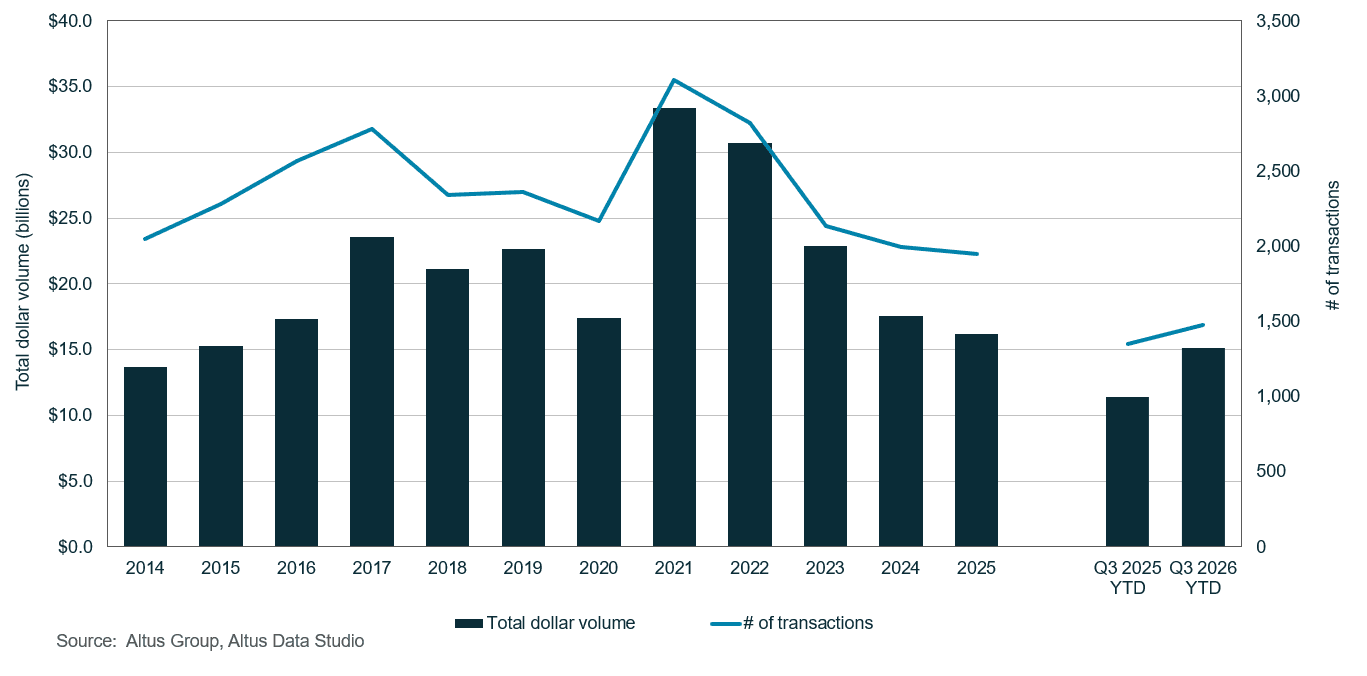
Through the third quarter of 2026, Greater Toronto Area commercial real estate investment volume rose 39% year-over-year to $15.1 billion
Multi-family and office led investment activity, with year-over-year increases of 273% and 154%, respectively
Retail investment volume declined 22% year-over-year to nearly $1.4 billion, as tight conditions and limited availability in high-demand retail corridors constrained transaction volume
Through the third quarter of 2026, GTA commercial real estate investment increased 39% year-over-year
Through the third quarter of 2026, investor confidence across the Greater Toronto Area (GTA) commercial real estate market demonstrated notable resilience, with total investment volume rising 39% year-over-year to $15.1 billion. Capital deployment was primarily driven by substantial transaction volume expansion in the office and multi-family sectors. Conversely, while retail asset fundamentals remained operational and tight, severe inventory constraints in high-demand corridors contributed to a pullback in retail deal flow, limiting its overall contribution to broader regional transaction totals.
Despite lingering headwinds from global trade policy volatility, shifting demographic flows and elevated debt-servicing costs following a period of macroeconomic recalibration, regional market activity reflected defensive yet opportunistic deployment. Investors remained highly selective, directing capital toward core asset classes and premium nodes that offered long-term cash-flow stability and structural supply protection.
Figure 1: Greater Toronto Area property transactions - All sectors by year
Geopolitical and Trade Dynamics
Following initial discussions related to the July 2026 joint review of the Canada-United States-Mexico Agreement (CUSMA), corporate occupiers refined supply-chain resilience strategies and maintained inventory models for near-term volatility. Institutional investment nevertheless increased year-over-year, indicating that domestic and global investors continued to prioritize the GTA’s demographic base, constrained supply in core submarkets and a stabilizing interest-rate environment over near-term trade-policy uncertainty.
Macroeconomic and monetary indicators
The Bank of Canada held its target overnight rate at 2.25% at its July 15 and September 2, 2026 announcements amid persistent global energy volatility linked to ongoing Middle East conflicts. For the GTA commercial real estate market, the pause improved cost-of-capital visibility and helped narrow bid-ask spreads, but borrowers and developers continued to face refinancing costs above prior-decade levels. Canadian gross domestic product expanded in May before remaining flat through mid-summer, providing a stable, though subdued, backdrop for regional commercial space demand.
At the local level, GTA labour market conditions moderated, with Toronto’s regional unemployment rate holding at 6.8% in August 2026. The stable employment backdrop supported corporate tenant retention and office utilization across downtown and suburban nodes. Consumer activity also remained resilient in high-density retail corridors, particularly for grocery-anchored and essential-service assets, while residential land and development markets continued to adjust to shifting demographic trends.
Capital allocation and investment strategy
A delicate tension between strong long-term leasing fundamentals and persistent short-term uncertainty defined the investment climate across the GTA through the third quarter of 2026. While macroeconomic indicators and debt markets demonstrated a measure of structural stabilization compared to prior cycles, a persistent gap in pricing expectations between buyers and sellers continued to create strategic pauses across the market.
Rather than retreating, institutional and private capital moved towards a heavily disciplined approach, shifting away from speculative, growth-oriented development and toward defensive, yield-generating assets. Investors aggressively prioritized core, income-producing properties that offered built-in operational buffers against inflation and volatile carrying costs. This risk-averse posture resulted in a highly bifurcated investment landscape. Speculative greenfield projects, unentitled land parcels, and non-core secondary assets faced intense underwriting scrutiny and wider yield spreads as lenders and equity partners demanded stringent risk mitigation. Conversely, highly functional assets in prime regional nodes continued to command premium pricing whenever product became available, though overall transaction velocity was frequently stifled by owners retaining stabilized holdings.
Investors prioritized established properties with immediate cash flow and exposure to the GTA’s long-term demographic and economic fundamentals. This selective approach shaped capital deployment across the region’s commercial sectors.
Multi-family investment activity
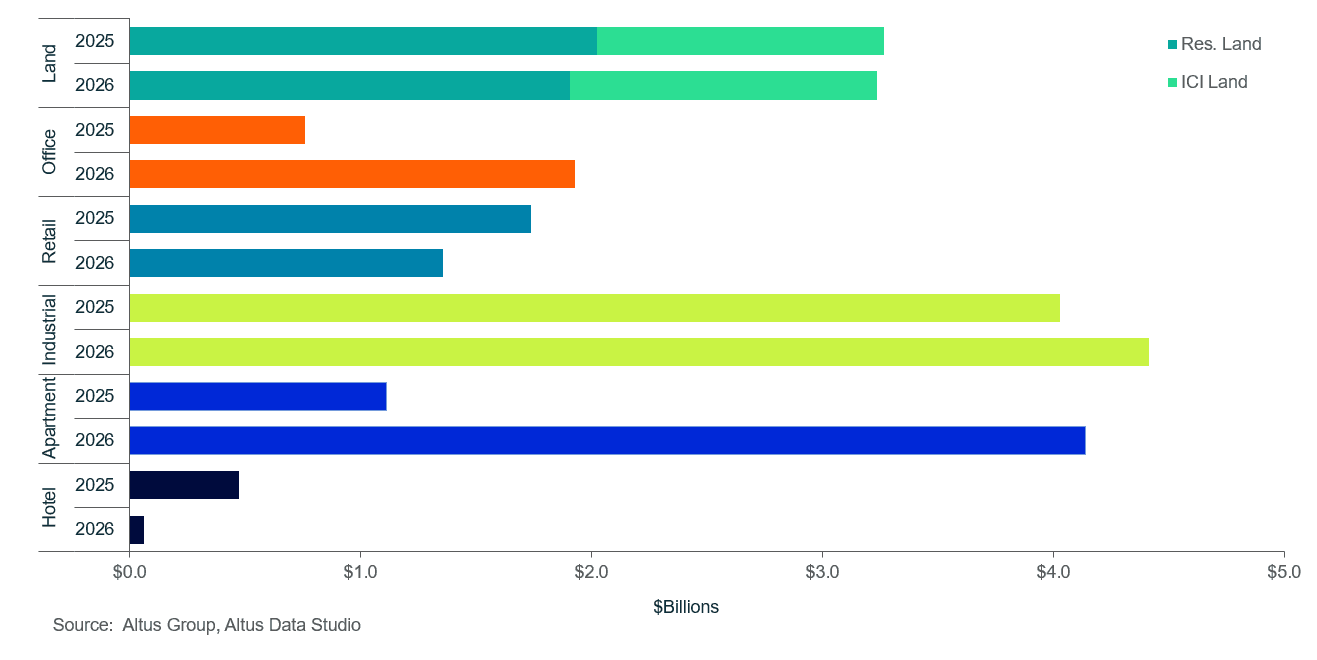
Multi-family transaction volume reached $4.1 billion through the third quarter, up 273% year-over-year. Activity increased across major submarkets with York, Durham, and the City of Toronto recording gains of 3,751%, 618% and 332%, respectively. These broad-based increases signalled strong institutional demand for residential assets in both the urban core and higher-density suburban markets.
Despite stronger transaction liquidity, investors remained disciplined as higher interest rates and tighter lending conditions increased financing costs. Purpose-built rental properties continued to appeal as an inflation hedge amid homeownership affordability constraints, but buyers did not rely on near-term yield compression, and some developers deferred uncommitted projects. At the same time, new purpose-built rental deliveries and supply from the secondary condominium-rental market moderated absorption and rent growth, extending the sector’s stabilization period.
The City of Toronto advanced its Toronto Builds framework to streamline affordable rental housing delivery on public land through the Housing Development Office. Provincial initiatives, paired with federal partnerships, also sought to expand rental financing tools and accelerate housing supply. Updates to Ontario’s rental and Landlord and Tenant Board frameworks included streamlined non-payment notice timelines and clearer dispute criteria, which were intended to reduce administrative friction for residential landlords.
Office investment activity
Office investment volume reached $1.9 billion, up 154% year-over-year, as institutional and private buyers focused on stabilized Class AAA and Class A assets. Increased workplace utilization under broader return-to-office mandates supported leasing momentum through the third quarter of 2026, reinforcing demand for a limited supply of premium space.
According to Altus Group's latest Canadian Office Market Update, Toronto’s office availability rate declined 190 basis points year-over-year to 15.1%. Sustained demand for premium downtown space drove this improvement, lowering Class A availability in the Financial District to 9.2%. Year-to-date transaction data further illustrated the market’s continued flight to quality:
Class A offices accounted for 166 transactions covering more than 5 million square feet
Class B offices accounted for only 26 transactions totalling approximately 440,000 square feet
This disparity highlighted a pronounced operational divide across the GTA, as aging and functionally obsolete buildings continued to fall short of modern corporate requirements. Development activity remained disciplined, with only two office properties completed in the third quarter, totalling approximately 155,000 square feet: the fully leased, 35,682-square-foot Concord Canada House in Toronto’s Downtown South and the fully vacant, nearly 119,000-square-foot office component at 5250 Yonge Street in the North Yonge submarket.
The completion of 5250 Yonge Street marked the conclusion of a court-ordered receivership initiated after the developer defaulted on more than $185 million in construction debt. Although the project was completed under court supervision to stabilize the asset, receivership-related operational disruptions resulted in the property being delivered fully unleased, an exception among the quarter’s otherwise fully leased completions.
The development pipeline comprised seven buildings totalling nearly 877,000 square feet, with 70% of the space still available for lease. These projects were designed to address evolving tenant requirements through features such as collaborative workspaces, integrated technology and wellness amenities.
Industrial investment activity
The GTA industrial sector remained resilient through the third quarter of 2026, with transaction volume increasing 10% year-over-year to $4.4 billion despite trade-policy uncertainty. Some major logistics occupiers continued to favour just-in-case inventory strategies as they responded to changing global trade policies, cross-border tariff risks and regional transportation constraints. This supported demand for strategically located distribution and inventory space.
Industrial fundamentals weakened in the third quarter. After four consecutive quarters of positive net absorption from Q2 2025 through Q2 2026, the GTA market returned to negative absorption as new supply entered the market, corporate approval cycles lengthened and cost sensitivity increased. Speculative projects delivered without pre-leasing commitments added further pressure. According to Altus Group's latest Canadian Industrial Market Update, Toronto’s industrial availability rate rose 60 basis points year-over-year to 5.3%. Demand remained concentrated in high-specification Class A facilities with modern clear heights, ample power capacity and advanced logistics technology. This flight to quality absorbed part of the new supply and limited the increase in overall availability.
Nine industrial projects delivered nearly 2.5 million square feet in the third quarter, with 85% of the space uncommitted at quarter-end. A further 43 projects totalling 12.3 million square feet were under construction, of which 63% remained available. This pipeline was expected to place upward pressure on availability into early 2027, although estimated asking rents remained stable at $16 to $17 per square foot, as they had since early 2025. Near-term absorption risk therefore remained elevated, while dense regional demographics, trade infrastructure and demand for automated logistics facilities continued to support the sector’s longer-term outlook.
Retail investment activity
Retail performance varied significantly by submarket and asset type. Prime urban high streets, grocery-anchored centres and dominant regional shopping centres maintained strong tenant demand and near-zero vacancy. However, limited availability of top-tier assets and elevated debt-servicing costs constrained transaction volume despite these strong operating fundamentals.
GTA retail investment volume declined 22% year-over-year to nearly $1.4 billion. Limited availability of stabilized, high-performing assets constrained institutional transaction activity, while elevated capital costs reduced acquisition capacity among private and corporate buyers.
Slower provincial population growth, persistent inflation and elevated mortgage renewal costs weighed on household disposable income, shifting spending toward necessity-based retail and pressuring discretionary merchandise tenants. Over the longer term, the GTA’s scale and role as a gateway for international retailers continued to support demand and capital values for well-located, high-quality assets.

Leverage our real estate data and predictive analytics
The performance attribution, predictive analytics and market intelligence you need to explain performance and improve decision making.
Land investment activity
The GTA land sector recorded approximately $3.2 billion in transaction volume, an 18% year-over-year increase from a weak 2025 baseline. Despite the increase, transaction activity remained below historical levels, indicating that elevated financing, entitlement and development costs continued to constrain land liquidity.
Sector performance remained divided between industrial, commercial and institutional (ICI) land and residential land. ICI land transaction volume reached nearly $1.3 billion, up 7% year-over-year. Residential land activity reached nearly $1.9 billion through the third quarter of 2026, a 28% year-over-year increase, although the gain largely reflected comparison with a historically weak 2025. Prolonged municipal entitlement timelines, elevated development charges and high carrying costs amid unchanged interest rates continued to limit developer risk appetite, prompting residential builders to optimize density within existing landbanks rather than acquire unentitled parcels.
Municipal and provincial initiatives sought to reduce front-end development costs and delays. Regional development-charge recalibrations and the Canada-Ontario Development Charge Reduction Program aimed to lower capital requirements and support municipal infrastructure expansion. Their ability to restore project viability, however, depended on broader financing, demand and entitlement conditions.
Figure 2: Greater Toronto Area property transactions by asset class (Q2 2025 vs. Q2 2026)
Notable Toronto property transactions
The following were the notable transactions for the Q3 2026 Toronto commercial real estate market update:
Citigroup Place, Toronto — Office
GWL acquired Citigroup Place in downtown Toronto for $243 million in July. The sale was the largest office transaction of the third quarter and the third-largest GWL acquisition recorded in Ontario. The purchase increased GWL’s Toronto office portfolio to approximately 1.7 million square feet. It was also the company’s third large-scale acquisition of 2026, following the first-quarter purchase of Northland Village Mall at 5111 and 5235 Northland Drive NW in Calgary for nearly $144.8 million and the second-quarter purchase of 2750 Morningside Avenue in Scarborough for $112.4 million. Together, the transactions demonstrate GWL’s investment activity across the office, retail and industrial sectors.
750 Creditstone Road & 121 Pippin Road, Vaughan — Industrial
Vaughan-based Zzen Group of Companies acquired two fully leased industrial buildings at 750 Creditstone Road and 121 Pippin Road from CPP Investments and Dream Industrial REIT for $115 million. Built in 1999, the properties total 346,035 square feet, implying a value of $332 per square foot. Both buildings are fully occupied by established tenants. The acquisition expands Zzen’s income-producing industrial portfolio and aligns with its long-standing focus on development and ownership in Vaughan.
The Ivy, Toronto — Apartment
Cadillac Fairview acquired The Ivy at 6–8 Gloucester Street in downtown Toronto for $162 million in September. The price equates to approximately $698,000 per unit for the recently completed 34-storey, 232-suite rental tower, which also includes 1,658 square feet of retail space. Developed by Tricon Residential and Angel Developments, the property offers studio through three-bedroom suites. The acquisition expands Cadillac Fairview’s multi-family portfolio and establishes an initial purpose-built rental presence in downtown Toronto.
The Oaks on Green, North York — Apartment
Laval, Quebec–based Groupe Dumont completed its first Toronto-area acquisition with the $265 million purchase of The Oaks on Green in North York. The property comprises four buildings and 1,212 units, resulting in a price of $218,647 per unit. Greenwin sold the property in a transaction brokered by the Colliers Multi-family Team. Its low vacancy and tenant turnover support stable occupancy and income. The acquisition establishes Groupe Dumont’s initial multi-family presence in the GTA, complementing its existing industrial holdings in Ontario’s tertiary markets.
Market 0utlook
As the GTA commercial real estate market entered the final quarter of 2026, investment conditions showed signs of cautious stabilization. Elevated debt costs, differing buyer and seller pricing expectations, and uneven supply absorption were expected to constrain near-term activity. Institutional investors were likely to remain focused on high-quality, income-producing assets in core submarkets, while speculative and unentitled projects remained largely on hold, pending clearer underwriting conditions.
Legislative and municipal initiatives were expected to influence the pace of residential and commercial development. The Toronto Builds program, development-charge recalibrations, and streamlined Landlord and Tenant Board processes could gradually reduce upfront capital and administrative barriers. However, new multi-family and industrial deliveries, together with secondary inventory, were likely to extend supply absorption over several years rather than allow the market to rebalance in 2027.
The GTA’s scale, economic importance, and role as a gateway market continued to support its long-term investment outlook. Greater clarity on cross-border trade policy and interest rates could narrow the gap between buyer and seller pricing expectations and support stronger liquidity in 2027. In that environment, functional modern space, necessity-based retail and strategically located logistics assets were positioned to attract sustained investor interest.
Want to be notified of our new and relevant CRE content, articles and events?
Disclaimer
This publication has been prepared for general guidance on matters of interest only and does not constitute professional advice or services of Altus Group, its affiliates and its related entities (collectively “Altus Group”). You should not act upon the information contained in this publication without obtaining specific professional advice.
A number of factors may influence the performance of the commercial real estate market, including regulatory conditions and economic factors such as interest rate fluctuations, inflation, changing investor sentiment, and shifts in tenant demand or occupancy trends. We strongly recommend that you consult with a qualified professional to assess how these and other market dynamics may impact your investment strategy, underwriting assumptions, asset valuations, and overall portfolio performance.
No representation or warranty (express or implied) is given as to the accuracy, completeness or reliability of the information contained in this publication, or the suitability of the information for a particular purpose. To the extent permitted by law, Altus Group does not accept or assume any liability, responsibility or duty of care for any consequences of you or anyone else acting, or refraining to act, in reliance on the information contained in this publication or for any decision based on it. The distribution of this publication to you does not create, extend or revive a client relationship between Altus Group and you or any other person or entity. This publication, or any part thereof, may not be reproduced or distributed in any form for any purpose without the express written consent of Altus Group.
Author
Jennifer Nhieu
Senior Research Analyst
Resources
Latest insights