In CRE, AI is only as intelligent as its data foundation
Generic AI can’t defend a CRE valuation. Altus Group’s Shubhra Srivastava on the data foundation AI needs to support high-stakes decisions.
In CRE, AI is only as intelligent as its data foundation
Generic AI can’t defend a CRE valuation. Altus Group’s Shubhra Srivastava on the data foundation AI needs to support high-stakes decisions.

Shubhra Srivastava
Senior Vice President, Product Management, Altus Group
Key highlights:
Without a strong data foundation, adding more data to your systems increases risk rather than improving the intelligence you get from it
Being data-forward takes an intentional governance strategy, often one that sits between centralized bottlenecks and federated silos
General-purpose AI can automate away the human checks that made your numbers trustworthy, making it hard to tell whether the AI failed or the data did
General-purpose AI has a place in CRE for language-based tasks, but the modeling behind high-stakes decisions calls for purpose-built AI that understands how the industry works
More data, more risk
For more than 30 years, my work has been focused on data. I’ve evolved from a daily user to leading the development of data products across multiple lines of the commercial real estate business. And in all that time, one constant has held true: without a strong foundation, more data adds more risk — not better intelligence.
In my experience, a strong foundation comes down to two things. The first is governance; specifically, whether the data is clean, clearly defined, owned, and maintained. The second is how the data is (or isn’t) connected and organized. Data often sits within the teams that own or use it most, structured specifically to support the type of work they do. Every handoff to another team or user becomes a chance for misinterpretation.
And as firms race to realize the benefits of AI, both of these challenges can get decidedly worse.
Governance: the difference between having data and being data-forward
The CRE industry has never had a shortage of information. Firms are constantly adding data sources to their systems, building reports and dashboards, all in pursuit of better insights and better, more informed business decisions. But having data and being data-forward are not the same thing. A data-forward firm is one that has invested the time to define its data strategy and prioritizes data governance, so decisions are made deliberately rather than by default.
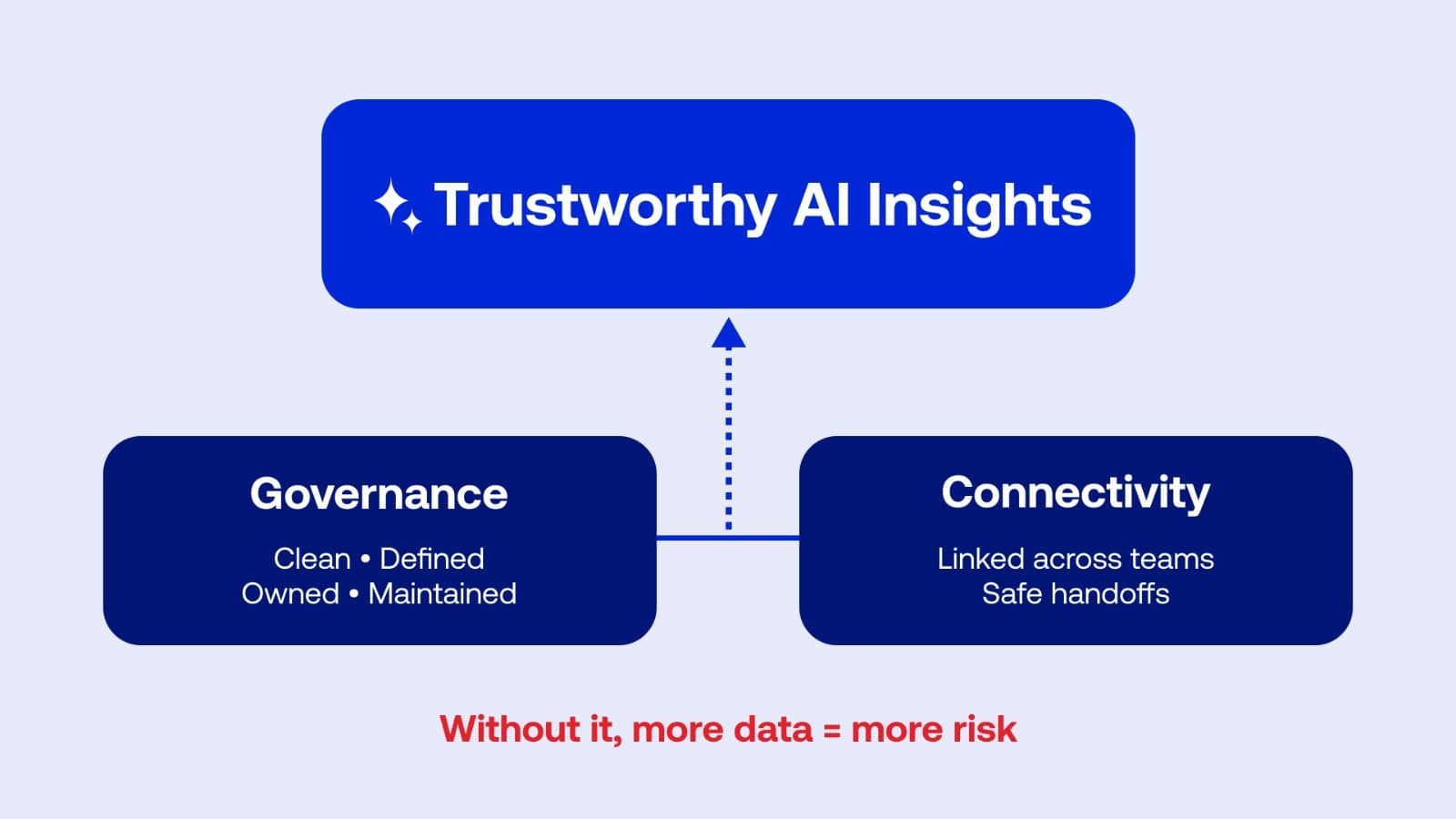
Most firms opt for either a centralized strategy where data is highly regulated and lives in a single system, or a federated approach where data sits with different teams. Both have pros and cons. A centralized strategy makes it easy to maintain data standards, but can cause bottlenecks, with long waiting times to access information. In a federated model, every team can do what they need to do, but the data sits in silos and makes it hard to see the big picture. The sweet spot is usually somewhere in the middle: a light central layer of governance that defines data dictionaries, codifies nomenclature, and assigns ownership, while each team maintains its own data and makes it usable for the teams that rely on it.
Data governance isn’t cool or sexy. It’s hard work, but if done right, it becomes the bedrock for confident, data-driven decisions.
How AI raises the stakes: one size does not fit all
Organizations are under tremendous pressure to adopt AI, and many are reaching for general-purpose, one-size-fits-all solutions. Those solutions have a place, even in CRE, but that place is not in high-stakes CRE decisions where hundreds of millions in capital are on the line. Because they understand language, they’re well-suited for everyday, language-based tasks like interrogating and translating documents, especially when a person is reviewing the results as they go. In CRE, for example, a brokerage or property management team might use them to search hundreds of past RFP responses for the most relevant ones, or a fund manager might use them to compare responses when selecting a property manager.
But those tools typically do not have customized know-how of CRE, where modeling is a balance between art and science. They aren’t anchored to proven models and workflows. Without that context, the AI decides for itself how a data model should come together, and that’s a bit scary. General-purpose AI can automate away the human checks and balances that made your numbers trustworthy, and when something does not look right – it is incredibly difficult to tell whether the AI failed, or the data did.
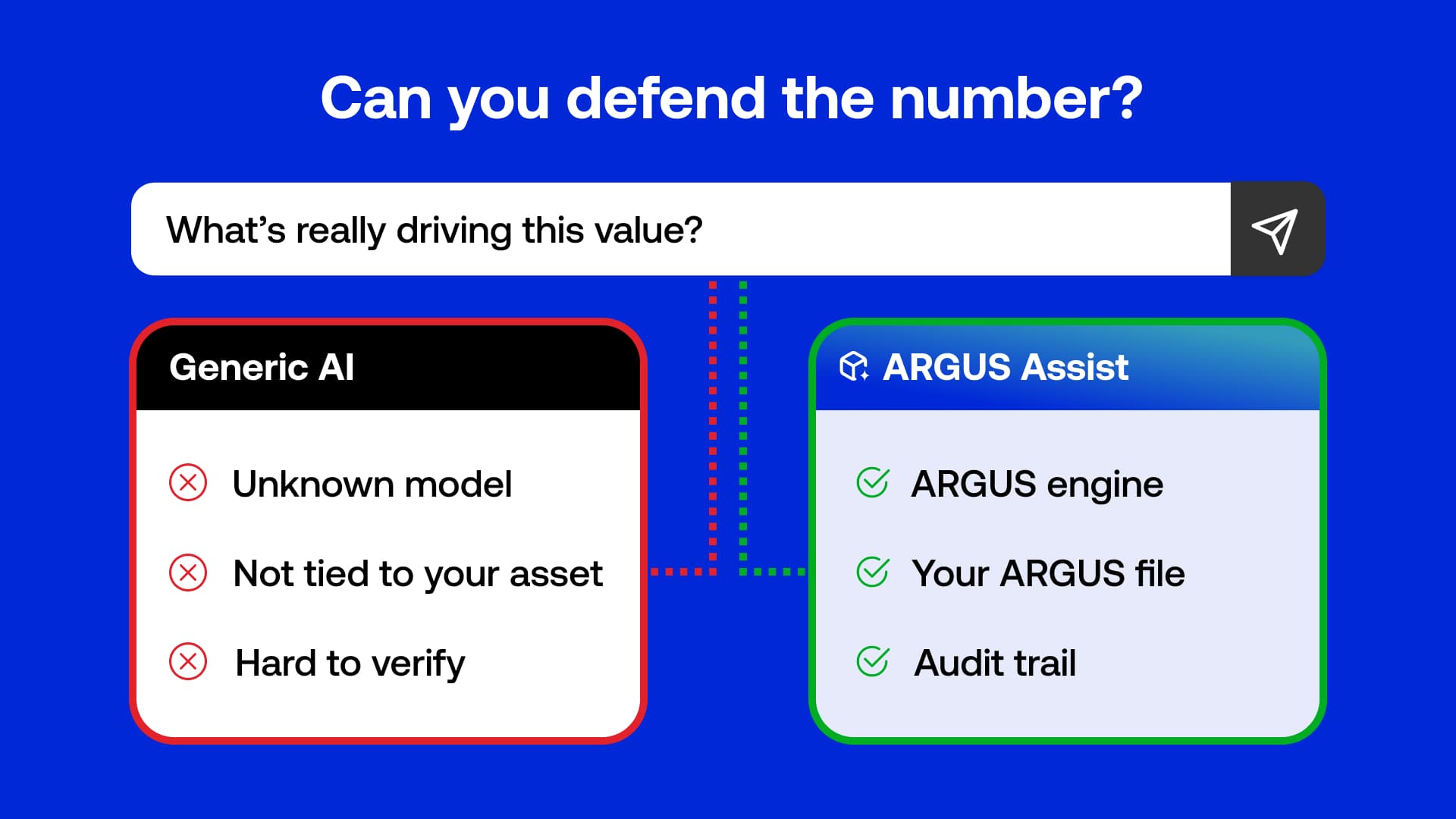
With generic AI, you can’t have confidence that the numbers in front of you are connected to the right asset, assumptions, and market conditions. You can’t explain it, defend it, or show an audit trail.
And you certainly can’t make high-stakes CRE decisions based on it.
ARGUS Assist: context changes everything
AI with context informs decisions. AI with context produces decisions. In building our agentic AI experience, ARGUS Assist, we set out to give it that context by addressing the inherent data and connectivity challenges that general-purpose AI solutions can’t. Your data is validated before it’s uploaded to the system, so you can be certain it’s structured properly. And we have specialized data teams that streamline the process and minimize the lift. Then there’s connectivity: ARGUS Assist is embedded into the ARGUS Intelligence Platform, which connects your team, your data, and your work across every stage of the CRE investment lifecycle, so everyone across your firm works from a single source of truth.
For decades, the world’s leading real estate organizations have relied on us to inform their most critical decisions. With ARGUS Assist, we're making sure you can continue to rely on us for your decisions. Every number it gives you is calculated by the ARGUS calculation engine and backed by the ARGUS file you already trust. And we do the due diligence general-purpose AI doesn’t, testing extensively to make sure that ARGUS Assist’s results are consistent with the calculation engine.
The outputs are deterministic, meaning every person - from a broker to an acquisition manager - who runs something through the calculation engine gets the same number, every time.
What’s next for ARGUS Assist: more intelligence built around real work
At Altus, we don’t just build for you - we build with you. That means focusing on the functionalities that have the greatest impact on your business. As we build new capabilities into the ARGUS Intelligence Platform, our aim is to make them available through ARGUS Assist as specialized agents built around real acquisition, investment, development, debt, and data management workflows. And as always, our rigorous testing standards mean you have the same high degree of confidence in their outputs that you have in the ARGUS calculation engine you’ve trusted for decades.
We’re also working on bringing ARGUS Assist’s capabilities into the AI tools you already use, through MCPs. So even when you’re working in a general-purpose AI tool, the numbers can come from ARGUS Assist.
Data you can trust, insights you can defend, decisions that endure
As the CRE industry adopts AI, the lesson I’ve carried through my career matters more than ever: more data isn’t better. Governed data is. Connected data is. Proven models are. Those are the things that separate general-purpose AI from purpose-built AI like ARGUS Assist. And they are the foundation for insights you can defend and data you can trust.
Want to be notified of our new and relevant CRE content, articles and events?
Disclaimer
This publication has been prepared for general guidance on matters of interest only and does not constitute professional advice or services of Altus Group, its affiliates and its related entities (collectively “Altus Group”). You should not act upon the information contained in this publication without obtaining specific professional advice.
A number of factors may influence the performance of the commercial real estate market, including regulatory conditions and economic factors such as interest rate fluctuations, inflation, changing investor sentiment, and shifts in tenant demand or occupancy trends. We strongly recommend that you consult with a qualified professional to assess how these and other market dynamics may impact your investment strategy, underwriting assumptions, asset valuations, and overall portfolio performance.
No representation or warranty (express or implied) is given as to the accuracy, completeness or reliability of the information contained in this publication, or the suitability of the information for a particular purpose. To the extent permitted by law, Altus Group does not accept or assume any liability, responsibility or duty of care for any consequences of you or anyone else acting, or refraining to act, in reliance on the information contained in this publication or for any decision based on it. The distribution of this publication to you does not create, extend or revive a client relationship between Altus Group and you or any other person or entity. This publication, or any part thereof, may not be reproduced or distributed in any form for any purpose without the express written consent of Altus Group.
Shubhra Srivastava
Senior Vice President, Product Management, Altus Group
Resources
Latest insights