Montreal commercial real estate market update – Q3 2026
In Q3 2026, Montreal saw an 18% year-over-year increase in transaction activity, with growth led by office and multi-family.
Montreal commercial real estate market update – Q3 2026
In Q3 2026, Montreal saw an 18% year-over-year increase in transaction activity, with growth led by office and multi-family.
Key highlights:
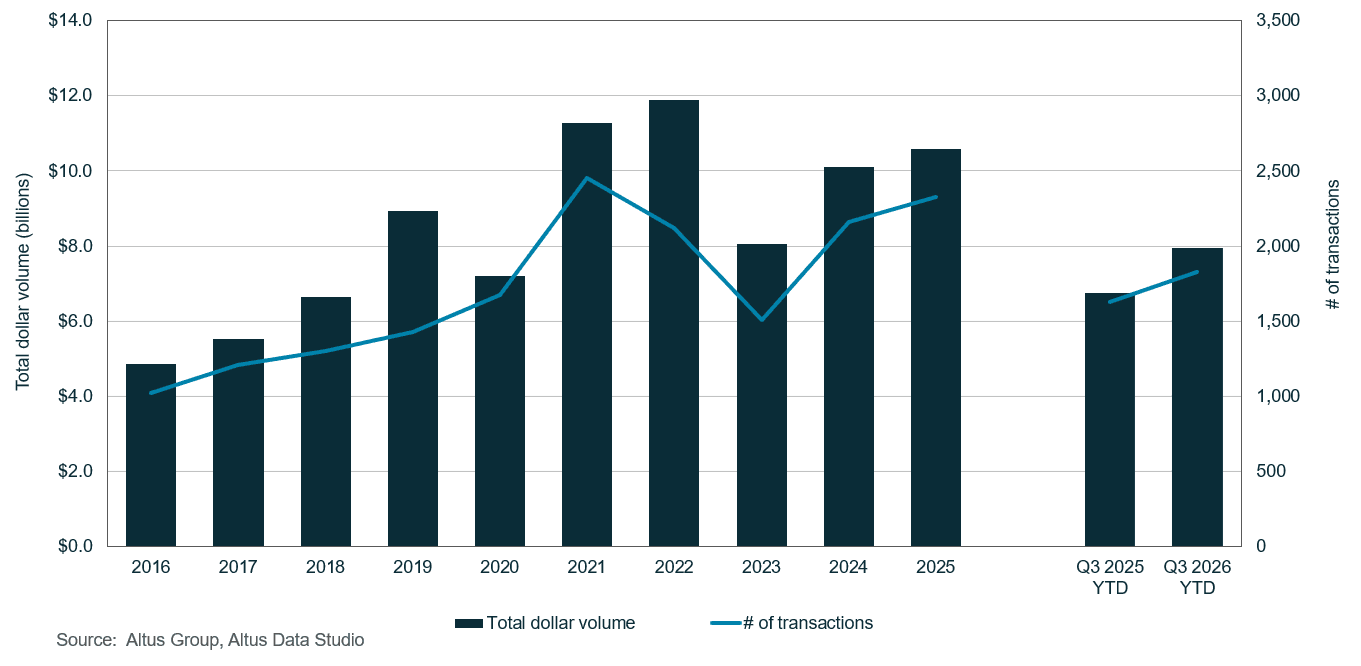
By the third quarter of 2026, Montreal reported an 18% year-over-year improvement in overall investment activity, with nearly $8 billion in dollar volume transacted
Office investment volume rose 122% year-over-year to $1 billion, the strongest growth reported among the sectors covered
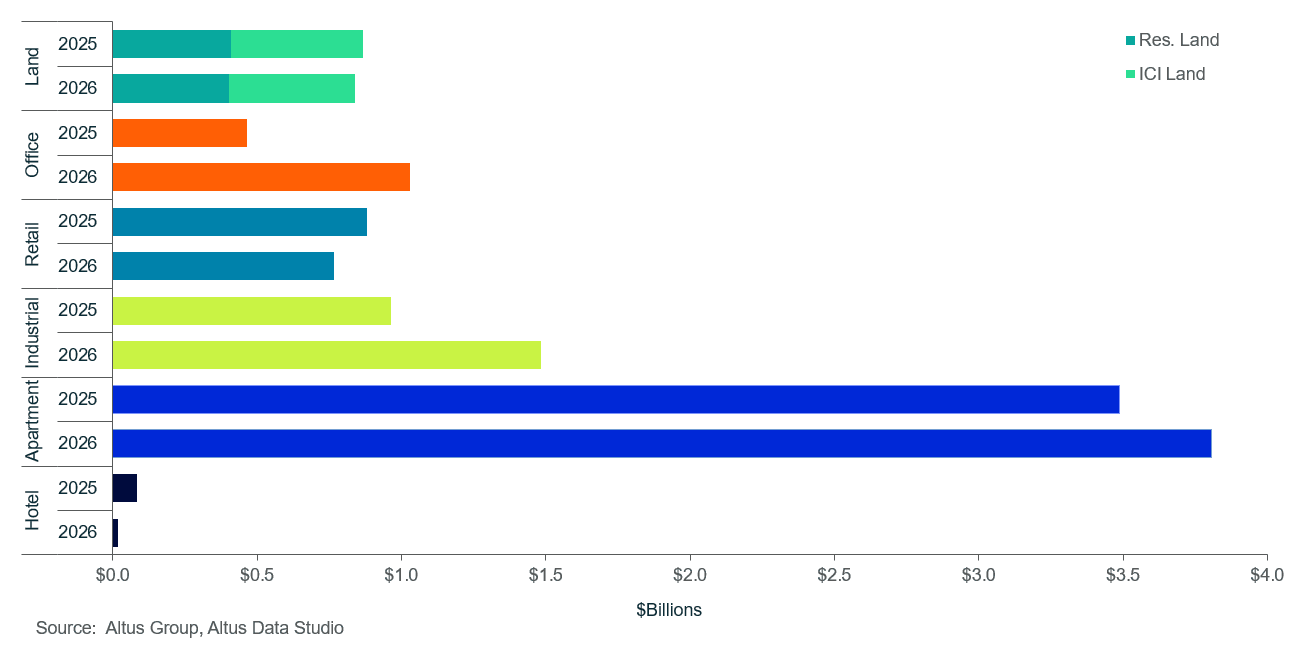
Multi-family remained Montreal’s largest commercial real estate investment sector, drawing nearly $3.8 billion in capital, almost half of total investment volume and up 9% year-over-year
Market overview
Montreal’s commercial real estate investment volume increased 18% year-over-year to $7.9 billion through the third quarter of 2026, with capital deployment broadening across some core sectors. That increase may signal renewed institutional confidence, but transaction volume alone does not establish stronger confidence or robust asset absorption. Multi-family faced more challenging investment conditions in the third quarter, despite its cumulative growth; fluctuating bond yields raised debt costs and narrowed cap rate spreads, prompting a strategic pullback from the sector during the quarter. Underlying rental demand nevertheless held firm
Figure 1: Montreal property transactions - All sectors by year
Geopolitical and trade dynamics
Trade negotiations and ongoing reviews of the Canada-United States-Mexico Agreement (CUSMA) framework created an uncertain backdrop for Montreal’s commercial market through the first three quarters of 2026. Corporate logistics operators and industrial tenants adjusted their supply-chain strategies amid elevated trade uncertainty and shifting tariff dynamics. In primary industrial hubs, reported responses included nearshoring, tactical inventory holdback and targeted expansion into modern facilities, rather than committing to large-bay leases. These patterns suggested a more selective approach to industrial space commitments.
Montreal’s role as a North American supply-chain gateway remained supported by the Port of Montreal, extensive rail connectivity and modernized distribution hubs. Institutional investors remained committed to the market’s long-term fundamentals despite macroeconomic trade friction, while Class A office buildings and core logistics hubs continued to show sustained liquidity throughout the third quarter of 2026. Multi-family residential assets also remained liquid on a year-to-date basis, although investment activity in the sector softened during the quarter. These investment patterns were consistent with the region’s infrastructure advantages
Macroeconomic and monetary indicators
The Bank of Canada (BoC) held its benchmark overnight rate at 2.25% across its summer and September decisions, leaving the policy rate unchanged through September 30, 2026. The pause reflected a balance between inflation control and global macroeconomic volatility associated with international energy costs and geopolitical tensions. For Montreal’s commercial real estate market, the implications differed by financing channel. Stable short-term borrowing costs provided a more predictable underwriting foundation, while fluctuating benchmark bond yields continued to create uneven debt-cost pressures. Debt liquidity was also slowly improving. This backdrop may have supported some narrowing of buyer-seller bid-ask spreads and greater confidence in core asset acquisitions, although price discovery remained unsettled.
Montreal’s unemployment rate rose to 7.4% in September 2026, up 1.2 percentage points year-over-year. The uptick was driven by public sector payroll contractions in education and healthcare, combined with corporate cost-cutting across the financial, insurance, and real estate sectors. While this softer labour backdrop encouraged more cautious household spending on discretionary items, growth in technical services and steady baseline corporate activity helped soften the impact on the wider market. Core commercial property sectors nevertheless maintained relatively stable operational performance and tenant retention across downtown corridors through the third quarter, while prime retail hubs showed more mixed conditions as household spending remained selective.
Capital allocation and investment strategy
Investors prioritized income stability and proven liquidity while pursuing selective growth opportunities. Multi-family anchored market activity and drew the largest share of capital, as institutional and private investors sought the stability of rental housing demand. Beyond residential assets, investors focused on top-tier commercial properties offering proven liquidity. Together, these preferences combined defensive asset preservation with strategic growth.
A pronounced flight to quality defined office investments, with institutions competing for Class AAA downtown towers, while industrial buyers favoured functional, mid-sized distribution facilities over more speculative, large-format logistics developments. Given elevated long-term yields and disciplined lending standards, investors largely sidelined capital-intensive, high-risk speculative ground-up projects. Instead, market participants focused their strategies on site intensification, tactical asset repositioning and pad-site additions to unlock embedded value and secure immediate cash flows.
Multi-family investment activity
Multi-family assets led Montreal’s transaction activity at $3.8 billion, accounting for nearly half of total investment volume and increasing 9% year-over-year. The region’s renter-heavy demographics, supported consistent demand and liquidity despite economic volatility in other major Canadian markets. The Island of Montreal accounted for the largest transaction volume at $2.6 billion. Peripheral submarkets diverged: Longueuil recorded the strongest growth, rising 48% year-over-year to $385 million, while Laval fell 58% to $230 million. These contrasting results indicate location-specific capital allocation rather than a uniform shift toward peripheral submarkets.
Three mechanisms shaped multi-family investment: development policy, rent underwriting and financing. On development policy, the City of Montreal’s changes to the By-law for a Diverse Metropolis (By-law 20-041) raised the floor area threshold for mandatory social and affordable housing contributions to 18,000 square metres. Temporary exemptions for downtown office-to-residential conversions through late 2026 and targeted density incentives were also intended to reduce front-end financial barriers for major private developments. For rental underwriting, Tribunal administratif du logement (TAL) rent adjustment guidelines provided a reference point. For financing, CMHC’s MLI Select program offered access to preferential federal financing terms. Together, these mechanisms may have helped offset elevated construction and financing costs. They may also have supported institutional and private investment in core urban density projects and outer-ring suburban rental corridors through the third quarter.
Office investment activity
By the third quarter, Montreal’s office transaction volume reached $1 billion, up 122% year-over-year. Part of the increase reflected a weak comparison period. The first quarter of 2025 recorded the third-lowest quarterly volume on record. Institutional commitment to best-in-class assets and strengthened corporate return-to-office (RTO) mandates also supported the sector. Investors favoured Class AAA properties, where low vacancy and limited contiguous space sustained price premiums. The following transaction breakdown distinguishes Class A and Class B activity but does not separately quantify Class AAA investment:
Class A office transactions comprised 51 deals, totalling approximately 1.6 million square feet
Class B office space accounted for 21 transactions, totalling just over 580,000 square feet
Downtown core Class A availability fell by 200 basis points year-over-year to 13.9% in the third quarter of 2026, leaving fewer large-block direct space options. Available sublease inventory also dropped close to 60% from peak levels as occupiers absorbed surplus space internally or allowed temporary listings to expire. These changes were consistent with improving leasing conditions alongside broader corporate RTO mandates, more consistent occupancy patterns and greater clarity for long-term space planning.
With no new office completions during the quarter and speculative construction stalled, adaptive reuse became key to repurposing underused Class B and C inventory. Municipal and provincial incentives, including temporary exemptions from By-law 20-041 through late 2026, accelerated this supply rationalization. The Du Canal conversion and master-planned redevelopments of the former Radio-Canada/CBC facilities and Molson Brewery site illustrated the move toward mixed-use residential development. As occupiers absorbed premier Class A space and older buildings were repurposed, limited top-tier office supply continued to sustain market competition.
Industrial investment activity
Montreal’s industrial investment volume rose 54% year-over-year to nearly $1.5 billion through the third quarter of 2026, alongside supportive national and provincial economic output. Third-quarter leasing indicators were more mixed. According to the Altus Group Canadian Industrial Market Update, net absorption reached nearly 1.7 million square feet, the strongest quarterly total since Q3 2021, while availability rose 80 basis points (bps) year-over-year. Stronger absorption can coexist with rising availability when new space enters the market. Speculative supply additions, trade policy uncertainty, tenant reluctance to lease in large-bay logistics nodes and residual sublease space all contributed to the increase. Meanwhile, net asking rents rose to $14.00–$15.00 per square foot after nearly three years at $13.00–$14.00.
Submarket performance diverged across the Montreal region. Peripheral submarkets along the North and South Shores captured the logistics and distribution demand that did proceed, driven by modern facilities with clear heights exceeding 30 feet, expansive truck courts and lower relative land costs rather than by large-bay lease commitments. Conversely, Island of Montreal locations remained constrained by aging infrastructure, smaller bay sizes, and higher municipal tax burdens. Even so, occupiers continued to pay rental premiums for central urban sites. These locations offered direct proximity to Montreal’s dense consumer base, lower last-mile transit costs, shorter drayage times, and direct port and highway access.
Montreal’s near-term industrial supply risk sat mainly in the construction pipeline rather than in third-quarter completions. Only two properties, totalling approximately 166,000 square feet, were completed during the quarter, with 22% uncommitted at completion. By contrast, 18 buildings totalling three million square feet remained under construction, with 69% still unleased. If that space is not leased before delivery, the speculative pipeline could put further upward pressure on availability and reinforce a disciplined, risk-aware capital-deployment environment.
Retail investment activity
Montreal’s reported retail investment volume stood at $767 million through the third quarter, down 13% year-over-year. Volume held steady quarter-over-quarter, and the annual decline is attributed to a higher comparison base in the same year-to-date period through the third quarter of 2025. Performance nevertheless remained resilient relative to historical benchmarks, despite selective consumer spending and elevated long-term yields.
Capital stayed concentrated in food-anchored retail properties in Montreal, as investors prioritized durable cash flows, steady foot traffic and inflation-hedging qualities. This preference contributed to a shortage of top-tier assets, since many owners continued to hold high-performing, income-generating properties rather than sell. Meanwhile, elevated long-term yields and tight lending conditions made ground-up retail development harder to justify across the region.
Getting more from existing assets and intensifying individual sites became the main alternatives to ground-up retail construction across key Montreal submarkets. Elevated yields and tight lending favoured strategies with lower capital outlays and faster cash flow, including pad-site developments, footprint reconfigurations and anchor re-tenanting. Although large-scale presale condo development faced headwinds across major Canadian markets, Montreal’s housing demand supported selective purpose-built rental integration alongside retail footprint optimization. Along prime urban corridors such as Sainte-Catherine Street, owners subdivided legacy spaces for expanding fashion flagships, essential service providers and experiential dining concepts. With limited prime inventory keeping transaction activity measured, tenant diversification and targeted site improvements gave asset managers ways to support portfolio performance in 2026.
Land investment activity
Montreal’s residential and industrial, commercial and institutional (ICI) land sectors recorded a combined $838 million in transaction volume through the third quarter, a marginal decline of 3% year-over-year following several years of persistent contraction.
Residential land sales built momentum in the second quarter but lost it in the third, with volume down 2% year-over-year to nearly $401 million. Activity centred on high-density urban infill and transit-oriented sites on the Island, along with medium-density suburban parcels. Developers moved to take advantage of recent municipal policy shifts, including relaxed inclusionary housing requirements, transit-oriented density incentives and the previously mentioned By-law 20-041, which has spurred land purchases for affordable housing projects.
ICI land transaction volume reached nearly $438 million, down 4% year-over-year. Activity through the third quarter was led by large-parcel agricultural and greenfield transactions in outer-ring submarkets, including perimeter land acquired for agricultural operations. Industrial land transactions followed, with developers seeking large, industrial-zoned parcels along primary transport corridors for next-generation distribution hubs. Municipal conservation and parkland acquisitions were a separate source of land demand, linked here to Montreal’s stated commitment, with a 2030 target date, to protect 30% of its land and natural areas. These sources of demand did not prevent the reported year-over-year decline in total ICI land volume.
Figure 2: Property transactions by total by asset class YTD (Q3 2025 vs Q3 2026)
Notable transactions
The following are the notable transactions for the Q3 2026 Montreal commercial real estate market update:
241-300 Vezina Street, 9778 Saint-Patrick Street, 275-295 Place Sterling, Montréal (LaSalle) – Apartment
La Renaissance apartments in LaSalle sold in early July for $46.5 million. With 260 units, the sale represented a price per unit of just under $179,000. About 19%, or 50 units, were vacant at the time of sale. The purchaser was Groupe Inspire. Its investment rationale was not based on income. It stated that it planned to spend $10 million on renovations, with major work covering roofs, bricks, plumbing and electricity. The vacant units were also targeted for renovation. Inspire purchased 800 residential units in the past year, totalling 1,400 units, and it has its sights on another 1,000 within the next 12 months. Groupe Inspire also invests in industrial properties. Some of its properties are located well outside the GMA boundaries, notably District Lupel, a 360,000-square-foot industrial agri-food hub in Trois-Rivières, about 140 kilometres from Montreal.
805 Guimond Boulevard, Longueuil (Vieux-Longueuil) – Industrial
805 Guimond Boulevard closed in August for $36.5 million, making it the priciest transaction in Montreal’s industrial sector for the third quarter. The almost 125,000-square-foot manufacturing plant represented a price per square foot of $293. The purchaser, Italpasta, had already acquired the property’s tenant, Grisspasta, in 2024. Both are Canadian food manufacturers, and with the acquisition of both the company and the property, Italpasta plans to strengthen its production capabilities for both its flagship products and private label brands, catering to the diverse needs of customers across Quebec and Eastern Canada.
3570-3664 Saint-Charles Boulevard, Kirkland – Retail
Les Galeries Kirkland, at 3570-3664 Saint-Charles Boulevard in Montreal’s West Island suburb of Kirkland, was the most expensive retail sale of the third quarter, selling for $22.5 million. The two-storey complex combines ground-floor retail space with second-floor office space and has a 98% occupancy rate across 63 tenants, with a weighted average lease term of 4.4 years. It is located 500m from the Trans-Canada Highway (A-40) and a few minutes from the new Kirkland and Fairview REM stations. The purchaser, MTRPL, continued expanding across Montreal, with just under 40 properties and approximately one million square feet.
1172-1188 Sherbrooke Street West & 2200 Stabley Street (Maison Alcan), Montréal (Ville-Marie) – Office
Maison Alcan, a heritage building in downtown Montreal, was the most expensive office transaction of the third quarter, closing at $93 million, or $344 per square foot. The vendor, Lune Rouge, had purchased the property 10 years earlier for roughly 50% less and entered a sale-leaseback with the intention of occupying approximately 10,000 square feet of office space. The purchaser, Groupe Mach, adds another important office building to its already diversified portfolio, notably 1000 De La Gauchetière, located roughly 1km south. At the time of sale, the property was 90% occupied, with notable tenants EA Motive and Dialogue Health Technologies.
Market outlook
As Montreal moves through the final quarter of 2026, the commercial real estate market is entering a period defined by strategic patience and careful asset selection. Rather than chasing speculative expansion, market participants continue to take a measured approach.
Capital deployment broadened across some core sectors through the third quarter, but tight lending standards and persistent financing costs continue to limit how widely it can spread, and investor sentiment reflects a careful balance between structural optimism and capital discipline.
Looking toward year-end, market performance will hinge on the balance between leasing absorption, supply integration and debt pricing, with trade uncertainty remaining a backdrop to occupier and investor decisions. A deep, renter-heavy demographic base continues to anchor underlying demand. If price discovery improves and buyer-seller expectations converge, the market may be well positioned over the longer term.
Want to be notified of our new and relevant CRE content, articles and events?
Disclaimer
This publication has been prepared for general guidance on matters of interest only and does not constitute professional advice or services of Altus Group, its affiliates and its related entities (collectively “Altus Group”). You should not act upon the information contained in this publication without obtaining specific professional advice.
A number of factors may influence the performance of the commercial real estate market, including regulatory conditions and economic factors such as interest rate fluctuations, inflation, changing investor sentiment, and shifts in tenant demand or occupancy trends. We strongly recommend that you consult with a qualified professional to assess how these and other market dynamics may impact your investment strategy, underwriting assumptions, asset valuations, and overall portfolio performance.
No representation or warranty (express or implied) is given as to the accuracy, completeness or reliability of the information contained in this publication, or the suitability of the information for a particular purpose. To the extent permitted by law, Altus Group does not accept or assume any liability, responsibility or duty of care for any consequences of you or anyone else acting, or refraining to act, in reliance on the information contained in this publication or for any decision based on it. The distribution of this publication to you does not create, extend or revive a client relationship between Altus Group and you or any other person or entity. This publication, or any part thereof, may not be reproduced or distributed in any form for any purpose without the express written consent of Altus Group.
Authors

Jennifer Nhieu
Senior Research Analyst

Daniel Marro
Senior Market Analyst
Authors
Jennifer Nhieu
Senior Research Analyst
Daniel Marro
Senior Market Analyst
Resources
Latest insights