The Power Premium Arrived Before the Power Crunch
This article is an abbreviated version of a study presented to Forum Groups at the Commercial Real Estate Development Association (CREDA) conference in Denver, October 6-7, 2026.
The Power Premium Arrived Before the Power Crunch
This article is an abbreviated version of a study presented to Forum Groups at the Commercial Real Estate Development Association (CREDA) conference in Denver, October 6-7, 2026.

Leverage our real estate data and predictive analytics
The performance attribution, predictive analytics and market intelligence you need to explain performance and improve decision making.
Over the past few years, power has gone from a utility line item to a site-selection headline. Data centers built for AI, new factories brought back to the U.S., and traditional warehouses that are increasingly automated are all asking more of the electric grid, and utilities have warned that power supply may not keep up. That raises a simple question for industrial real estate: are buyers paying more for buildings close to power, the way they have long paid more to be close to traditional infrastructure like interstate highways or cargo airports?
The short answer is yes – buyers are paying more for industrial property near power – but not in the way today’s headlines might suggest.
The premium paid for proximity to power arrived early and has mostly reversed. Buildings near firm power plants (those that can run around the clock) began selling at a premium around 2013, years before today’s power crunch. It peaked in 2022 and has mostly faded since.
Grid access now matters more than proximity to a plant. In 2026, the premium for being near a power transmission line overtook the premium for being near a power plant.
Data center metros account for most of what remains. The premium has been much stronger in metros with many data centers and has faded to about zero elsewhere.
Raw land near plants carries a bigger premium than buildings. Being near a transmission line, however, has mattered much less for raw land.
Geography matters. In much of the Midwest, where power travels long distances from power plants in Appalachia, being near a local plant carries little premium. In the denser Northeast and Mid-Atlantic, it carries a substantial one (10% or more).
These findings come from an analysis by Altus Group’s Research Team of more than 350,000 industrial sales and 780,000 vacant land sales across the U.S. from 2000 through 2026 year to date, drawn from Reonomy property records. Each sale was matched to the power plants that were operating when the sale closed.
How we measure it: the “premium” mentioned in this article is the extra price per square foot (per acre for land) for being twice as close to a firm power plant or a transmission line, for example, 1 mile away instead of 2. Firm power plants are those that can run around the clock: natural gas, nuclear, coal and hydro. Solar and wind are excluded. Transmission lines are the high-voltage lines that carry power from plants to the local grid. We control for property characteristics, location, local demographics and proximity to other infrastructure, so the premium reflects power rather than those factors.
The premium came and went
In 2000, an industrial building twice as close to a firm power plant sold at a 4.6% discount, likely because plants were seen as undesirable neighbors, with noise, emissions and heavy-industrial surroundings. But by 2022, it sold at a 6.4% premium, putting proximity to power roughly on par with proximity to an interstate highway. So far in 2026, that premium has fallen to 2.0%.
The timing stands out. The premium began climbing around 2013, years before AI and reshoring made power a boardroom topic, and started falling in 2023, just as that demand arrived. The decline is not simply other infrastructure taking credit. A warehouse near a plant that also sits next to a highway may have located there for the highway access, but the premiums for being near highways and cargo airports held up better than the power premium over the same period. Nor is it simply new plants making power less scarce: there is less firm power available today than there used to be.
Figure 1: Power generation went from a discount to rivaling the interstate
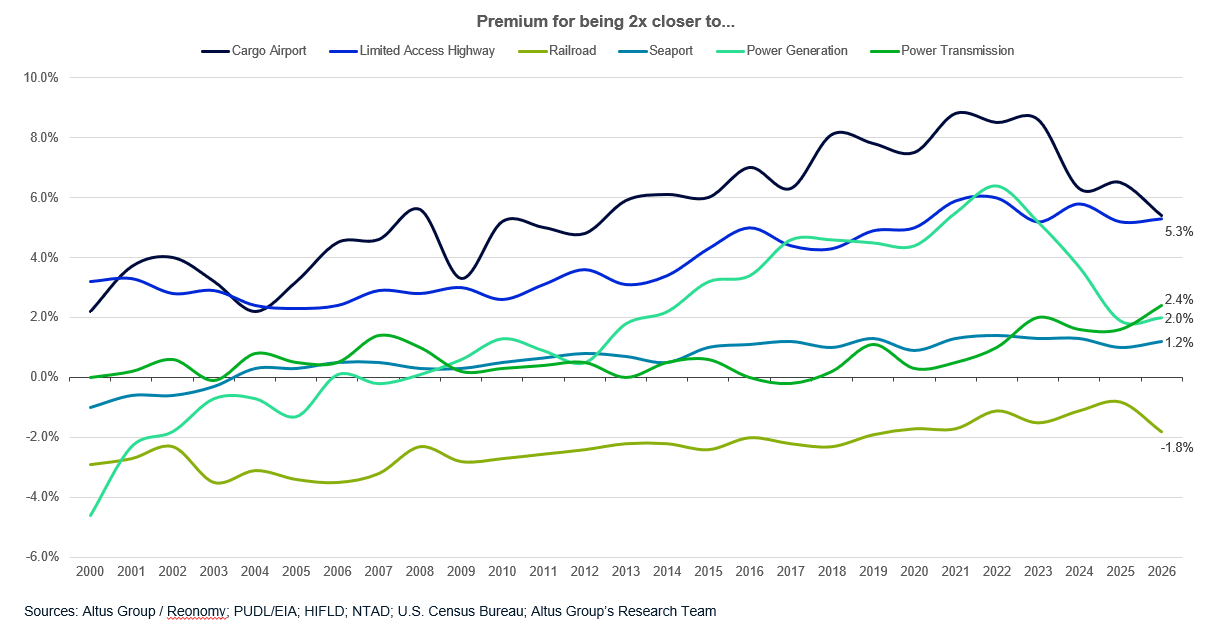
Price premium for being twice as close to each type of infrastructure, industrial sales, 2000 to 2026 year to date.
Access to the grid now matters more than proximity to a plant
For existing buildings, being near a transmission line now carries a bigger premium than being near a plant. Proximity to transmission mattered little for most of this century, but in 2026 its premium overtook the generation premium for the first time since the global financial crisis. Buyers appear to be shifting from paying to be near a power plant toward paying for access to the grid that delivers the power. That shift may also explain why buyers paid to be near a plant in the first place: anecdotally, the grid tends to be better maintained near generating plants.
Conversations at the recent CREDA Conference, when this study was initially presented, point to why. Many members described utilities asking tenants to prove how much power they need before agreeing to connect them. That is a real problem for speculative industrial buildings, which are built before a tenant signs: because the power follows the tenant, a developer can buy a site next to a plant and still be unable to promise capacity to a future user. As that became clearer, simple proximity to generation may have lost value even as demand for power grew.
The premium is much stronger where data centers cluster
We suspected that the rise of power-hungry data centers might be pushing buyers to compete harder for sites near power, so we looked at the metros where data centers cluster. We compared two groups of data center (DC) metros with the rest of the country. “DC-heavy” metros are the 16 established markets most commonly named in brokerage reports on data centers. “DC-intensive” metros are those where data centers make up a larger share of industrial space than they do nationally. Both groups are based on present-day data and held fixed over time. “Everywhere else” covers all metros in neither group.
The premium for being near a plant was much stronger in data center metros. In both groups, it peaked in 2022 and has since fallen, but it remains well above the rest of the country: from 13.1% to 5.8% in DC-intensive metros, and from 8.0% to 2.3% in DC-heavy metros. Everywhere else, it has faded to about zero. The data can’t prove that data centers caused the premium, but the pattern holds in both groups. It may also help explain the early timing: earlier waves of cloud data centers were also heavy power users and could have lifted the premium well before today’s AI-focused facilities.
Figure 2: The generation premium is a data-center-market phenomenon
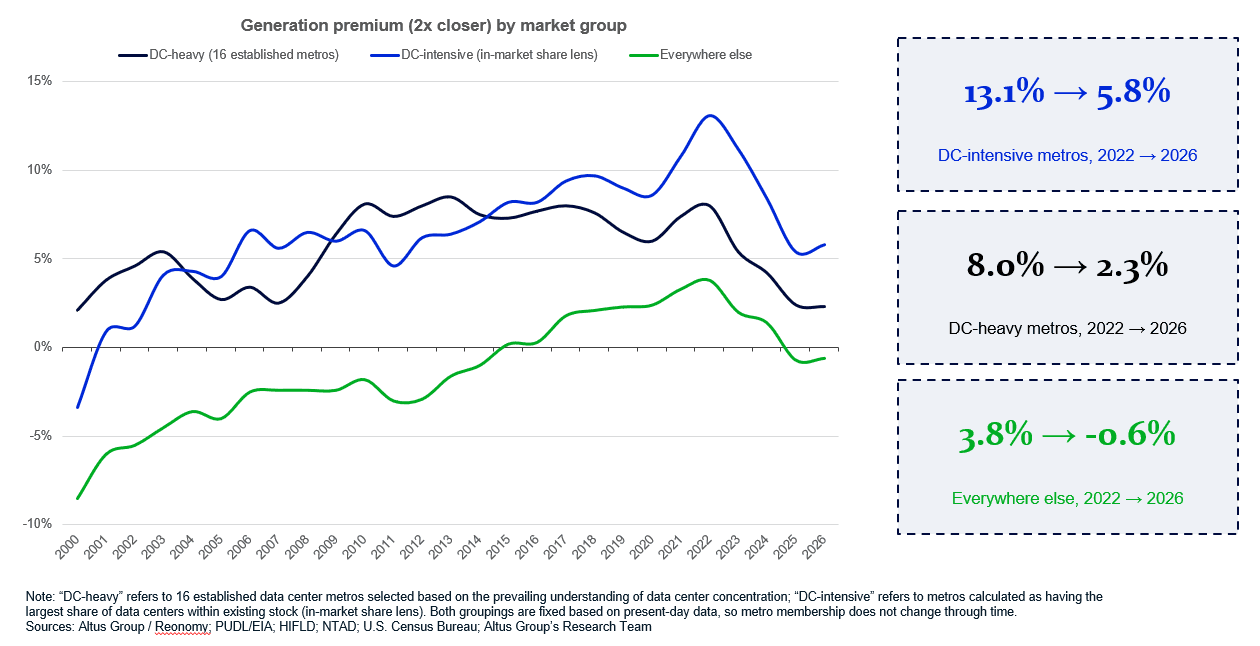
Premium for being twice as close to firm power, by market group, 2000 to 2026 year to date.
Land near plants carries a bigger premium than buildings
Because utilities now often ask users to prove they need power, and because it is cheaper to build for heavy power use from the start than to retrofit an existing building, we expected land near power to carry a premium. It does, and a larger one than buildings: land twice as close to a firm power plant carries a 3.3% premium so far in 2026, compared with 2.0% for existing buildings. That suggests buyers are paying for the option to build power-intensive uses. If anything, our estimates may understate the land premium: developers often assemble sites from multiple parcels, and those deals don’t show up among the single-property sales we analyzed. However, being near a transmission line has mattered much less for land, which carried only a modest premium there from 2021 through 2025 before it faded in 2026.
Figure 3: The land market agrees... and hasn't pulled back
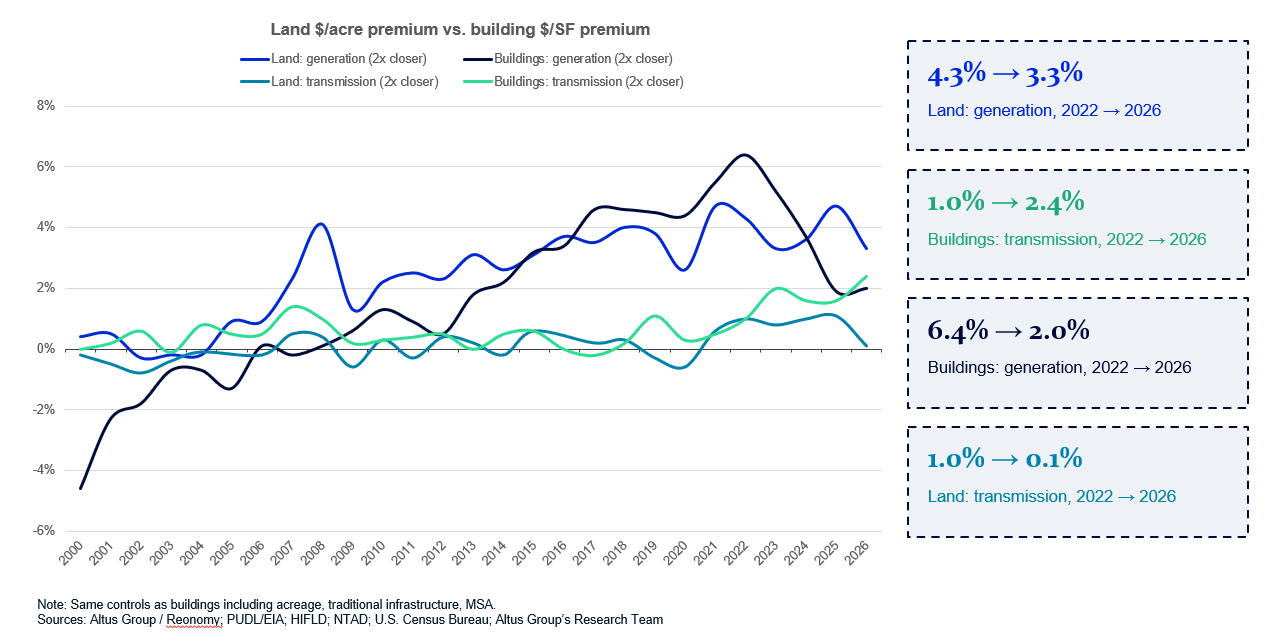
Premium for being twice as close to firm power plants and to transmission lines, land vs. buildings, 2000 to 2026 year to date. Land premiums are measured in dollars per acre; building premiums in dollars per square foot.
Regional patterns make geographic sense
Metro-level estimates carry wide margins of error, but the broad regional patterns make geographic sense. In several Midwestern metros, being near a plant carries little or no building premium. That is consistent with users there drawing power over long-distance, high-voltage lines from generation concentrated in Appalachia, so being next to a local plant matters less. That pattern aligns with observations made in geopolitical strategist Peter Zeihan’s conference keynote from the CREDA conference. In the Northeast and Mid-Atlantic, by contrast, the premium is substantial, possibly because power and users must sit closer together in those denser markets.
Figure 4: Buildings – premium for being 2x closer to generation
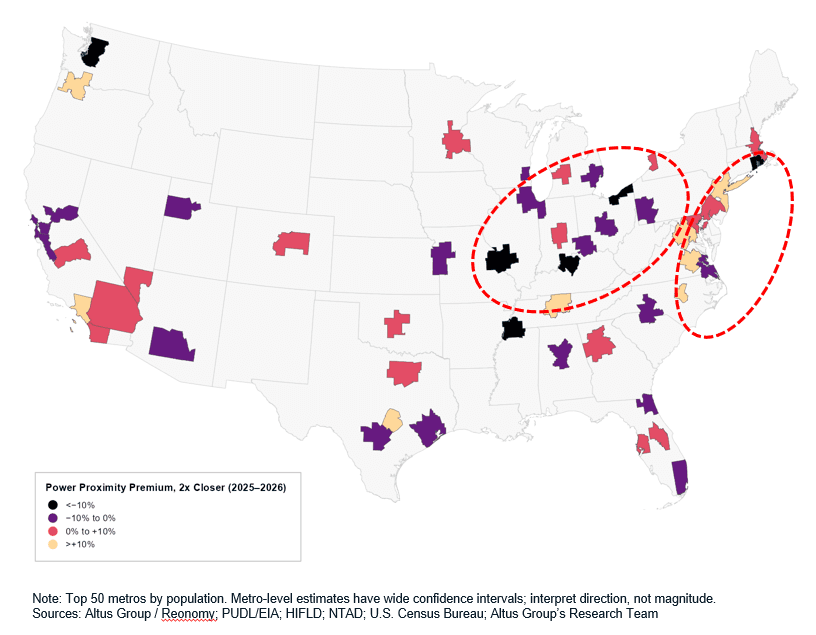
Building premium for being twice as close to firm power, 50 largest metros, 2025 to 2026 year to date. Dashed outlines highlight the Midwest and the Northeast corridor; metro estimates are best read for direction rather than exact size.
Where to look next
The results suggest where investors and developers should look. The premium for being near a plant is concentrated in metros with many data centers, so its 2022 peak shouldn’t be assumed outside those markets, and even there it has fallen by more than half. Elsewhere, traditional infrastructure still matters more to industrial pricing than power. For existing buildings, access to the grid now counts for more than distance to a plant, so confirming that a site can actually be served for its eventual tenant matters more than how close it sits to generation. For land, proximity to a plant still carries a meaningful premium, reflecting the option to build for heavy power use.
For more on the study, contact Cole.Perry@altusgroup.com.
Want to be notified of our new and relevant CRE content, articles and events?
Disclaimer
This publication has been prepared for general guidance on matters of interest only and does not constitute professional advice or services of Altus Group, its affiliates and its related entities (collectively “Altus Group”). You should not act upon the information contained in this publication without obtaining specific professional advice.
A number of factors may influence the performance of the commercial real estate market, including regulatory conditions and economic factors such as interest rate fluctuations, inflation, changing investor sentiment, and shifts in tenant demand or occupancy trends. We strongly recommend that you consult with a qualified professional to assess how these and other market dynamics may impact your investment strategy, underwriting assumptions, asset valuations, and overall portfolio performance.
No representation or warranty (express or implied) is given as to the accuracy, completeness or reliability of the information contained in this publication, or the suitability of the information for a particular purpose. To the extent permitted by law, Altus Group does not accept or assume any liability, responsibility or duty of care for any consequences of you or anyone else acting, or refraining to act, in reliance on the information contained in this publication or for any decision based on it. The distribution of this publication to you does not create, extend or revive a client relationship between Altus Group and you or any other person or entity. This publication, or any part thereof, may not be reproduced or distributed in any form for any purpose without the express written consent of Altus Group.
Author

Cole Perry
Associate Director of Research, Altus Group
Author
Cole Perry
Associate Director of Research, Altus Group
Leverage our real estate data and predictive analytics
The performance attribution, predictive analytics and market intelligence you need to explain performance and improve decision making.
Resources
Latest insights