Toronto commercial real estate market update – Q2 2026
Toronto’s CRE market in Q2 2026 experienced significant growth in investment activity, due to strong performance in multi-family, industrial, and office sectors.
Toronto commercial real estate market update – Q2 2026
Toronto’s CRE market in Q2 2026 experienced significant growth in investment activity, due to strong performance in multi-family, industrial, and office sectors.
Authors

Jennifer Nhieu
Senior Research Analyst

Lucy Wu-Yu
Market Analyst
Key highlights:
Source: Altus Data Studio market data and analysis
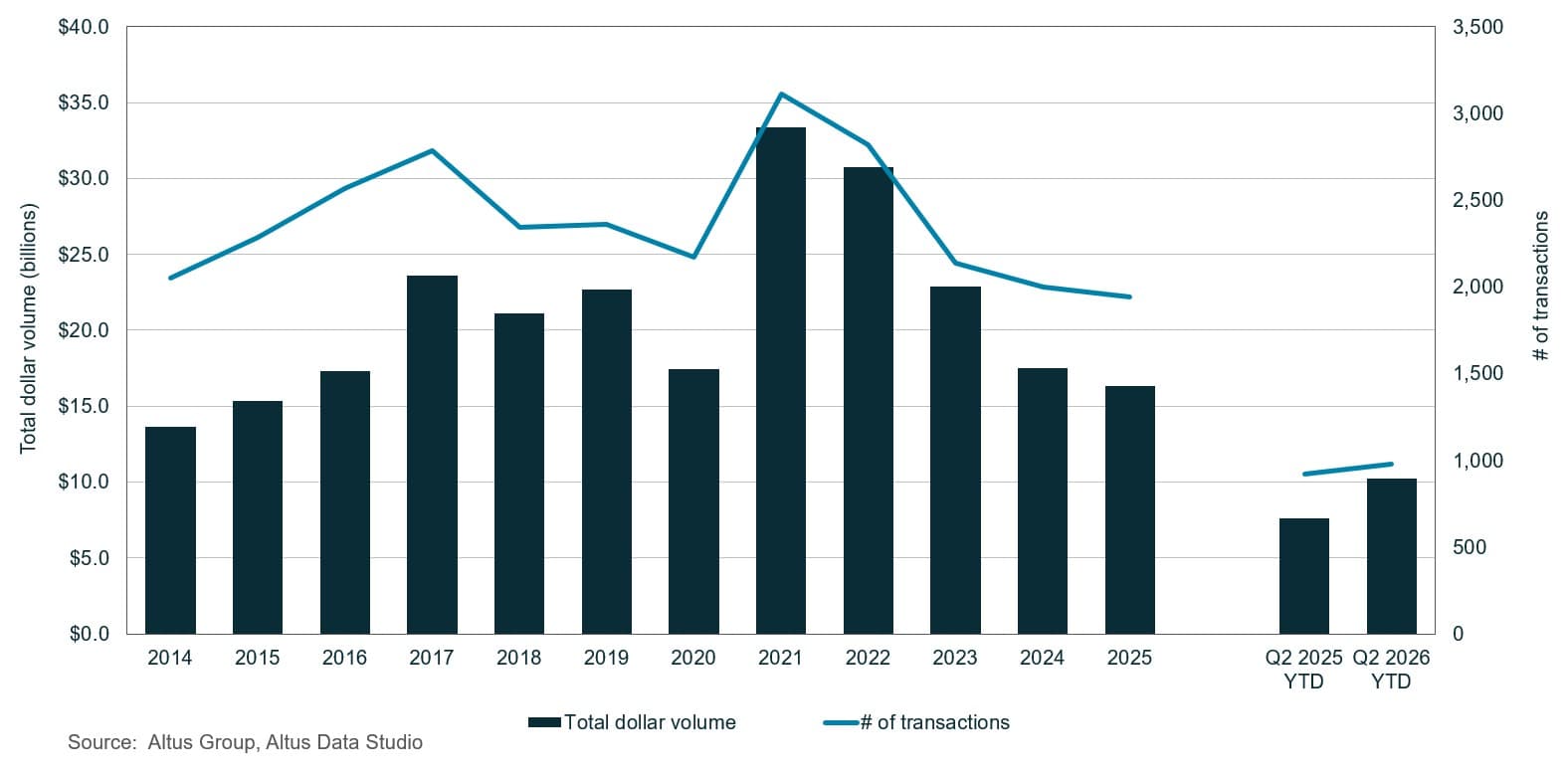
GTA investment activity rose nearly 35% year-over-year in the first half of 2026, reaching nearly $10.2 billion in transaction volume
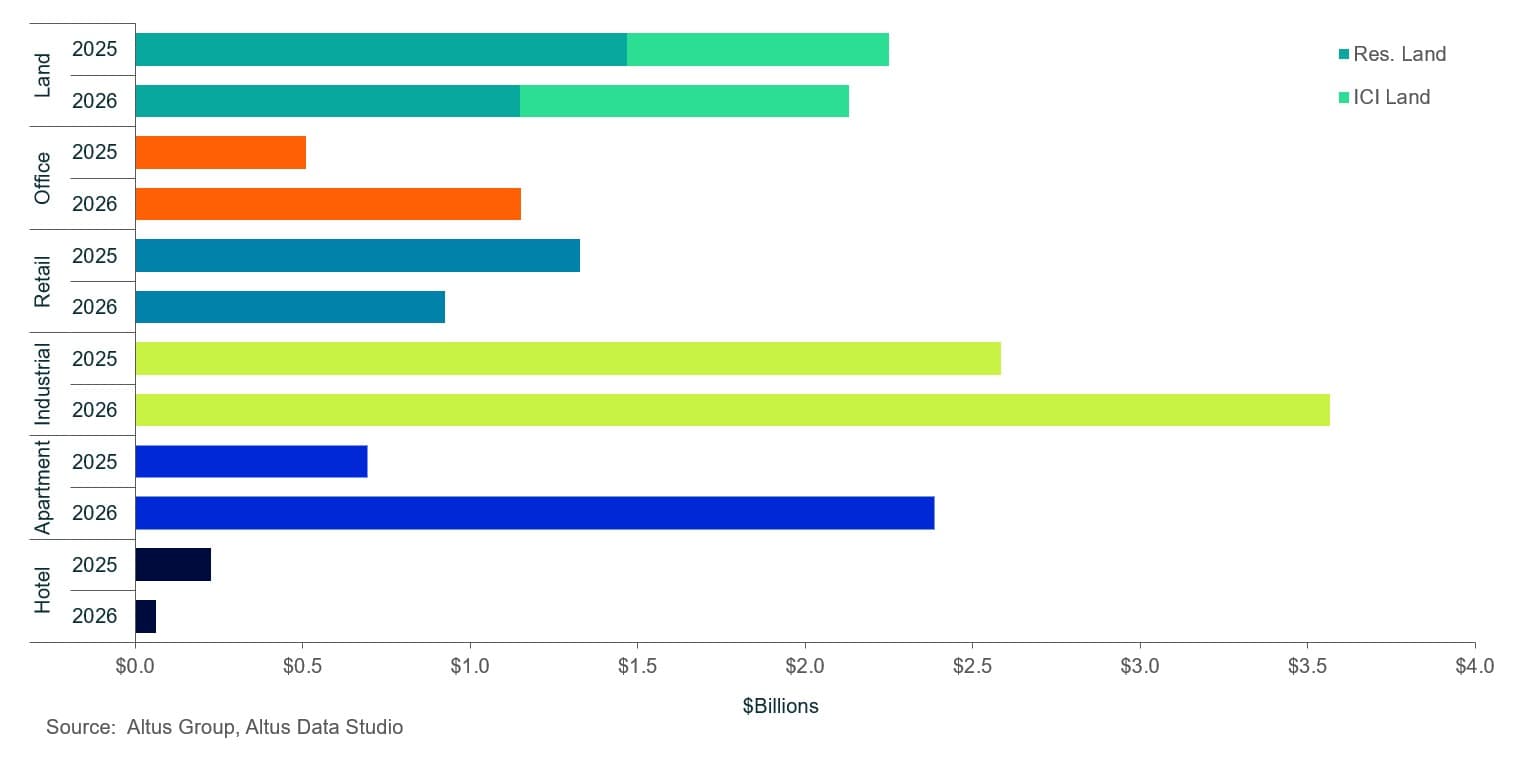
Multi-family and office led investment activity, with year-over-year increases of 244% and 125%, respectively
Retail investment volume declined 30% year-over-year to $926 million, despite stronger second-quarter activity, as tight conditions and limited availability in high-demand retail corridors constrained transaction volume
In the second quarter of 2026, commercial investment in the Greater Toronto Area saw a 35% increase year-over-year
Based on data from Altus Data Studio, during the first half of 2026, investor confidence in the Greater Toronto Area (GTA) commercial real estate market improved, with total investment volume rising nearly 35% year-over-year to $10.2 billion. The increase was supported by stronger transaction activity in the office and multi-family sectors. Retail continued to attract investor interest, but severe inventory constraints in high-demand corridors contributed to a 30% year-over-year decline in retail investment volume, limiting its contribution to broader GTA totals.
Despite headwinds from global geopolitical instability, shifting regional demographics, and the gradual recovery from a technical recession earlier in the cycle, market expansion remained promising. Investor sentiment during the quarter was defensive but opportunistic, with capital focused on specific asset classes offering stronger income stability and long-term resilience.
Figure 1: Greater Toronto Area property transactions – All sectors by year
Geopolitical and trade dynamics
While high-level policy discussions surrounding the July 2026 Canada-United States-Mexico Agreement (CUSMA) joint review prompted corporate occupiers to assess supply chain resilience and adopt “just-in-case” inventory models, the broader investment community remained remarkably undeterred. Rather than stalling capital allocation, investors largely looked past the short-term political noise of the trade review, recognizing that the treaty itself remained structurally secure until at least 2036. Ultimately, rather than pulling back due to geopolitical concerns, global and domestic capital continued to target Toronto’s commercial real estate as a defensive safe haven, prioritizing the region’s robust demographic fundamentals, tight vacancy and a stabilizing interest rate environment over temporary cross-border trade discussions.
Macroeconomic and monetary indicators
On June 10, 2026, the Bank of Canada held its overnight rate at 2.25% amid heightened global energy volatility linked to ongoing conflicts in the Middle East. For the GTA commercial real estate market, the rate hold provided both support and constraint: it helped establish a valuation floor and narrow bid-ask spreads across multi-family, industrial, trophy office and prime retail transactions; however, borrowers continued to face refinancing pressure at yields structurally above the previous decade. Domestic economic growth also improved, with Canadian Gross Domestic Product rising 0.5% in April after a 0.1% contraction in March, supported by stronger goods-producing activity in mining, quarrying, oil and gas extraction, and manufacturing.
At the provincial level, Ontario’s broader economic slowdown was reflected in stabilizing hiring after a cumulative gain of 84,000 jobs over the preceding two months. This affected Toronto’s office sector, while the provincial unemployment rate held at 7.0% and Toronto’s rate eased slightly to 6.9%. In contrast, consumer demand in high-density GTA nodes remained broadly resilient, supported by a 0.5% increase in national retail sales and a decline in the national unemployment rate to 6.5%. This relative stability continued to support grocery-anchored retail assets, even as slower provincial population growth weighed on new residential demand.
Capital allocation and investment strategy
The investment climate prompted a significant shift in Toronto’s institutional and private investment playbooks, moving capital away from speculative, growth-oriented development and toward defensive, yield-generating assets.
As capital markets stabilized and underwriting visibility improved, active capital across the GTA moved from cautious observation toward disciplined deployment.
Rather than retreating from the market, investors aggressively prioritized stable income-producing core assets that offered a built-in operational buffer. This strategy resulted in a highly bifurcated investment landscape. Speculative greenfield projects and non-core, secondary properties faced heightened scrutiny and wider yield spreads as lenders and equity partners demanded stricter risk mitigation. Conversely, premier, highly functional assets in prime regional nodes continued to command premium pricing.
By focusing on established properties that benefited from Toronto’s long-term demographic density and highly resilient consumer base, capital sought immediate cash-flow stability over speculative future appreciation. This measured, highly selective approach set the strategic, defensive foundation for how capital was being deployed across the region’s individual commercial sectors.
The following sections examine how these macroeconomic, capital market and demographic conditions shaped investment activity across the GTA’s major commercial property sectors.
Multi-family investment activity
The multi-family sector recorded nearly $2.4 billion in transaction volume, representing a 244% year-over-year increase. Capital deployment was not limited to isolated portfolio transactions. Instead, it reflected broad-based momentum across key submarkets. York, Durham and the City of Toronto posted year-over-year increases of 5,128%, 807%, and 300%, respectively. This elevated transaction velocity reflected strong institutional demand for residential density and a strategic shift in capital toward both the GTA’s established urban core and its expanding high-density suburban hubs.
The multi-family sector continued to serve as a primary strategic hedge against inflation, supported by persistent housing supply-side imbalances and acute affordability pressures in homeownership across the region. However, capital allocation became increasingly disciplined as market participants adjusted to the BoC’s tightening bias. Rather than underwriting near-term relief, institutional investors structured models around elevated debt costs and stricter lending parameters, a shift that restricted refinancing volumes and compelled developers to defer uncommitted pipeline projects.
Furthermore, market participants universally anticipated that stronger tenant absorption and a return to historical rental growth premiums would remain muted over the medium term. This measured outlook persisted as the regional marketplace worked to systemically digest a substantial dual-supply overhang, comprised of elevated purpose-built rental deliveries alongside a heavily supplied secondary condominium rental market. Consequently, a full stabilization of regional rental fundamentals was projected to extend over a multi-year horizon rather than correcting within the immediate annual cycle.
Office investment activity
Office investment activity continued to improve, with total transacted dollar volume reaching nearly $1.2 billion, up 125% year-over-year. Capital deployment remained concentrated in Class AAA and A assets, as institutional and private investors prioritized premium, stabilized properties. This strategy was reinforced by broader return-to-office mandates, which improved workplace utilization and sustained competitive leasing momentum through the first half of 2026 as occupiers competed for a limited supply of premier space.
The latest Altus Group Canadian Office Market Update reported that Toronto’s office availability rate decreased 190 bps to 15.1% year-over-year. This improvement stemmed primarily from persistent tenant demand for premium downtown real estate, which subsequently compressed the downtown Class A availability within the Financial District to 9.1%. Transaction data from the first half of 2026 further illustrated this flight to quality:
Class A office transactions comprised 129 deals, encompassing nearly 4.2 million square feet
Class B office space accounted for only 16 transactions that totalled approximately 291,000 square feet
This disparity highlighted a stark operational bifurcation across the GTA, as aging, functionally obsolete buildings failed to meet modern corporate standards.
Supply-side activity remained disciplined during the second quarter, marked by the completion of three office properties. Chief among these deliveries was the highly anticipated fully leased CIBC Square Phase 2 (141 Bay Street), adding 1.44 million square feet of premier, Class AAA office space to downtown Toronto. Notably, this tower represents the last Class AAA building of over one million square feet in the active development pipeline across the entire country. As a state-of-the-art trophy asset connected directly to the PATH, its delivery underscored the market’s strong appetite for top-tier workplace environments while marking the end of a major cycle for large-format office completions in Canada.
Looking ahead, the remaining development pipeline included seven buildings under construction totalling approximately 877,000 square feet, with 70% remaining available for lease. These projects focused on evolving tenant requirements, such as collaborative environments, integrated technology and wellness amenities.
Industrial investment activity
The industrial sector recorded nearly $3.6 billion in transaction volume, up 38% year-over-year, as corporate occupiers increasingly adopted “just-in-case” strategies to mitigate volatility ranging from global policy shifts to local highway congestion.
According to the latest Altus Group Canadian Industrial Market Update, Toronto’s industrial availability rate edged up 10 basis points year-over-year to 4.8%, reflecting a more cautious and measured leasing environment. While new speculative developments continued to add available space, rising vacancy was driven largely by longer occupier decision timelines and a more risk-averse approach. Sustained demand for Class A, high-specification assets remained the main driver of leasing activity, helping align the delivery pipeline with steadier demand and limiting the sharper vacancy increases seen in earlier periods.
The GTA reported a constrained industrial pipeline in the second quarter, with seven completions adding nearly 1.1 million square feet to market inventory. Despite this lower output relative to historical peaks, nearly 62% of the newly added space remained available for lease at quarter-end. With 39 projects totalling 11.3 million square feet under construction and 64% of that space still available, availability rates were expected to remain elevated as these developments were delivered.
Despite near-term supply pressures and softer leasing momentum, the GTA industrial market’s long-term fundamentals remained strong. Developers continued to advance speculative projects, expecting modern, future-ready facilities designed for advanced automation and sustainable energy needs to capture the next wave of expansionary demand. The region’s strategic location, dense population base and ongoing need for sophisticated e-commerce and logistics infrastructure continued to support market resilience amid short-term volatility.
Retail investment activity
The GTA retail sector showed a clear operational split, with performance varying by asset type and submarket position. High street corridors, including Bloor-Yorkville and Queen Street West, as well as dominant regional shopping centres, continued to see strong tenant demand. In these prime nodes, exceptionally tight vacancy limited available space and new leasing opportunities. However, limited product availability and elevated financing costs continued to weigh on transaction velocity and overall leasing volume.
These macroeconomic pressures were especially evident in regional capital deployment. Total GTA retail investment volume declined to over $925 million, marking a 30% year-over-year contraction. The drop reflected limited product availability, as owners retained stabilized assets, and a broader pause among private and corporate buyers as they adjusted underwriting assumptions to prevailing capital costs.
The regional retail market also faced near-term headwinds from slower provincial population growth and softer consumer purchasing power. Elevated debt-servicing costs reduced household disposable income and weighed on consumer confidence. As a result, spending patterns shifted, with households increasingly prioritizing non-discretionary essentials over discretionary retail categories.
Despite these short-term challenges, the GTA retail market retained strong long-term fundamentals. As Canada’s primary commercial hub, the region continued to offer a resilient economic base. Its scale and market depth kept the GTA a key entry point for leading international brands, supporting long-term stability for well-located, stabilized retail assets across the metropolitan area.
Land investment activity
The land sector, which includes residential and ICI land, saw modest investment activity in the first half of 2026, with transaction volume reaching nearly $2.1 billion, down 5% year-over-year. Although transaction velocity showed signs of stabilization relative to recent cyclical lows, this performance should be viewed carefully, as growth from a severely depressed baseline can overstate underlying momentum.
The ICI land sector served as the primary engine of regional land investment, with transaction volume reaching nearly $983 million, up 26% year-over-year. The increase was anchored by a major first-quarter Durham Region transaction: a 92-acre Oshawa land assembly acquired by Amazon from Quebec-based developer Broccolini for nearly $124 million. Broader second-quarter momentum also underscored sustained institutional appetite for strategically located logistics and employment lands across the GTA.
Conversely, the residential land segment experienced a pullback in investment activity. Total dollar volume reached $1.1 billion, representing a moderate 22% year-over-year decrease. Activity remained constrained by prolonged municipal entitlement timelines, elevated development charges and compounding carrying costs in a stagnant interest rate environment. As a result, GTA residential developers remained cautious, prioritizing site plan approvals and density optimization on existing landbanks over acquisitions of unentitled sites.
Figure 2: Greater Toronto Area property transactions by asset class (Q2 2025 vs. Q2 2026)
Notable Toronto property transactions
The following were the notable transactions for the Q2 2026 Toronto commercial real estate market update:
Amica-Welltower Portfolio, GTA (National) – Apartment
Eight GTA senior housing properties totalling approximately $979.7 million formed part of Welltower's $4.6 billion acquisition of Amica Senior Lifestyles from the Ontario Teachers' Pension Plan. The national portfolio included 31 existing senior residences, seven communities under construction, and nine development sites across Ontario and B.C. OTPP first invested in Amica in 2010 and helped build the platform into one of Canada's largest seniors housing operators before its sale to Welltower. As part of the transaction, Welltower acquired a minority interest in Amica's management company and established a long-term partnership focused on future growth in Toronto, Vancouver, and Victoria. Welltower cited the portfolio's concentration in affluent neighbourhoods with limited new supply as a key investment rationale. The transaction reflected continued institutional demand for seniors housing, supported by an aging population and increasing demand for private senior living accommodations.
95 Wellington Street West, Old Toronto – Office
Representing the largest office transaction in the GTA year-to-date, BGO acquired the 23-storey, 330,000-square-foot office tower from Cadillac Fairview for $198.13 million. Despite being approximately 43% vacant at the time of sale, the property traded at roughly $600 per square foot, highlighting investor confidence in the leasing prospects of well-located and transit-friendly office buildings. Situated in Toronto’s Financial Core, the building was directly connected to Union Station and the PATH network. The transaction added to growing evidence of renewed interest in premium office assets, supported by improving leasing activity, return-to-office policies, and limited future office supply in Toronto's downtown core.
4670 & 4680 Garrard Road, Whitby - Industrial
Further expanding its presence within the GTA logistics market, Pure Industrial acquired the 777,040-square-foot industrial complex from Panattoni for $190.5 million, marking the largest industrial transaction in the GTA during the quarter. The property traded at approximately $245 per square foot and comprised two distribution facilities constructed in 2023 and 2024 by Panattoni, one of North America’s leading industrial developers. The buildings were leased to Atlantic Packaging and Kruger Products, with a combined weighted average lease term of approximately 5.4 years. Located within Whitby's growing logistics corridor, the asset benefited from direct access to the major 400-series highways, providing connectivity to key population centres throughout the GTA.
1345 Lakeshore Road East, Mississauga – Residential Land
KingSett Capital acquired the Lakeview DXE Club development site through a court-approved vesting order sale following the receivership of Vandyk Properties. Planned as a two-tower, 478-unit condominium development in Mississauga's Lakeview community, the project had achieved substantial pre-sale status before the developer began to face construction and financing challenges. Since 2023, Vandyk Properties had defaulted on multiple development loans, leading several of its Ontario projects into receivership proceedings. Across the GTA, higher borrowing costs, construction inflation, and weaker condominium market conditions continued to pressure residential developers, resulting in a growing number of distressed sales and ownership transfers to lenders and institutional investors.
Market outlook
Commercial real estate investment across the GTA is expected to continue shifting from cautious capital preservation toward disciplined deployment. Although the previous year’s activity was shaped by geopolitical volatility and trade uncertainty, broader macroeconomic conditions have begun to stabilize, creating a more predictable environment for long-term underwriting.
Policy stability in capital markets was a key driver of improved clarity. The BoC’s decision to hold its target overnight rate steady provided investors with needed cost-of-capital visibility. Combined with easing credit spreads, this helped narrow the persistent bid-ask gap that had constrained transaction velocity. However, underwriting standards remained rigorous, with capital continuing to favour high-conviction opportunities that prioritize cash-flow durability and capital preservation over speculative growth.
Looking ahead, GTA investor sentiment is positioned for a period of measured optimism. While broader macroeconomic variables, including ongoing global trade policy reviews, currency fluctuations and shifting demographic trends, will continue to influence near-term momentum, the GTA’s underlying position as Canada’s dominant financial and economic engine remains a key stabilizing force. As capital deployment becomes increasingly selective, the market is expected to undergo a multi-year recalibration, with well-positioned investors navigating a complex but progressively stabilizing investment landscape.
Want to be notified of our new and relevant CRE content, articles and events?
Disclaimer
This publication has been prepared for general guidance on matters of interest only and does not constitute professional advice or services of Altus Group, its affiliates and its related entities (collectively “Altus Group”). You should not act upon the information contained in this publication without obtaining specific professional advice.
A number of factors may influence the performance of the commercial real estate market, including regulatory conditions and economic factors such as interest rate fluctuations, inflation, changing investor sentiment, and shifts in tenant demand or occupancy trends. We strongly recommend that you consult with a qualified professional to assess how these and other market dynamics may impact your investment strategy, underwriting assumptions, asset valuations, and overall portfolio performance.
No representation or warranty (express or implied) is given as to the accuracy, completeness or reliability of the information contained in this publication, or the suitability of the information for a particular purpose. To the extent permitted by law, Altus Group does not accept or assume any liability, responsibility or duty of care for any consequences of you or anyone else acting, or refraining to act, in reliance on the information contained in this publication or for any decision based on it. The distribution of this publication to you does not create, extend or revive a client relationship between Altus Group and you or any other person or entity. This publication, or any part thereof, may not be reproduced or distributed in any form for any purpose without the express written consent of Altus Group.
Authors
Jennifer Nhieu
Senior Research Analyst
Lucy Wu-Yu
Market Analyst
Resources
Latest insights