Montreal commercial real estate market update – Q2 2026
Montreal’s commercial real estate market showed strong recovery and growth in the first half of 2026, despite some macroeconomic and geopolitical uncertainties.
Montreal commercial real estate market update – Q2 2026
Montreal’s commercial real estate market showed strong recovery and growth in the first half of 2026, despite some macroeconomic and geopolitical uncertainties.
Authors

Jennifer Nhieu
Senior Research Analyst

Daniel Marro
Senior Market Analyst
Key highlights:
Source: Altus Data Studio market data and analysis
In the first half of 2026, Montreal reported a 38% year-over-year improvement in overall investment activity, with $5.7 billion in dollar volume transacted
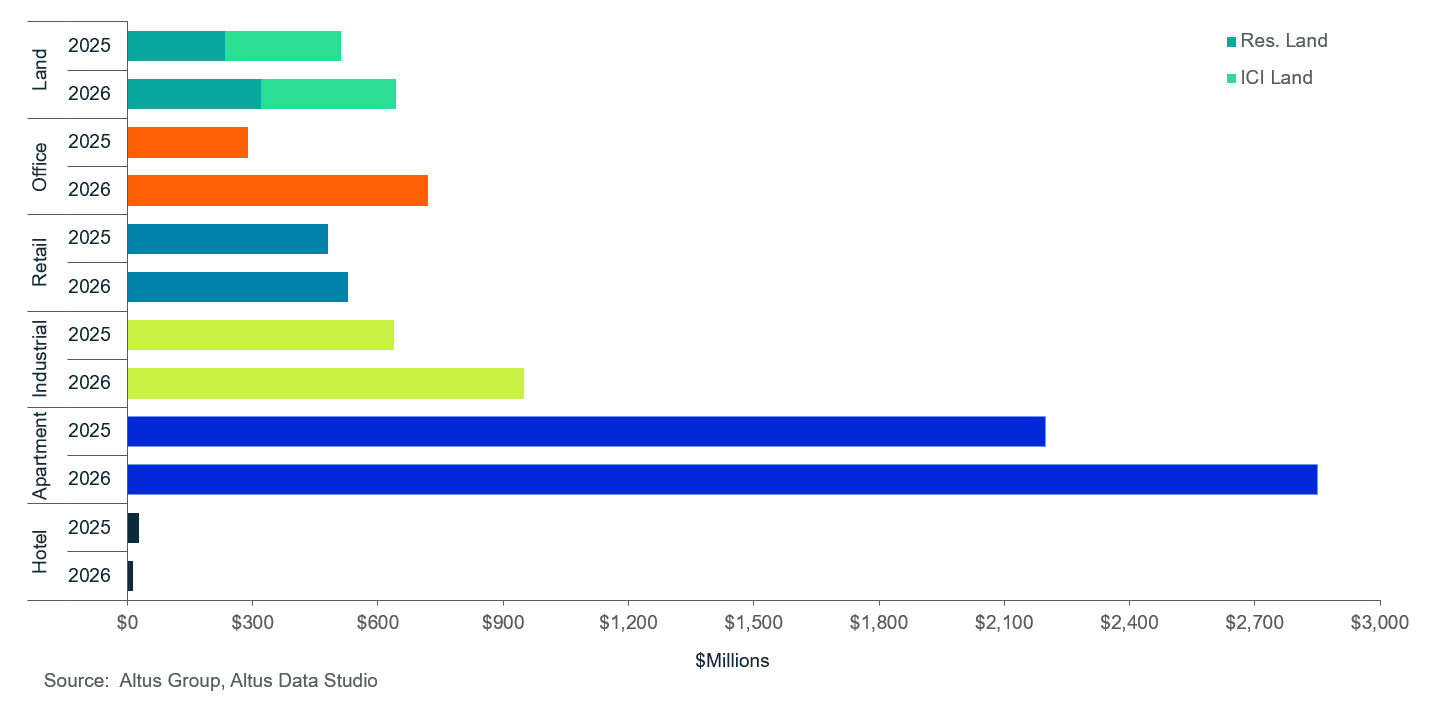
The office sector demonstrated the strongest upward growth trajectory, with investment volume up 149% year-over-year to $720 million, underscoring demand for Class AAA office space
The multi-family sector remained the cornerstone of Montreal’s commercial real estate market, accounting for half of total investment volume, attracting nearly $2.9 billion in capital and rising 30% year-over-year
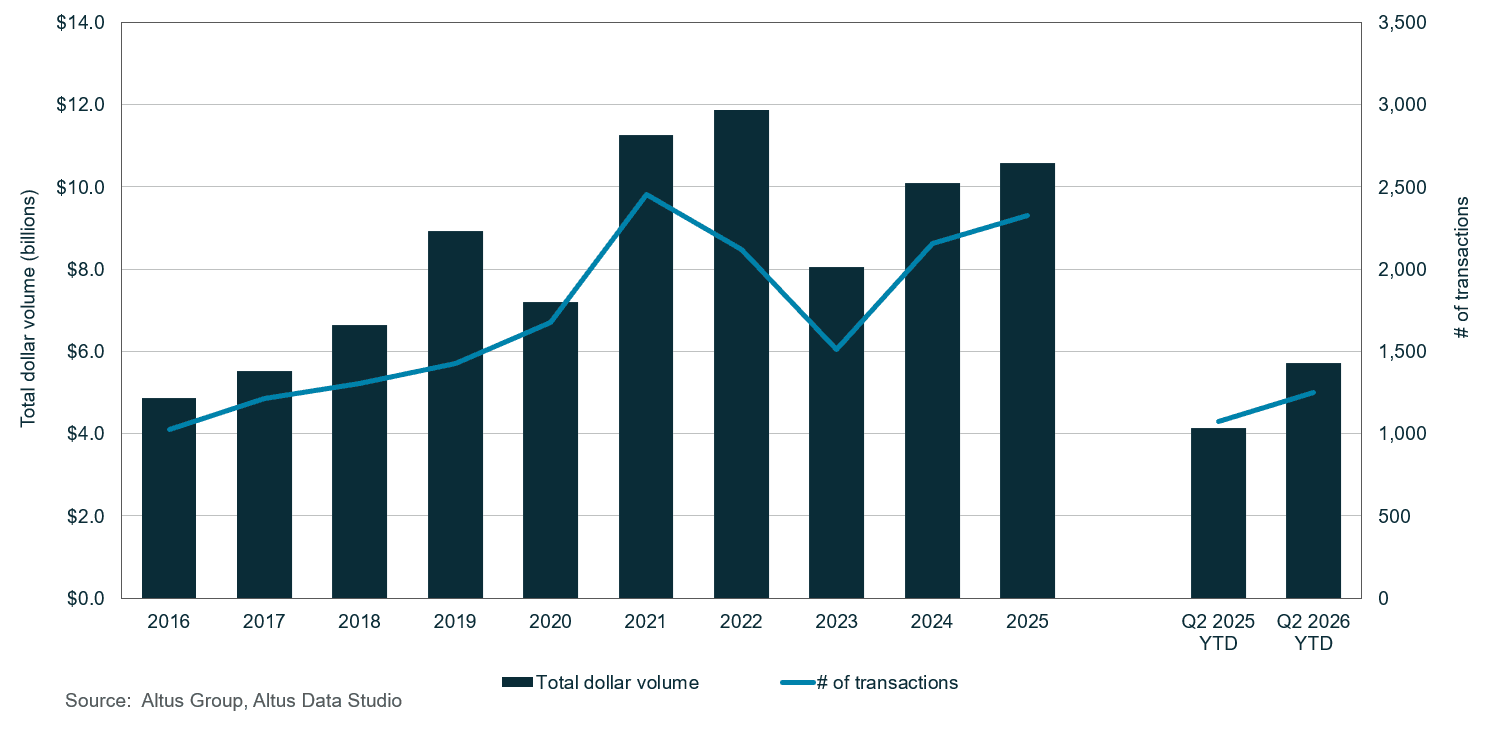
In the first half of 2026, Montreal recorded stronger investment activity, with total volume increasing 38% year-over-year
The Montreal commercial real estate market demonstrated notable resilience during the first half of 2026. Based on data from Altus Data Studio, total investment volume increased 38% year-over-year to reach $5.7 billion. While this percentage gain was partially amplified by a depressed early 2025 baseline, driven by widespread market slowdowns amid macroeconomic uncertainty, the rebound reflected genuine recovery. Following an intensive market recalibration in late 2025, capital deployment expanded across core sectors in Montreal, signalling renewed institutional confidence and robust asset absorption.
Figure 1: Montreal property transactions - All sectors by year
Geopolitical and trade dynamics
Policy discussions surrounding the July 2026 Canada-United States-Mexico Agreement (CUSMA) joint review created trade uncertainty, although the impact in Montreal was concentrated mainly among corporate occupiers and industrial logistics users. The prospect of tighter rules of origin led some occupiers, particularly in manufacturing and distribution hubs such as Lachine and Saint-Laurent, to adopt “just-in-case” inventory strategies and delay commitments on large-bay facilities. Institutional real estate investors, however, remained largely focused on Montreal’s long-term fundamentals. With CUSMA’s protective framework structurally intact through at least 2036, investors continued to view the region as a resilient market supported by the Port of Montreal, strong rail and supply-chain infrastructure, and steady absorption across small- to mid-bay industrial, Class A office and multi-family assets.
Macroeconomic and monetary indicators
Domestic monetary stability provided a clearer underwriting environment for Montreal’s commercial real estate market during the first half of 2026. On June 10, 2026, the Bank of Canada (BoC) maintained its benchmark overnight rate at 2.25% for the fifth consecutive decision, balancing domestic inflation targets against macroeconomic risks stemming from geopolitical tensions in the Middle East. For Montreal’s capital markets, this sustained rate hold anchored borrowing costs and stabilized five-year bond yields, narrowing bid-ask spreads between buyers and sellers. With debt liquidity gradually improving, cap rate expansion across core assets began to narrow, improving price discovery and enabling investors to underwrite acquisitions with greater confidence.
National and provincial economic output further supported underlying leasing fundamentals in Montreal. Canadian Gross Domestic Product (GDP) grew at an annualized rate of 3.3% in the second quarter, led by higher exports, household spending, and business capital investment; however, this expansion in industrial output did not translate into consistent space take-up in Montreal. Industrial net absorption across core logistics nodes, including Lachine, Saint-Laurent, and the South Shore, remained uneven and volatile over the past four quarters as persistent supply deliveries and broader macroeconomic uncertainty continued to outpace organic occupier expansion.
At the regional level, strengthening labour market conditions and consumer activity provided a steady tailwind for local property sectors. Quebec’s provincial unemployment rate eased to 5.4% in June, down from a spring peak of 6.2%, while monthly retail sales surged 4.6% to $16.1 billion in May. Locally, Montreal’s municipal unemployment rate improved by 0.6 percentage points to 5.9%, marking a 1.1 percentage point reduction year-over-year. This solid employment baseline helped stabilize retention of downtown office occupiers, while resilient retail spending supported cash flows and sustained foot traffic across prime commercial corridors.
Capital allocation and investment strategy
Capital allocation in Montreal reflected a balance of defensive positioning and targeted opportunism during the first half of 2026. Residential multi-family assets remained the primary anchor of regional transaction activity, attracting capital seeking durable, inflation-hedged income amid persistent housing shortages. The office sector recorded the sharpest year-over-year increase, supported by institutional investors that shifted capital toward best-in-class assets. Premier Class AAA properties continued to trade at a premium, reflecting low vacancy rates, elevated net asking rents, and limited availability of top-tier contiguous space. Industrial real estate also maintained momentum, ranking second in relative growth and overall volume as buyers selectively targeted prime logistics hubs despite supply headwinds. Overall, capital flows pointed to a dual focus on defensive residential stability and strategic expansion into higher-performing commercial assets.
Multi-family investment activity
During the first half of 2026, multi-family remained the cornerstone of Montreal’s commercial real estate market. The sector accounted for half of total investment volume, attracting nearly $2.9 billion in capital and rising 30% year-over-year. This liquidity reflected the region’s renter-heavy demographic profile, which continued to sustain resilient fundamental demand despite economic volatility in other major Canadian markets. The Island of Montreal retained its leading position with $1.9 billion in transaction volume, while capital increasingly flowed to peripheral submarkets. Longueuil posted the strongest growth, with volume up 221% year-over-year to $290 million, whereas Laval declined 19% to $203 million.
Investor confidence was further supported by local policy and regulatory changes intended to ease supply constraints and accelerate residential development. The City of Montreal amended the By-law for Diverse Metropolis (By-law 20-041), raising the threshold for mandatory affordable housing contributions to 18,000 square metres. Combined with temporary exemptions for downtown office-to-residential conversions through late 2026 and new borough-level height and density allowances, this reduced upfront barriers for major private projects. Provincial rent adjustments administered by the Tribunal administratif du logement (TAL), along with continued access to CMHC’s MLI Select program, also improved underwriting visibility. Together, these measures helped offset elevated construction costs and supported capital deployment across core urban density projects and expanding suburban rental corridors.
Office investment activity
Montreal’s office sector recorded $720 million in transaction volume during the first half of 2026, a 149% year-over-year increase. The sharp rise partly reflected an exceptionally weak prior-year comparison, as Q1 2025 marked the third-lowest volume on record. Activity was also supported by corporate return-to-office mandates and institutional capital concentrating in best-in-class assets. Investors targeted premier Class AAA properties, which continued to command price premiums due to low vacancy and limited contiguous space. Transaction data from the first half of 2026 further illustrated this flight to quality:
Class A office transactions comprised 31 deals, totalling approximately 855,000 square feet
Class B office space accounted for 13 transactions, totalling approximately 207,000 square feet
This sustained flight to quality led to a notable tightening in upper-tier segments. According to the latest Altus Group Canadian Office Market Update, Montreal’s office availability rate contracted by 130 basis points to 16.4%. Specifically, Class A availability registered a decline of 210 bps year-over-year, settling at 14.7%. Meanwhile, Class B assets exhibited more marginal improvements, with availability receding by 90 bps to 18.5%. This discrepancy underscored a deepening bifurcation within the office market, as aging inventory failed to satisfy the sophisticated amenity and infrastructure requirements of modern corporate tenants.
The complete halt in new office completions further impacted the market’s structural balance. The regional development pipeline remained entirely stagnant, with no future office projects initiated, as the prevailing trend of converting or repositioning existing assets discouraged speculative new construction. This lack of incoming supply was expected to function as a primary driver for continued availability rate compression throughout 2026. As high-quality Class A inventory was increasingly absorbed by organizations prioritizing centralized, high-performance corporate hubs, the scarcity of premium space exerted additional upward pressure on the competitive landscape.
Industrial investment activity
The industrial sector maintained momentum in the first half of 2026, with investment volume up 49% year-over-year to more than $950 million. Operating fundamentals, however, continued to soften gradually. According to the latest Altus Group Canadian Industrial Market Update, Montreal’s availability rate rose 90 bps year-over-year to 8.9%. Net asking rents remained stable at $13.00 to $14.00 per square foot for the 13th consecutive quarter, reflecting tenant resistance to higher rents alongside landlords’ focus on protecting baseline cash flow.
A clear divide continued to emerge between urban infill and peripheral submarkets. The North Shore and South Shore corridors attracted large-scale logistics demand, supported by modern facilities with clear heights above 30 feet, expansive truck courts, and lower land costs. By contrast, the Island of Montreal assets faced constraints related to aging infrastructure, lower clear heights, smaller bay layouts, and higher taxes. Even so, occupiers continued to pay premiums for Island locations because they offered proximity to Montreal’s consumer base, shorter drayage times, lower last-mile transit costs and direct access to major highways, the Port of Montreal and public transit, which supported labour access and tight availability for functional urban space.
Investor and occupier sentiment remained cautious but opportunistic in the second quarter. Trade policy uncertainty tied to the ongoing CUSMA joint review led some large-format users to delay major commitments, yet market participants continued to pursue selective opportunities. Buyers and tenants focused on functional small- to mid-bay facilities with stronger tenant liquidity and lower vacancy risk, balancing near-term caution with strategic acquisition goals.
Supply growth further tested market absorption through mid-2026. Seven new industrial developments were delivered in the second quarter, adding more than 1.2 million square feet of inventory, with roughly half uncommitted at completion. Another 11 buildings, totalling 2.5 million square feet, were under construction, with 63% still unleased. This sizeable speculative pipeline is expected to maintain near-term upward pressure on availability rates and reinforce a disciplined, highly selective capital-deployment environment.
Retail investment activity
The Montreal retail sector sustained the momentum established in 2025, recording $529 million in total transaction volume during the first half of 2026. Although this represented a modest 10% year-over-year increase, the performance indicated continued resilience relative to historical benchmarks, particularly given cautious consumer spending and persistent elevated borrowing costs.
Capital remained concentrated in essential-service and food-anchored retail strips in Montreal, as investors prioritized resilient cash flows, steady foot traffic and inflation-hedging qualities. This sustained investor preference contributed to a shortage of top-tier assets, as many existing owners continued to hold high-performing, income-generating properties rather than bring them to market. At the same time, high financing costs and tight lending conditions limited the feasibility of ground-up commercial retail development across the region.
With new construction largely stalled, property owners and developers increasingly focused on site intensification and adaptive land use across key Montreal submarkets. Owners sought to unlock land value by adding residential density to suburban shopping centres and open-air plazas, repositioning traditional retail sites as mixed-use hubs. Retail landlords also re-tenanted and reconfigured large-format vacancies, particularly after major anchor departures along prime corridors such as Sainte-Catherine Street, by subdividing larger footprints into experiential and specialized retail spaces. As a result, near-term retail investment activity remained constrained by limited prime product, while market participants prioritized site optimization, tenant diversification and mixed-use redevelopment.
Land investment activity
The Montreal land sector, encompassing both residential and ICI land, recorded $644 million in transaction volume during the first half of 2026, a 26% year-over-year increase. While this signalled a return of market activity, the gain followed several years of persistent contraction, indicating recovery from an exceptionally weak prior-year baseline rather than broad market expansion.
Residential land sales drove a significant portion of this momentum, totalling $320 million, a 37% increase year-over-year. Strategic acquisitions were heavily concentrated in high-density urban infill and transit-oriented sites on the Island, as well as in medium-density suburban parcels. Developers actively acquired sites to capitalize on recent municipal policy shifts, including relaxed inclusionary housing requirements and transit-oriented density incentives.
Simultaneously, ICI land volume reached $324 million, expanding 17% year-over-year. This surge was primarily propelled by large-parcel agricultural and greenfield transactions across outer-ring submarkets, where perimeter land was acquired specifically for agricultural operations. Commercial and industrial land transactions followed, with persistent demand for industrial-zoned sites along primary transport corridors further bolstering overall volumes as developers sought expansive parcels to accommodate next-generation distribution hubs.
Figure 2: Property transactions by total by asset class YTD (Q2 2025 vs Q2 2026)
Notable Montreal property transactions
The following are the notable transactions for the Q2 2026 Montreal commercial real estate market update:
300 Léo-Pariseau Street (Place du Parc), Montréal (Le Plateau-Mont-Royal) – Office
The second highest-value office transaction was the sale of 300 Léo-Pariseau Street for $48 million. The nearly 570,000-square-foot complex, which includes an office tower and underground retail concourse, transacted at approximately $85 per square foot. The relatively low valuation reflected a sale price estimated to be 30% below the municipal assessment. Despite being anchored by Air Transat and Nestlé/Nespresso Canada, the 50-year-old complex was approximately 40% vacant at the time of sale, consistent with conditions observed among many older Class B and Class C office properties across the GMA. To reposition the asset and enhance cash flow, purchaser Alta Canada indicated plans to upgrade several common areas, including the rooftop, which may be adapted into a panoramic city viewpoint.
655 des Promenades Boulevard, Saint-Bruno-de-Montarville – Retail
Located on Montréal’s South Shore at the highly accessible intersection of Sir-Wilfrid-Laurier Boulevard (Route 116) and Autoroute 30, 655 des Promenades Boulevard was formerly occupied by Toys “R” Us for more than 30 years. The vacant property, which sold for just under $15 million, was the last remaining Toys “R” Us store in Quebec. Purchaser Decathlon plans to use the building for its own operations, with a new store scheduled to open in autumn 2026. The location is expected to create nearly 70 jobs and become Decathlon’s 13th store in the province. CEO Stéphane Montoni also noted that the acquisition represents the company’s first real estate asset in Canada, underscoring its long-term commitment to the country.
7000 Hochelaga Street, Montréal (Mercier-Hochelaga-Maisonneuve) – Industrial
7000 Hochelaga Street was the highest-value industrial transaction, selling for $45.4 million. The 160,000-square-foot building was owner-occupied by furniture manufacturer Primo International, which continued operating on-site after the sale. Purchaser Hydro-Québec plans to redevelop the property in 2027 for the construction and connection of a new electrical substation to replace the Longue-Pointe substation, which has been operating since the late 1950s. The site’s location and existing development were key factors in the acquisition, as they are expected to limit the need to remove green space. The project follows other Hydro-Québec substation upgrades or planned upgrades on the Island of Montreal, including the Downtown Pivot Station, Côte Saint-Luc Substation, and Anjou Substation.
240-250 Notre-Dame Street West & 450 Saint-François-Xavier Street (Laurence Condos), Montréal (Ville-Marie) – Apartment
Located in Old Montreal, steps from Notre-Dame Basilica, Laurence Condos was the highest-value apartment transaction, selling for more than $130.0 million, or $581,215 per unit. The sale represented Mondev’s only apartment disposition of the quarter and Canadian Urban Limited’s only apartment acquisition. Canadian Urban Limited noted that the property aligned with its strategy of acquiring institutional-quality urban assets in transit-oriented locations with a focus on ESG and sustainability. Although the residential component was only 2% vacant, the approximately 21,000 square feet of ground-floor retail space was fully unleased at the time of sale. The purchaser identified this space as a significant opportunity, citing its scale relative to the smaller and older retail premises nearby.
Looking ahead
As Montreal moved through the first half of 2026, investor sentiment reflected a measured return of confidence supported by disciplined selectivity. Since late 2025, underwriting across asset classes had largely priced in macroeconomic friction, including elevated debt costs and CUSMA-related policy uncertainty, allowing market participants to operate from a more stable baseline. Capital moved with greater predictability into opportunities that offered durable cash flow and long-term structural tailwinds. Investors continued to prioritize income stability in prime commercial assets while using municipal policy tools, including relaxed inclusionary housing thresholds and downtown conversion incentives, to advance targeted site intensification and adaptive reuse projects.
Moving forward, performance across submarkets was expected to hinge primarily on the pace of supply absorption and local execution. The near-term influx of speculative industrial space and ongoing residential completions was expected to test market capacity, likely keeping rent growth moderate and reinforcing a favourable environment for well-capitalized landlords with high-quality offerings. Overall, investment activity was expected to remain concentrated around prime urban infill nodes, essential-service retail, and high-density residential developments. Supported by solid urban demographic fundamentals and a persistent structural housing shortage, Montreal remained a resilient flight-to-quality target for institutional and private capital.
Want to be notified of our new and relevant CRE content, articles and events?
Disclaimer
This publication has been prepared for general guidance on matters of interest only and does not constitute professional advice or services of Altus Group, its affiliates and its related entities (collectively “Altus Group”). You should not act upon the information contained in this publication without obtaining specific professional advice.
A number of factors may influence the performance of the commercial real estate market, including regulatory conditions and economic factors such as interest rate fluctuations, inflation, changing investor sentiment, and shifts in tenant demand or occupancy trends. We strongly recommend that you consult with a qualified professional to assess how these and other market dynamics may impact your investment strategy, underwriting assumptions, asset valuations, and overall portfolio performance.
No representation or warranty (express or implied) is given as to the accuracy, completeness or reliability of the information contained in this publication, or the suitability of the information for a particular purpose. To the extent permitted by law, Altus Group does not accept or assume any liability, responsibility or duty of care for any consequences of you or anyone else acting, or refraining to act, in reliance on the information contained in this publication or for any decision based on it. The distribution of this publication to you does not create, extend or revive a client relationship between Altus Group and you or any other person or entity. This publication, or any part thereof, may not be reproduced or distributed in any form for any purpose without the express written consent of Altus Group.
Authors
Jennifer Nhieu
Senior Research Analyst
Daniel Marro
Senior Market Analyst
Resources
Latest insights