Why the next Canadian CRE cycle will be won on data
Practitioners from Altus Group, Newmark, and Centurion on why the data foundation has to come before the algorithm.
Why the next Canadian CRE cycle will be won on data
Practitioners from Altus Group, Newmark, and Centurion on why the data foundation has to come before the algorithm.
Contributors

Christina Gratrix
Senior Director of Product Management at Altus Group

Ray Wong
Vice President, Research at Newmark

Carl Gomez
Chief Economist & EVP of Research at Centurion Asset Management
Key highlights:
With the tailwind that propped up the last cycle dwindling, fundamentals decide outcomes, and only investors working from reliable, consistent data can see where the real opportunities are
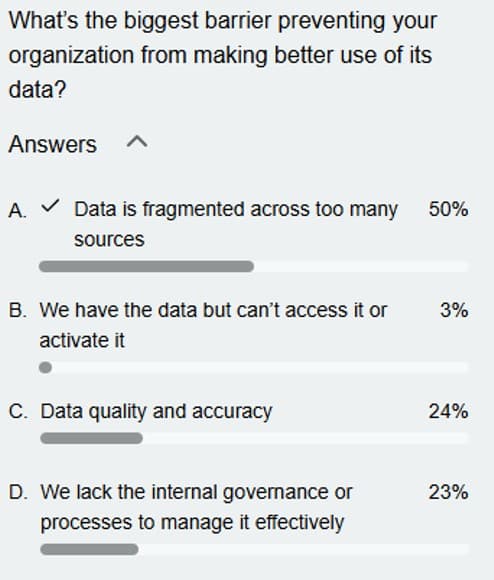
Asked to name their single biggest barrier to using data well, half of attendees (50%) pointed to fragmentation; nearly as many again named quality (24%) or governance (23%)
Most firms are sitting on a goldmine of proprietary intelligence they can’t use, because it was structured for the questions they had a decade ago, not the ones they’re asking now
For most of the last cycle, Canadian commercial real estate had the wind at its back. Interest rates fell, cap rates compressed, and values floated upward on a tide that lifted nearly every asset. “All boats were lifted by that great, benevolent cycle,” as Carl Gomez, Chief Economist and EVP of Research at Centurion Asset Management, put it. But the trouble with a tailwind that doesn’t discriminate is that it disguises the difference between a good decision and a lucky one. And once that wind dies down – as it now has – that distinction is everything.
At a recent Altus Group webinar on how data and AI are reshaping Canadian investment decisions, Gomez joined Raymond Wong, VP of Research at Newmark Canada, and Christina Gratrix, Senior Director of Product Management at Altus Group. The discussion proved to be less of a debate and more of a convergence: with the easy money gone, fundamentals once again decide who wins. But you can’t read fundamentals off data you don’t trust.
Back to the basics
Gomez has spent 25 years reading the market through data, and his diagnosis is blunt. When cap-rate compression was doing the lifting, weak fundamentals didn’t much matter; plenty of “sins,” as he puts it, got papered over by rising values. When you strip that away, returns now come down to where the underlying NOI growth actually holds up, asset class by asset class. “The specialists who understand how to drive the asset class amidst all this noise are the ones who’ll generate strong returns.”
Wong sees the same caution on the ground, with an added twist: conviction hasn’t disappeared, investors are just slower to act, and the opportunity set has spread beyond the core four into data centres, storage, and outdoor storage. Although the assets differ, there is a common thread of selectivity. The more experienced players, he adds, are picking specific assets against consistent, reliable information rather than betting on a tide that no longer exists.
Investment selectivity is only as good as the data behind it
When the audience was asked where their data breaks down, the consensus pointed to a shared problem.
Figure 1: Poll results - What's the biggest barrier preventing your organization from making better use of its data?
Source: Poll results from Altus Group webinar: Investing in Canadian CRE in 2026: How data and AI are changing the way CRE decisions get made
Half named fragmentation; another 24% pointed to quality and 23% to governance. Only 3% said the problem was reaching the data at all. Almost everyone in the room located the failure in the same place, not in access, but in the foundation underneath it.
Gomez framed why real estate is uniquely prone to this. Unlike a public equity you can pull off an exchange in real time, real estate is a physical asset with a lot of gray matter. From cash flows to lease dynamics and valuation conventions, the readings shift depending on who mined the data and how. Simplified its garbage in, garbage out.
Wong’s advice is to pick a horse and stay with it, noting that when there’s no perfect source, consistency matters more than chasing the most flattering number. For larger firms the real edge is proprietary: their own records layered onto external sources, but only if the two can actually be integrated.
Gratrix observes the consequence of this every day. Firms are sitting on five, ten, twenty years of their own history, captured for a different set of questions than the ones being asked now. One client recently broke out industrial values by power capacity and found a discrepancy they’d missed previously, simply because no one had isolated that variable five years ago. “The anomalies are where we can learn the most,” she explains, but only if the records are structured to surface them. Without a consistent framework, even the smartest tool has nothing coherent to read.
This is the logic behind Altus Data Studio: organize around the asset first, so the intelligence already inside the data becomes usable rather than buried.
Why a generic tool won’t survive an investment committee
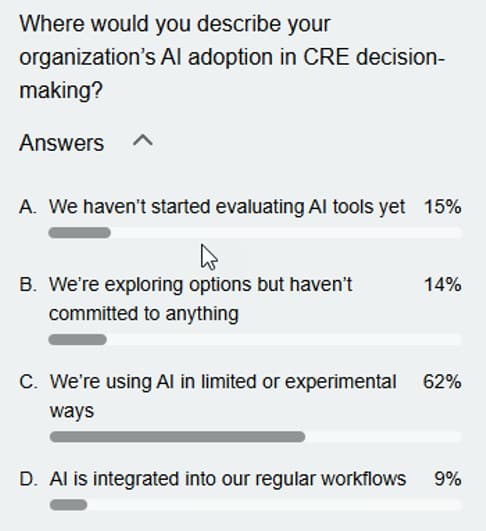
If the data foundation is shaky, AI doesn’t fix it. Worse, it inherits the problem. Asked to pinpoint where their own organization currently sits on the adoption curve, the audience heavily identified with still being in the early stages.
Figure 2: Poll results - Where would you describe your organization's AI adoption in CRE decision-making?
Source: Poll results from Altus Group webinar: Investing in Canadian CRE in 2026: How data and AI are changing the way CRE decisions get made
Nearly two-thirds are experimenting; fewer than one in ten have operationalized anything. That gap is where Gratrix spends her time. "The big question I get is, can I trust this output, and how do I explain it?" The reflex that follows, as she describes it, is to interrogate every answer: "We need to explain every aspect of why the AI came up with the answer it did." This is where generic tools crumble: they don't reliably pull from the right sources, so a tool only earns its place if it can answer every question. That level of defensibility demands data that’s governed, domain-specific, and tied to a transparent methodology. This is the standard behind ARGUS Assist, which streamlines the data pull without taking the judgment out of valuers' hands. When it’s time to run the model, the agent calls the ARGUS calculation engine directly, drawing on the existing ARGUS models, market data, and valuation frameworks unique to the valuer’s unique ARGUS environment, so the output is traceable to the same methodology that has been recognized by institutional investors, auditors, and counterparties for thirty years.
Gomez adds that today’s tools are generative and increasingly strong at distilling reports, running scenarios, and catching errors. But if you feed them the wrong sources, the answers will contradict what an experienced professional knows on the ground. His prescription is discipline: hold AI to the same KPIs you’d hold a person to. Gratrix put this a different way, insisting that the AI due diligence process should be just as rigorous as the investment due diligence process.
AI won’t replace judgment, but it will replace people who won’t use it
None of the three panelists anticipate a machine taking the wheel, conveying that they’re using AI to automate the rote work, not to make the important calls. Gomez is frank that this may not last; the entry-level analyst cranking out cash flows could eventually be displaced, though that hasn’t shown up in Canadian labour data yet. Right now, the demand for CRE professionals fluent in both the asset class and the tools is as organizational as it is technical.
Wong made the case for what data can't see. "A friend of mine coined a phrase I think is quite prevalent today: DALS. Drive around and look at stuff," he says. A data point won't tell you there's a chemical plant beside the outdoor-storage site you're underwriting, the kind of thing that undermines value.
Gratrix went a step further, noting that human judgement remains essential everywhere. AI and judgment aren’t substitutes; they’re complements. The tool handles computation and pattern recognition at scale; the person handles interpretation and stays the one who has to shape the narrative and defend it.
The firms navigating this period best aren’t necessarily the ones with the flashiest tools. Rather, they’re the ones that did the unglamorous work first: clean data, consistent methodology, and a framework that can survive the committee litmus test. AI is the accelerant, and the foundation is what it accelerates. The tailwind is gone; in its place is the discipline to tell a good decision from a lucky one, on data you can actually defend. That foundation is what Altus keeps building across the Canadian market, and based on the shared perspectives of this panel, it's what will determine the next cycle.
Want to be notified of our new and relevant CRE content, articles and events?
Contributors
Christina Gratrix
Senior Director of Product Management at Altus Group
Ray Wong
Vice President, Research at Newmark
Carl Gomez
Chief Economist & EVP of Research at Centurion Asset Management
Resources
Latest insights