Vancouver commercial real estate market update – Q2 2026
Vancouver investment activity contracted in H1 2026, with total dollar volume declining 23% year-over-year as capital shifted toward defensive, income-oriented opportunities.
Vancouver commercial real estate market update – Q2 2026
Vancouver investment activity contracted in H1 2026, with total dollar volume declining 23% year-over-year as capital shifted toward defensive, income-oriented opportunities.
Authors

Jennifer Nhieu
Senior Research Analyst

Liam Mackay
Market Analyst
Key highlights:
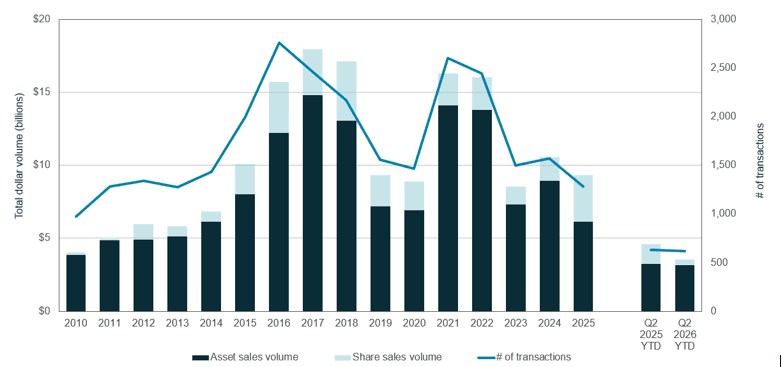
Investment activity became more selective in the first half of 2026, with total investment volume declining 23% year-over-year to $3.5 billion as capital shifted toward defensive, income-oriented opportunities
Office investment remained constrained by limited transaction supply and elevated financing costs, with year-to-date transaction volume down 46% despite sustained demand for high-quality, transit-oriented assets
Retail was the only major sector to record year-over-year growth, posting a marginal 1% increase supported by necessity-based formats, prime street-front assets and dense mixed-use locations
Commercial investment in Vancouver contracted 23% year-over-year
The first half of 2026 reflected a clear shift toward defensive capital allocation, with Vancouver’s commercial real estate investment volume declining 23% year-over-year to $3.5 billion. Most major sectors recorded lower transaction volume. Retail stood out as the only sector to post year-over-year growth, increasing by a marginal 1%. Broader market expansion remained constrained by macroeconomic and structural headwinds, including shifting population trends, trade policy uncertainty and softer consumer demand.
Figure 1: Vancouver property transactions - All sectors by year
Source: Altus Data Studio
Domestic monetary policy offered some stability in early 2026 as the Bank of Canada held its overnight rate steady amid persistent inflation. This helped anchor long-term cost-of-capital expectations. National economic output rose 0.3% in May, supported by gains in sectors producing both goods and services. Locally, Vancouver’s labour market followed a similar pattern, with unemployment falling 0.7 percentage points to 6.6% in June. Provincial job growth was led by health care, social assistance, and transportation and warehousing. However, continued losses in construction, technology and hospitality pointed to underlying softness in key commercial real estate demand drivers.
Investor sentiment in Vancouver remained centred on capital preservation rather than broad-based growth. High living costs, softer job creation and tighter underwriting continued to favour assets with durable income, strong locations and clearer policy support. Speculative development opportunities, by contrast, remained largely deferred.
Overall, the first half of 2026 marked a more selective underwriting environment, as investors adjusted strategies to reflect a prolonged neutral interest rate cycle and uneven demand conditions across asset classes.
This cautious investment backdrop played out differently across asset classes. Performance was increasingly shaped by asset quality, income durability, location strength and exposure to financing or development risk.
Office
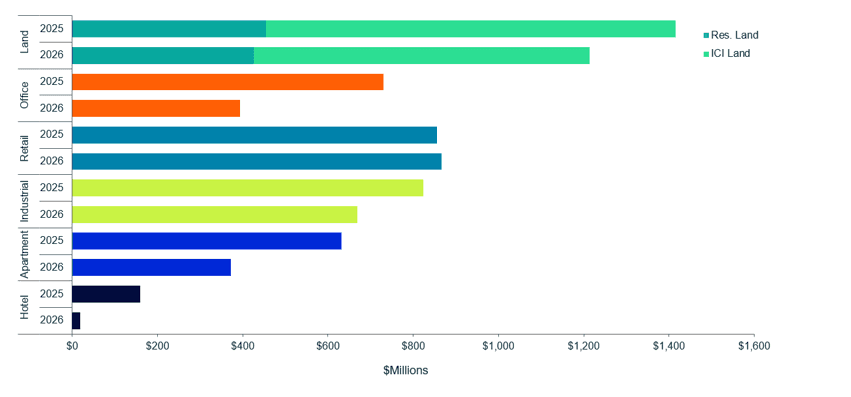
Office investment activity was constrained, primarily by limited high-quality supply rather than a material decline in demand. The sector recorded approximately $394 million in transaction volume, down 46% year-over-year. Owners retained income-generating Class AAA assets, while elevated financing costs limited new development. According to Altus Group’s latest Canadian Office Market Update, Vancouver’s office availability rate reached 12.4%, up 10 basis points year-over-year. Availability remained within the 12% to 13% range for a third consecutive year amid hybrid work and cautious corporate space planning.
A defining feature of the office market was the continued bifurcation in leasing activity. Investors and occupiers maintained a clear flight to quality, favouring amenitized Class AAA space in transit-oriented locations. These premium assets continued to record comparatively tight vacancy and elevated rents, while older Class B and C properties faced increasing pressure as tenants prioritized modern workplace environments to support return-to-office strategies. Based on Altus Data Studio data, first-half 2026 leasing activity confirmed this preference for higher-quality assets.
Class A transactions constituted most of the activity, accounting for 70 deals and more than 1.3 million square feet.
Class B office space saw considerably less demand, comprising 16 transactions totalling approximately 245,000 square feet.
From a development perspective, two office buildings were completed in the first quarter: Valeo, a fully leased 26,000-square-foot property, and 837 Beatty Street, an adaptive reuse rehabilitation of an Edwardian industrial heritage building with 29,600 square feet of uncommitted office space. In the near term, the limited development pipeline was expected to be a critical factor in the anticipated tightening of availability rates. Fewer new projects were scheduled to enter the market and compete with existing inventory.
Retail
Retail remained Vancouver’s most defensive sector and the only major sector to record year-over-year growth. In the first half of 2026, transaction volume rose a marginal 1% to $866 million, supported by investor demand for necessity-based grocery-anchored strip centres, prime street-front locations and assets with low vacancy and inflation-hedging characteristics.
A significant share of this activity was concentrated in street-front retail space within residential mixed-use developments across Vancouver’s urban core. Commercial podiums benefited from built-in consumer bases, upper-floor residential density and consistent pedestrian traffic along key transit corridors. Investors favoured these assets for their lower absolute capital requirements, manageable operating overhead and limited exposure to large-scale tenant repositioning risks. Supported by resilient service occupiers, including medical practices, daily-needs retailers, and food and beverage operators, these assets provided reliable holding yields in a cautious market.
Underlying operational fundamentals remained structurally tight across the region, particularly within urban high-street and necessity-anchored formats. Despite consumer headwinds and a contraction in provincial retail sales during the second quarter, tenant demand was stabilized by essential services and selective expansion from new market entrants. Corporate leasing activity nevertheless remained highly selective. High-density urban corridors continued to draw luxury flagships and daily-needs banners, while elevated construction costs and tight financing sharply limited new supply. Consequently, development pipeline activity remained largely limited to mixed-use formats and master-planned suburban intensification.
Industrial
Industrial fundamentals remained resilient despite lower investment volume, reinforcing the sector’s long-term scarcity value. First-half 2026 transaction volume declined 19% year-over-year to nearly $669 million. Geographic constraints limited industrial land supply, and four consecutive quarters of positive absorption supported market stability. According to Altus Group’s latest Canadian Industrial Market Update, Vancouver’s availability rate stood at 5.9%, down 30 basis points year-over-year. Tenant demand remained broadly aligned with existing supply.
Tightening conditions were further supported by a disciplined pullback in the construction pipeline as developers responded to evolving macroeconomic signals. The active pipeline declined to 27 industrial buildings, totalling nearly 2.5 million square feet, with approximately 51% available for lease. This reduction reflected a strategic shift away from speculative development toward stricter pre-leasing requirements, as developers sought to manage elevated construction and financing costs.
Leasing conditions reflected structural bifurcation rather than a broad-based market decline. Modern, high-specification logistics space continued to achieve premium rents, supported by sustained tenant demand. In the small-to-mid-bay segment, newer assets remained highly sought after due to their operational flexibility across a diverse tenant base. By contrast, a meaningful share of older legacy inventory did not meet contemporary occupier requirements, placing downward pressure on rents and prompting owners of secondary assets to expand tenant inducements to maintain occupancy.
Multi-family
Multi-family investment slowed as investors recalibrated to weaker residential sales, elevated borrowing costs and softer rental growth expectations. Transaction volume declined 41% year-over-year to nearly $372 million, with activity concentrated in stabilized low-rise assets and specialized care facilities, including the $28 million acquisition of Lynn Valley Care Centre.
Operationally, the market continued to adjust to elevated condominium inventory and slowing construction starts, alongside softer tenant demand and shifting leasing conditions. Moderating population growth, driven by lower non-permanent resident inflows and ongoing affordability pressures eased rental growth overall, with suburban submarkets facing greater downward rent pressure than the more resilient urban core.
Government intervention continued to shape the multi-family investment landscape through affordability and transit-oriented growth policies. Mandatory rent stabilization policies offered greater security for existing tenants amid cost-of-living pressures and prompted institutional capital to recalibrate toward more balanced yields. Provincial density mandates and updated municipal land-use frameworks created a clearer foundation for long-term rental supply along key corridors. Near-term capital deployment in purpose-built rental housing remained measured as developers and lenders adjusted underwriting models to current macroeconomic conditions.
These housing and density policies also influenced land investment, where site selection increasingly reflected regulatory clarity, transit access and confidence in long-term redevelopment potential.
Land
Land investment continued to shift from speculative acquisition toward sites with clear policy support, predictable density and manageable holding costs. Total land transaction volume reached $1.2 billion, down 14% year-over-year, as buyers prioritized assets with defensible regulatory pathways and long-term income or redevelopment potential.
The residential land sub-sector recorded nearly $426 million in transaction volume, representing a 6% year-over-year decrease. Despite a broad market pause, urban zoning activity remained resilient. Capital was particularly concentrated within major transit-oriented areas, such as the City of Vancouver’s Broadway Plan corridor and designated growth hubs under the newly finalized Citywide Official Development Plan (ODP). These provincial and municipal policies removed spot-rezoning uncertainty and standardized density frameworks. As a result, developers selectively acquired and held high-density multi-family parcels to leverage long-term housing mandates.
Concurrently, the industrial, commercial and institutional (ICI) land sub-sector recorded nearly $788 million in transaction volume, down 18% year-over-year. This pullback reflected a broader shift away from speculative site acquisitions toward opportunities with clearer regulatory pathways, predictable density parameters and manageable holding costs. Long-term transit-oriented upzoning policies provided a structural foundation for future pipeline development. However, near-term capital deployment in site assembly remained selective.
Figure 2: Vancouver property transactions by asset class year-to-date
Source: Altus Data Studio
Notable Transactions
The following are the notable transactions for the Q2 2026 Vancouver commercial real estate market update:
Plaza 5400, 5400 Minoru Boulevard, Richmond – Industrial
Plaza 5400, the industrial property located at 5400 Minoru Boulevard in Richmond, was acquired in May for $16 million. The 40,560 square foot mixed-use retail and warehouse complex is situated on a 92,565 square foot site within Richmond City Centre, steps from Lansdowne SkyTrain Station and adjacent to several major redevelopment projects. Previous marketing materials identified the property as a transit-oriented development opportunity with an Urban Centre T5 designation under the City Centre Area Plan, supporting higher-density residential and commercial uses.
The acquisition provided control of a rare 2.1-acre site in one of Metro Vancouver’s most active urban growth areas. The property is located near the ongoing redevelopment of Lansdowne Centre, Atmosphere Living, and other large-scale mixed-use projects that continue to transform Richmond’s downtown core. Given the site’s scale, transit accessibility and redevelopment potential, the transaction reflected continued investor interest in land-constrained development opportunities within Richmond City Centre.
1777 West 8th Avenue, Vancouver – Office
The office property located at 1777 West 8th Avenue was acquired in June for nearly $6.3 million, representing approximately $868 per square foot across 7,202 square feet of office space. The property featured a two-storey office building situated within Vancouver’s Armoury District, a well-established commercial node located between Granville Island, South Granville and the Broadway Corridor.
The site benefits from underlying redevelopment potential under the Broadway Plan, where the Granville/Burrard Slopes Area E designation permits additional residential density and building heights beyond existing zoning. Located near the Broadway Subway extension and within one of Vancouver’s most active urban growth areas, the acquisition provided both near-term owner-user functionality and long-term redevelopment optionality. The transaction highlighted continued demand for smaller urban office assets with embedded land value and potential for future residential redevelopment.
4975–4997 Joyce Street, Vancouver – Residential Land
In April, Sightline Properties acquired the four-lot development site at 4975–4997 Joyce Street for $17 million. The acquisition expanded the firm's growing rental development pipeline and strengthened its presence within East Vancouver’s transit-oriented development market. The approximately 13,838 square foot assembly is located one block from Joyce-Collingwood SkyTrain Station within the Joyce-Collingwood Station Precinct Plan area. Vancouver City Council previously approved the site’s rezoning for a 38-storey mixed-use rental tower containing approximately 408 rental units, including 10% below-market rental housing and ground-floor commercial space. A subsequent development permit refined the proposal to approximately 404 rental units. The acquisition provided control of a fully entitled high-density rental development site in one of Metro Vancouver’s most active transit-oriented growth corridors and reflects continued developer demand for large-scale rental housing opportunities adjacent to rapid transit infrastructure.
The property traded at a comparatively low price per buildable square foot despite its proximity to Joyce-Collingwood Station, one of Metro Vancouver’s established transit-oriented redevelopment nodes, suggesting potential upside for future value creation.
2915–2925 Willow Street & 816–860 West 13th Avenue, Vancouver – Residential Land
In April, PC Urban acquired a multi-parcel land assembly at the southwest corner of West 13th Avenue and Willow Street for $44.3 million. The assembly occupied a strategic location directly across from Vancouver General Hospital within the Broadway Plan area and is one of the largest healthcare-oriented housing development sites assembled in Vancouver in recent years.
After the acquisition, PC Urban and Harrison Street Asset Management advanced plans for a purpose-built rental project with approximately 507 rental homes and an extended-hours childcare facility intended to support Vancouver General Hospital and Vancouver Coastal Health employees. The development represented one of the first large-scale workforce housing initiatives specifically designed for healthcare workers in Metro Vancouver. Situated near rapid transit, major employment centres and the future Broadway Corridor, the transaction reflected increasing investor interest in specialized housing strategies tied to essential-service employment and institutional demand drivers.
Market Outlook
Looking ahead, Vancouver’s market is expected to remain defined by disciplined capital deployment rather than a broad transaction rebound, with sector performance diverging according to asset quality rather than tracking a uniform recovery.
Retail was anticipated to serve as the most defensive sector, anchored by urban high-street spaces, necessity-based tenancies and tight vacancy. In the industrial sector, limited land supply and steady occupier demand for logistics and multi-tenant distribution facilities continued to support stable rents and low availability. Conversely, office and multi-family transaction velocity remained constrained by elevated borrowing costs, statutory rent control caps and cautious tenant underwriting, driving a sharp flight-to-quality toward prime transit-connected assets over secondary inventory. Meanwhile, land acquisitions pivoted sharply toward transit-oriented sites with transportation entitlement processes and manageable holding costs.
Overall, long-term fundamentals remained attractive, but near-term opportunities were likely to concentrate in assets where income durability, location quality and policy clarity could offset higher financing costs and slower demand growth. Sellers may need to adjust pricing expectations for assets that lack these characteristics.

Leverage our real estate data and predictive analytics
The performance attribution, predictive analytics and market intelligence you need to explain performance and improve decision making.
Want to be notified of our new and relevant CRE content, articles and events?
Disclaimer
This publication has been prepared for general guidance on matters of interest only and does not constitute professional advice or services of Altus Group, its affiliates and its related entities (collectively “Altus Group”). You should not act upon the information contained in this publication without obtaining specific professional advice.
A number of factors may influence the performance of the commercial real estate market, including regulatory conditions and economic factors such as interest rate fluctuations, inflation, changing investor sentiment, and shifts in tenant demand or occupancy trends. We strongly recommend that you consult with a qualified professional to assess how these and other market dynamics may impact your investment strategy, underwriting assumptions, asset valuations, and overall portfolio performance.
No representation or warranty (express or implied) is given as to the accuracy, completeness or reliability of the information contained in this publication, or the suitability of the information for a particular purpose. To the extent permitted by law, Altus Group does not accept or assume any liability, responsibility or duty of care for any consequences of you or anyone else acting, or refraining to act, in reliance on the information contained in this publication or for any decision based on it. The distribution of this publication to you does not create, extend or revive a client relationship between Altus Group and you or any other person or entity. This publication, or any part thereof, may not be reproduced or distributed in any form for any purpose without the express written consent of Altus Group.
Authors
Jennifer Nhieu
Senior Research Analyst
Liam Mackay
Market Analyst
Resources
Latest insights





Sep 10, 2026