The investor lens: what institutional capital is looking for right now
Leading institutional practitioners gathered in New York to share where private real estate capital is moving, and what managers must get right
The investor lens: what institutional capital is looking for right now
Leading institutional practitioners gathered in New York to share where private real estate capital is moving, and what managers must get right
Contributors

Robby Tandjung
EVP, Global Head, Valuation Advisory, Altus Group

Shree Guha
Vice President, Global Strategy & Operations, Altus Group

Alexander Jaffe
Regional Lead, Valuation & Advisory, Altus Group

Robert Tafaro
Regional Lead, Valuation Advisory, Altus Group
Key highlights
Across all three sessions, participants agreed that private real estate valuations have stabilized, with recovery expected to follow a gradual path rather than a sharp rebound
Institutional investors are not leaving private real estate, but capital is rotating toward core plus strategies, alternative property types, and sector-specialist funds as overall allocations hold
Secondary market activity has accelerated materially since late 2023, with narrowing discounts signaling that investors believe valuations have stabilized and expect a recovery
For two to three years, private real estate has navigated declining valuations, elevated redemption queues, and a cautious capital environment. That period isn't over, but the mood is changing. On June 24, 2026, Altus Group brought together a select group of senior institutional practitioners in New York City to do something that rarely happens in this industry: sit in the same room, speak candidly, and trade notes on where the market is headed.
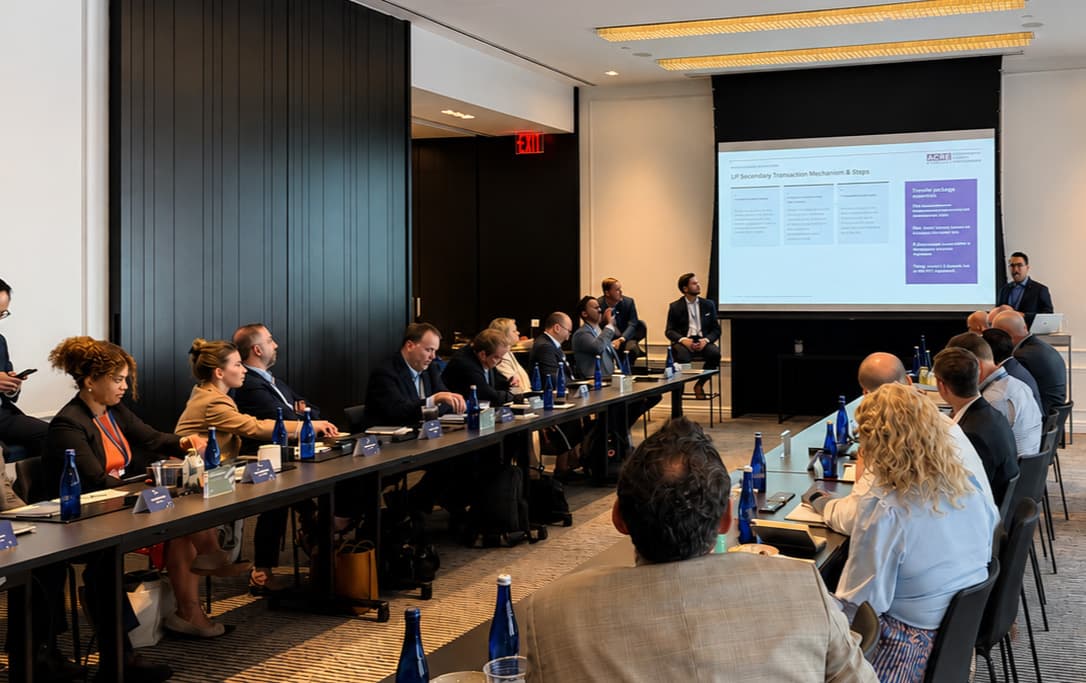
In session at Altus Group's roundtable discussion in New York City
Why this conversation, and why now
Altus sits in a unique position in this market. We work with fund managers, fund consultants, and capital allocators, usually separately, and usually on different sides of the same questions. We hear what each group is thinking, but we rarely see them all in the same room at the same time.
"When you go to a large industry conference, everyone is competing for time to meet with investors for capital raising or mostly sitting in sessions or presentations. Generally, not a lot of sharing amongst the group," said Robby Tandjung, EVP, Global Head of Valuation Advisory at Altus Group. "This was a different setting. The goal was to find the common threads, the shared questions the whole industry is working through, and address them directly."
The room reflected that intent. More than twenty-five senior executives across institutional real estate, no public transcript, firms that flew in from across North America: Chicago, Texas, California, and Canada. The format was deliberately small so everyone could have a voice, and no one could sit on the sidelines.
Alex Jaffe, Regional Lead, Valuation Advisory at Altus Group, had been sensing a shift in his client conversations for months before the event. "It feels like we're getting to a new chapter. We'd been hearing that from individual firms, but bringing everyone together confirmed it. There's real excitement about the next phase of the cycle."
Shree Guha, VP of Global Strategy and Operations, Valuation Advisory at Altus Group, was more direct: "The conversation was just electrifying."
Three speakers, three vantage points
The afternoon featured three institutional practitioners, each representing a distinct perspective on how capital moves through private real estate today.
Garrett Zdolshek, Chief Investment Officer at IDR Investment Management, spoke to where institutional capital is moving and what the current state of open-end fund vehicles tells us about market direction. IDR's index-style vehicle invests directly into open-end funds, giving Zdolshek a broad view of redemption queue dynamics, capital rotation, and sector sentiment across the ODCE universe.
Dan O'Connell, Senior Vice President at Townsend, brought the perspective of one of the industry's most respected fund consultants, the advisors who sit between institutional allocators and the managers competing for their capital. Townsend's evaluation criteria, and how those criteria have shifted through this cycle, carry direct implications for every manager in the room.
Phil Barker, CEO and Managing Partner of ACRE Solutions, addressed the secondary market, a segment that has grown rapidly since late 2023 and is redefining how institutions manage liquidity, rebalance portfolios, and think about the opportunity cost of staying in a position.
Together, these three perspectives (investor, evaluator, and liquidity provider) created a conversation that no single conference panel typically achieves.
What the room confirmed
The bottom is in, but recovery will be selective
Across all three sessions, the prevailing view was that private real estate valuations have stabilized. Cap rates have held relatively steady across several quarters, and early manager guidance pointed to another quarter of similar outcomes. “Everybody in that room truly believed that we're at or close to the bottom in terms of valuation," said Guha. "And everybody aligned on the recovery being a Nike Swoosh, not a hockey stick.”
That consensus came with an important caveat: future returns will not come from broad market appreciation. They will come from where within real estate you are allocated, which sectors you've chosen, and how well your manager executes.
Capital is rotating within real estate, not out of it
One of the clearest signals from the afternoon: institutional investors are not abandoning private real estate. Overall allocations are holding; what's changing is the composition. Capital is rotating toward core plus strategies, alternative property types, direct investments, and sector-specialist funds. Investors are chasing higher expected returns, not the exit.
That rotation is being driven as much by allocator preference as by manager strategy. O’Connell's session made clear that institutional investors are actively selecting managers who specialize in specific sectors and niche property types. While diversified portfolios remain foundational, alpha is anticipated through specialization. And this specialization has moved from a differentiator to a baseline expectation.
The pattern is visible in Altus's own client work. "We're seeing a lot of clients launching sector-specific funds," said Rob Tafaro, Regional Lead, Valuation Advisory at Altus Group. "Data centers, self-storage, student housing, the demand is there, and it's being driven by real tailwinds, demographic and macro."
Redemption queues are improving, but progress is slow
The data presented showed that redemption payments have increased significantly from the cycle lows; however, progress remains slow. New redemption requests continue to enter the system at a pace that nearly offsets outgoing payments. The consensus: reducing the inflow of new requests will ultimately matter more than increasing payment volume. Several funds reported minimal to no queue at all.
Secondaries have moved from a distress tool to portfolio management
Phil Barker reported that ACRE has completed approximately $6 billion across roughly 300 secondary transactions, predominantly in open-end funds, with activity accelerating materially since late 2023. Discounts that were wider in 2023 have narrowed significantly, a pricing signal supporting the view that valuations have stabilized and that investors expect a recovery.
The more important behavioral observation is that sellers are no longer asking: why should I sell at a discount? They're asking: what can I earn after redeploying that capital? That reframing, from loss aversion to opportunity cost, marks a maturation in how institutions use the secondary market. The buyer base also reflects it: where early secondary buyers were often overseas investors seeking discounted US real estate, today's market is dominated by domestic institutional capital.
Liquidity is a question the industry hasn't fully answered
Secondary markets have improved the liquidity picture, but they haven't resolved it. Fund consultants representing pension fund clients want faster, higher redemption payouts. Fund managers are balancing those requests to make sure that they are not forced to sell the assets at “fire sale” prices that will disadvantage the existing 80% to 90% of the investors that want to stay in the fund.
"Open-end funds are generally semi-liquid products," Tandjung observed. "The challenges are generally the structure of the funds and timing. Most of the open-end funds (especially core) have minimal liquidity sleeves and lower leverage to provide true real estate exposure while minimizing cash drags. These requirements will result in less liquidity. There's no perfect solution to that tension."
Secondary markets help, but the fundamental tradeoff between a product designed to hold illiquid assets and investors who sometimes need liquid outcomes remains an open question for the industry.
What's still being defined
Perhaps the most forward-looking thread of the afternoon was the question of definitions, and how many of the industry's standard categories no longer describe what's happening in the market.
"People talk about core commercial real estate, people talk about core plus," said Jaffe. "But one participant reframed it in a way that stuck: they didn’t call it core plus. They called it 'core, but...' Core, but with 50% leverage. Core, but with alternative sectors." The room recognized the framing immediately, because they're all living it.
Data centers generated the sharpest debate of any property type. Participants generally agreed that institutional allocation to data centers will grow, though disagreement remained over the ultimate scale. Current open-end fund exposure sits well below 1%. Five years ago, similar conversations were happening about self-storage, before it became a cornerstone allocation. The question the room couldn't answer cleanly is what happens when those leases expire. "The question we keep hearing is what happens at lease expiry on these hyperscaler facilities," said Tafaro. "They're purpose-built for a specific tenant, and at a time when AI is driving technological change faster than anyone anticipated, the reversion scenario just hasn't played out yet at this scale. If the hardware isn't being updated through the lease term, how much is it going to cost to re-tenant, and what does that do to your returns?" For an asset class attracting significant new institutional capital, it's a question the market hasn't had to answer yet.
These questions represent the leading edge of how the asset class is evolving and the work ahead for allocators, managers, and the advisors and data providers who support them.
The path forward
The conversations at the event pointed in a consistent direction. Valuations appear to have stabilized. Capital is moving, but selectively. The managers attracting attention are those who generated liquidity when it was hard, built portfolios around sectors with return potential, and communicated clearly with their investors through a difficult cycle.
The secondary market is telling a similar story: narrowing discounts and a changing buyer base suggest that the people closest to these transactions believe the worst is behind them. How quickly that confidence translates into broader capital deployment remains an open question.
What the discussion made clear is that the next phase of this cycle will reward precision over breadth, in sector selection, manager evaluation, and how institutions think about liquidity as a feature of portfolio construction.
Altus Group will continue to convene this type of conversation. If you weren’t in the room and want to be part of future conversations, reach out to your Altus partner.

Boost investor confidence with independently managed valuations
Independent appraisals trusted by funds, investors, lenders, and public entities around the world.
Want to be notified of our new and relevant CRE content, articles and events?
Disclaimer
This publication has been prepared for general guidance on matters of interest only and does not constitute professional advice or services of Altus Group, its affiliates and its related entities (collectively “Altus Group”). You should not act upon the information contained in this publication without obtaining specific professional advice.
A number of factors may influence the performance of the commercial real estate market, including regulatory conditions and economic factors such as interest rate fluctuations, inflation, changing investor sentiment, and shifts in tenant demand or occupancy trends. We strongly recommend that you consult with a qualified professional to assess how these and other market dynamics may impact your investment strategy, underwriting assumptions, asset valuations, and overall portfolio performance.
No representation or warranty (express or implied) is given as to the accuracy, completeness or reliability of the information contained in this publication, or the suitability of the information for a particular purpose. To the extent permitted by law, Altus Group does not accept or assume any liability, responsibility or duty of care for any consequences of you or anyone else acting, or refraining to act, in reliance on the information contained in this publication or for any decision based on it. The distribution of this publication to you does not create, extend or revive a client relationship between Altus Group and you or any other person or entity. This publication, or any part thereof, may not be reproduced or distributed in any form for any purpose without the express written consent of Altus Group.
Contributors
Robby Tandjung
EVP, Global Head, Valuation Advisory, Altus Group
Shree Guha
Vice President, Global Strategy & Operations, Altus Group
Alexander Jaffe
Regional Lead, Valuation & Advisory, Altus Group
Robert Tafaro
Regional Lead, Valuation Advisory, Altus Group
Resources
Latest insights