Powered land: How utility commitment prices data center sites
In data center development, power has become the binding constraint. The question has shifted from what power will cost to whether a site can get it at all, and land prices are starting to reflect that.
Powered land: How utility commitment prices data center sites
In data center development, power has become the binding constraint. The question has shifted from what power will cost to whether a site can get it at all, and land prices are starting to reflect that.

Access data-powered valuation advisory services
Leverage our market expertise, leading ARGUS technologies, and unique valuation datasets you need to drive asset performance and manage risk.
Key highlights
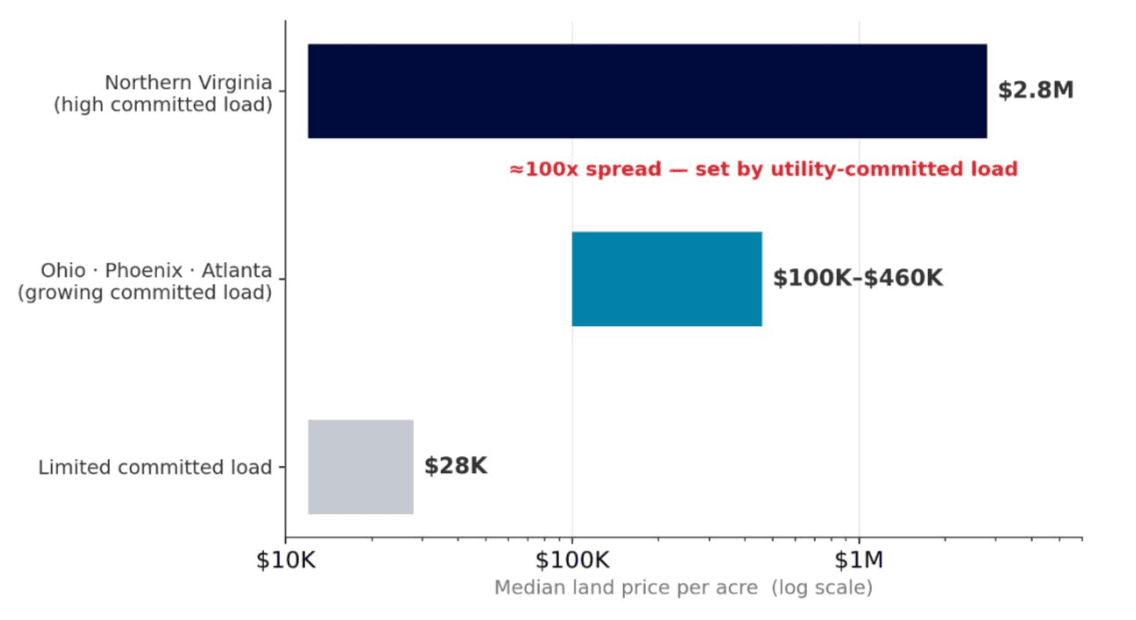
Based on Altus Group’s review of 80 US data center land transactions, land pricing varies significantly depending on power availability
Powered land requires both a grid interconnection agreement and a power purchase agreement, and transferability of these agreements directly affects deal valuation
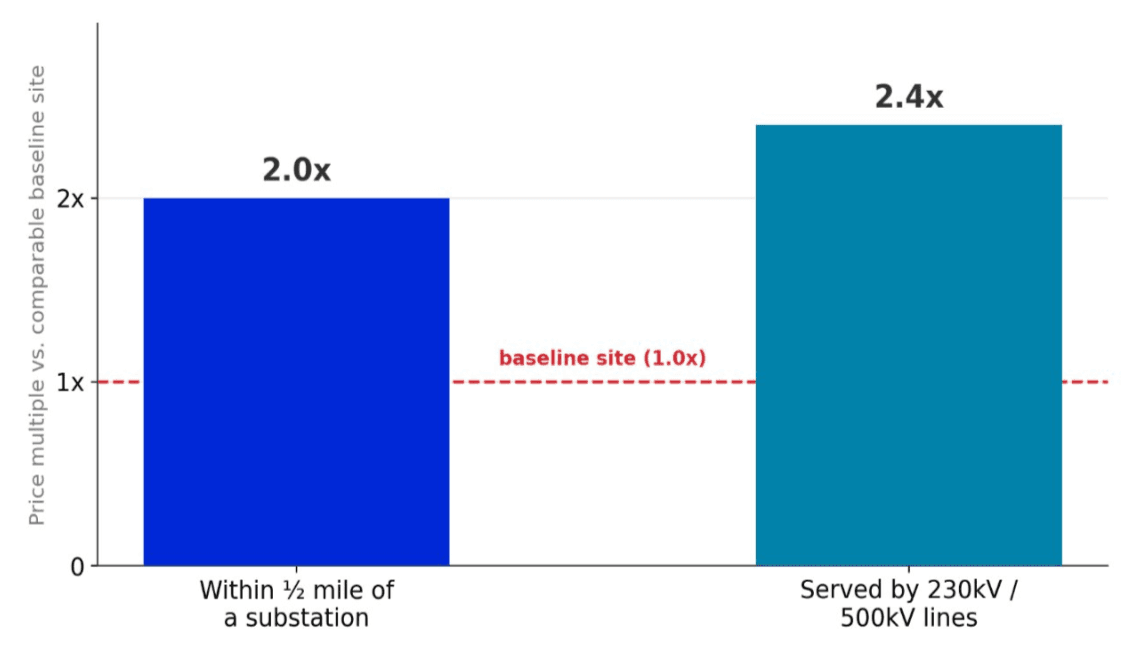
Infrastructure proximity multiplies land value: sites near substations price at 2x baseline, and those served by high-voltage transmission lines price at 2.4x
Interconnection timelines now stretch 7-10 years in many markets, forcing developers toward hybrid power systems that combine onsite generation with grid connections to move projects forward
Altus Group's review of 80 data center land transactions across the US, stratified by how much deliverable power utilities have committed in each market, shows how wide the gap has become. Where committed load is limited, land traded at a median of about $28,000 per acre. In growing markets with some power availability, prices ranged from roughly $100,000 to $460,000 per acre.
Figure 1: Where value is created (median $/acre)
Source: Altus Valuation Data
Infrastructure proximity adds to the effect. Sites within half a mile of a substation priced at about twice the comparable baseline, and sites served by 230 or 500 kilovolt transmission lines priced at about 2.4 times. Buyers are paying for real, deliverable interconnection, and proximity to major infrastructure is one of the clearest signals that a site can get it.
Figure 2: Infrastructure proximity and voltage data
Source: Altus Group; infrastructure proximity & voltage data via Cliff (premiums vs. otherwise-comparable sites)
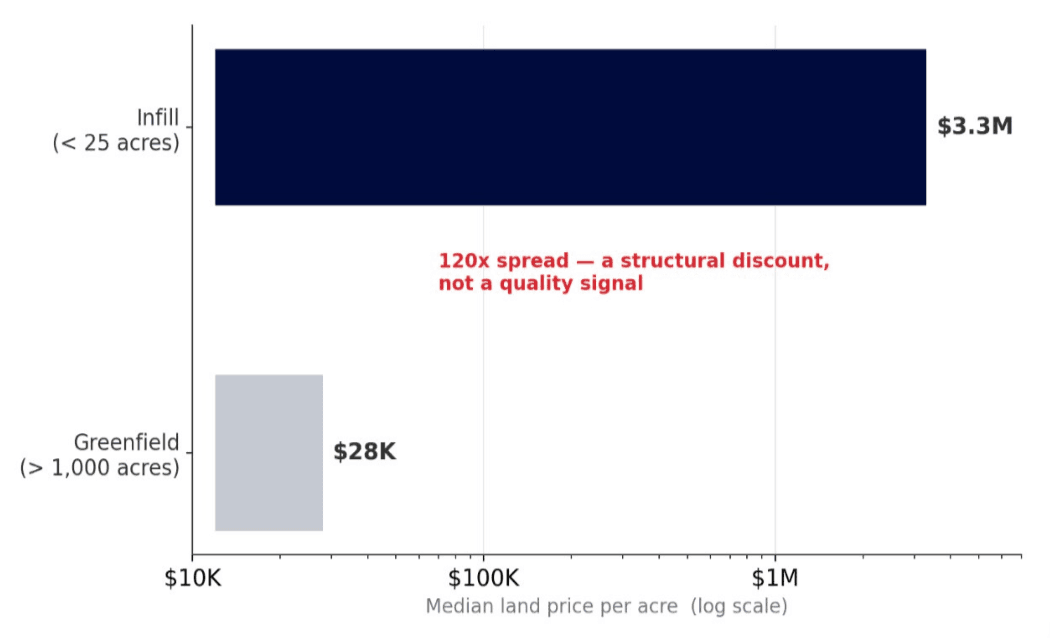
Parcel size needs more care. Small infill parcels under 25 acres priced around $3.3 million per acre, compared with about $28,000 for parcels over 1,000 acres, shown in Figure 3. Most of that gap reflects size, since large parcels cost less per acre, in the same way most things cost less in bulk, so price per acre is only a fair comparison within the same size tier.
Figure 3: Median land price per acre by parcel size
Source: Altus Valuation Data
Note: Per-acre figures are not comparable across size tiers without stratifying first.
These findings were presented in a recent Altus Group webinar on power procurement. Adam Mauro, Altus Director and Market Expert, hosted panelists Andrew Soare, Principal at Blue Owl, and Doug Chambers, Chief Development Officer at Aston Power.
What “powered land” means
For Soare, the definition starts with contracts. “To us, powered land is a contractual right to deliverable megawatts on a known date, not just land near a substation,” he says. “There’s the interconnection agreement, the infrastructure to connect to the grid, and there’s also the power supply, the generation or energy from the grid... Either way, you need both of these components.”
Each agreement covers a different risk. The grid connection agreement provides the right to connect and a timeline to capacity, but it doesn’t guarantee supply or price stability. The power purchase agreement locks in supply and economics, but only applies once power is received.
Transferability matters too. According to Soare, whether those agreements can move to a new owner often depends on the counterparty’s credit requirements and any approvals needed from a public utility commission or the utility itself, and Blue Owl makes transferability a condition of closing. Power alone also doesn’t justify a premium. The firm needs line of sight into state and local support, zoning and entitlements, local infrastructure, and whether the location will appeal to its hyperscale tenants.
Chambers adds that the definition has broadened. A powered site today is defined by its full power system, including onsite generation, battery storage, and the power ramp, along with the grid connection.
Why timelines matter as much as capacity
According to Chambers, many interconnection queues can now be a decade long. On one Aston Power project in Arizona, the local utility estimated seven to ten years to deliver a grid connection and the generation needed to support the load request.
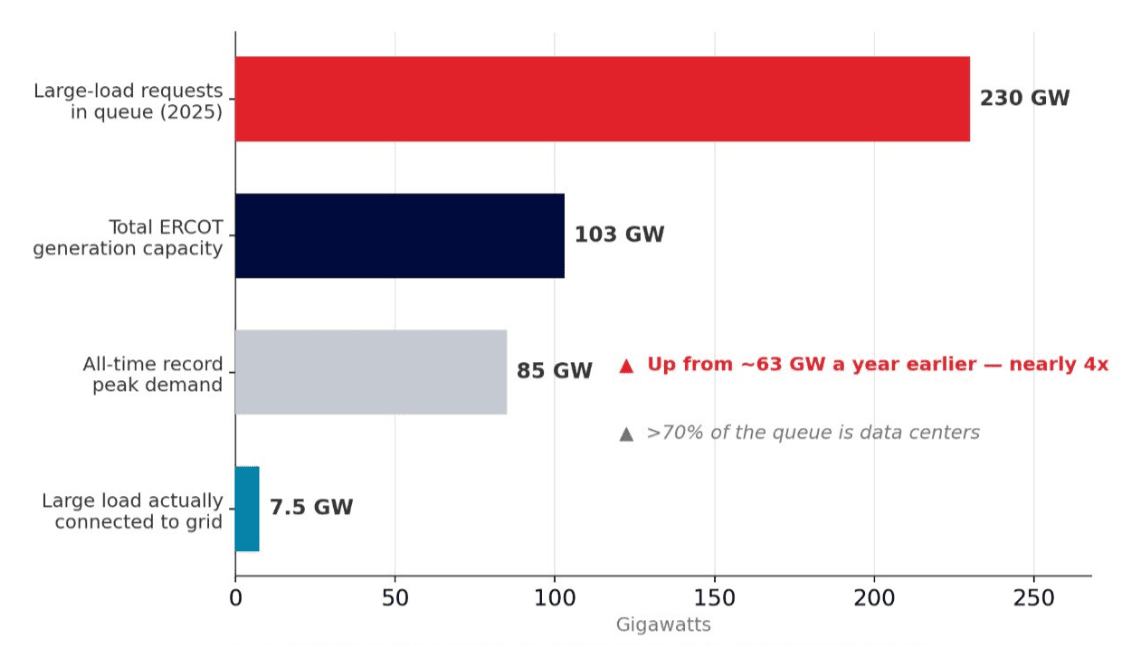
The demand behind those queues is enormous, though not all of it is real. ERCOT’s 2025 queue includes around 230 gigawatts of large load requests, more than double the grid’s entire 103 gigawatt generation fleet, and well above its all-time peak of 85 gigawatts. Only about 7.5 gigawatts has actually connected.
Figure 4: ERCOT’s large-load queue is now bigger than the grid
Source: ERCOT System Planning update, Dec 2025 board materials (Via Utility Dive, Latitude Media)
Soare expects much of that to fall away. “There’s double counting, and there’s triple counting,” he says. “It’s very similar to what happened in the renewables industry, where developers flooded the interconnection queue with many projects, but in reality, not all of these projects were built.” As states and grids make large load interconnection more expensive, he expects the projects that advance to be those with the right locations, entitlements, and community support, backed by experienced, well-capitalized developers.
The studies are where timelines tend to slip. “When you put in a large load request, typically what happens first is a system impact study,” Chambers explains, “and even those system impact studies over the last couple of years have been delayed for months, if not years.” A facility study follows, telling the developer what grid upgrades will cost, how long they’ll take, and whether they’re possible at all. Batch reviews, part of SB6 in ERCOT and being adopted elsewhere, aim to speed up the process, but the volume of requests remains significant.
Hybrid power is becoming the default
With grid timelines this long, Chambers says most large sites now need a hybrid approach. “You likely need onsite generation plus a grid connection to actually make things work in a timeframe that makes any sense,” he says.
On the Arizona project, Aston combined significant onsite generation with a direct connection to federal transmission infrastructure operated by Western Area Power Administration (WAPA). “We can purchase power and port those electrons to the site, combine those electrons with the electrons that we will generate onsite, and effectively provide a utility-like service to the end user,” Chambers says.
Regulation is pushing in the same direction. Chambers points to SB6 in Texas, which he describes as still somewhat in flux, under which large loads are effectively expected to build onsite generation, and the amount of onsite capacity they build is the amount they can be curtailed from the grid during emergencies. “More and more we’re seeing utilities that will effectively demand that you have onsite generation because they will curtail you,” he says. “We expect to see that sort of all over the place.”
Soare sees the grid as the long-term path. “Our priority is grid connected projects. The grid is the most resilient and cost-effective path to serve these large load projects, and it provides the best access to clean energy,” he says. Blue Owl invests in behind-the-meter generation when benefits like a faster ramp or protection against curtailment outweigh the added cost, with the expectation that it will eventually be grid connected.
The underwriting reset
For investors, power now sits at the center of site selection. “Understanding the timelines, the power ramp, the costs, the risk, what infrastructure is needed on the grid, both from a transmission and generation perspective, what the contractual terms look like,” Soare says. “All of these are essential to understand the power piece of the equation.” Blue Owl dedicates 12 months or more to pre-development, structuring utility agreements and community partnerships and planning a multi-phase approach, so it isn’t simply holding land and waiting for power.
Underwriting powered land now means accounting for study delays, queue positioning, regulatory change, and the cost and timeline of hybrid power, alongside the fundamentals that have always mattered. Site selection has become as much an infrastructure negotiation as a land deal. A $28,000-per-acre parcel in a power-constrained market may be inexpensive land, but it won’t become an investable opportunity until the power story is solved.
Watch the full webinar to hear Soare and Chambers walk through grid connection agreements, system impact studies, transferability, and how to assess power certainty in deal underwriting.
Want to be notified of our new and relevant CRE content, articles and events?
Disclaimer
This publication has been prepared for general guidance on matters of interest only and does not constitute professional advice or services of Altus Group, its affiliates and its related entities (collectively “Altus Group”). You should not act upon the information contained in this publication without obtaining specific professional advice.
A number of factors may influence the performance of the commercial real estate market, including regulatory conditions and economic factors such as interest rate fluctuations, inflation, changing investor sentiment, and shifts in tenant demand or occupancy trends. We strongly recommend that you consult with a qualified professional to assess how these and other market dynamics may impact your investment strategy, underwriting assumptions, asset valuations, and overall portfolio performance.
No representation or warranty (express or implied) is given as to the accuracy, completeness or reliability of the information contained in this publication, or the suitability of the information for a particular purpose. To the extent permitted by law, Altus Group does not accept or assume any liability, responsibility or duty of care for any consequences of you or anyone else acting, or refraining to act, in reliance on the information contained in this publication or for any decision based on it. The distribution of this publication to you does not create, extend or revive a client relationship between Altus Group and you or any other person or entity. This publication, or any part thereof, may not be reproduced or distributed in any form for any purpose without the express written consent of Altus Group.
Authors

Adam Mauro, CFA
Director, Valuation Advisory, Altus Group

Doug Chambers
Chief Development Officer

Andrew Soare
Principal
Authors
Adam Mauro, CFA
Director, Valuation Advisory, Altus Group
Doug Chambers
Chief Development Officer
Andrew Soare
Principal
Access data-powered valuation advisory services
Leverage our market expertise, leading ARGUS technologies, and unique valuation datasets you need to drive asset performance and manage risk.
Resources
Latest insights