Calgary commercial real estate market update – Q1 2026
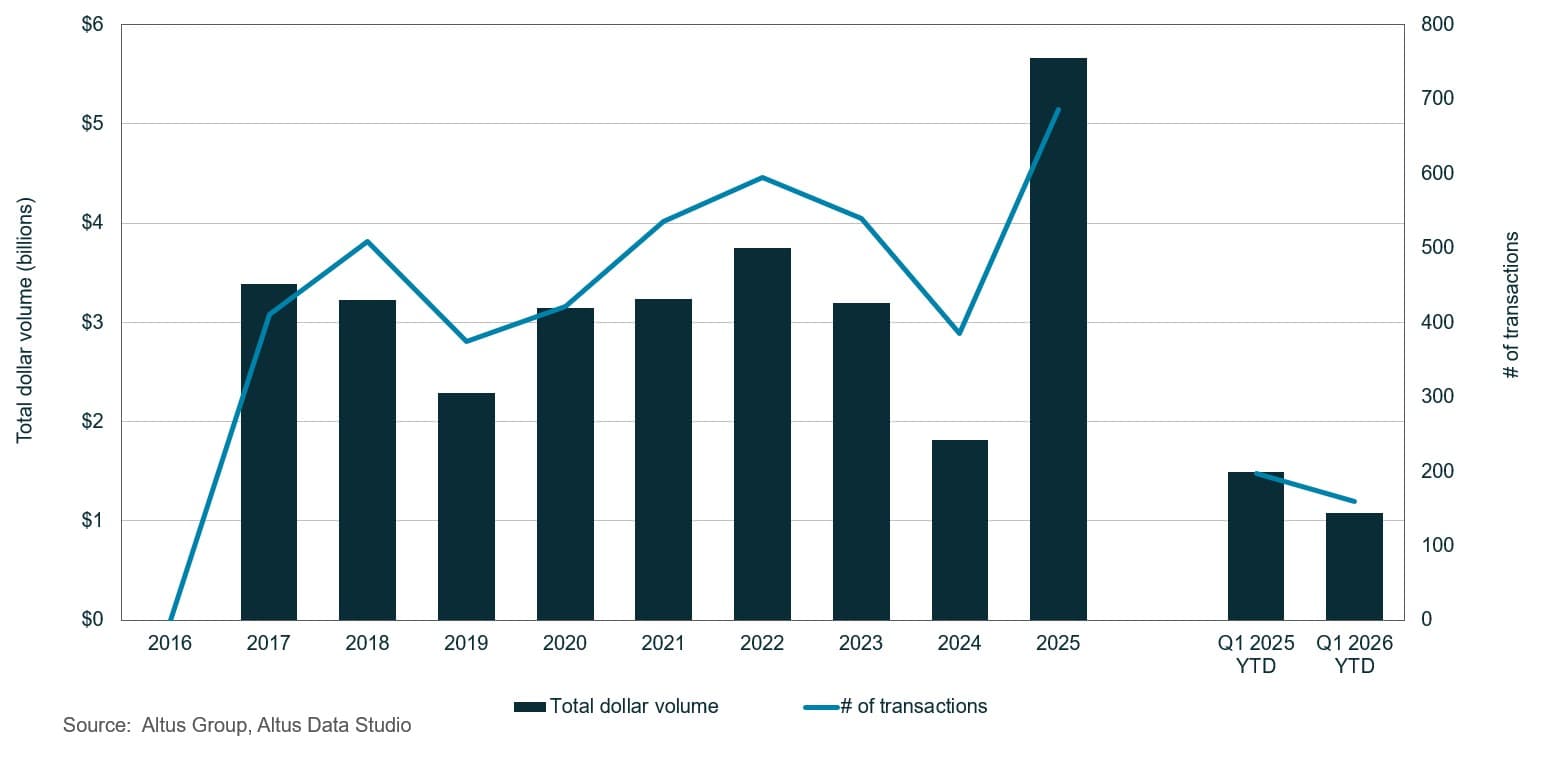
Calgary’s CRE market showed moderated activity in Q1 2026, with nearly $1.1 billion in investment volume, reflecting a slowdown after a strong late 2025 period.
Calgary commercial real estate market update – Q1 2026
Calgary’s CRE market showed moderated activity in Q1 2026, with nearly $1.1 billion in investment volume, reflecting a slowdown after a strong late 2025 period.
Authors

Jennifer Nhieu
Senior Research Analyst

Nhu Pham
Market Analyst
Key highlights:
Source: Altus Data Studio market data and analysis
By the first quarter of 2026, Calgary recorded nearly $1.1 billion in commercial real estate investment volume, reflecting softer quarterly activity after a strong late-2025 finish
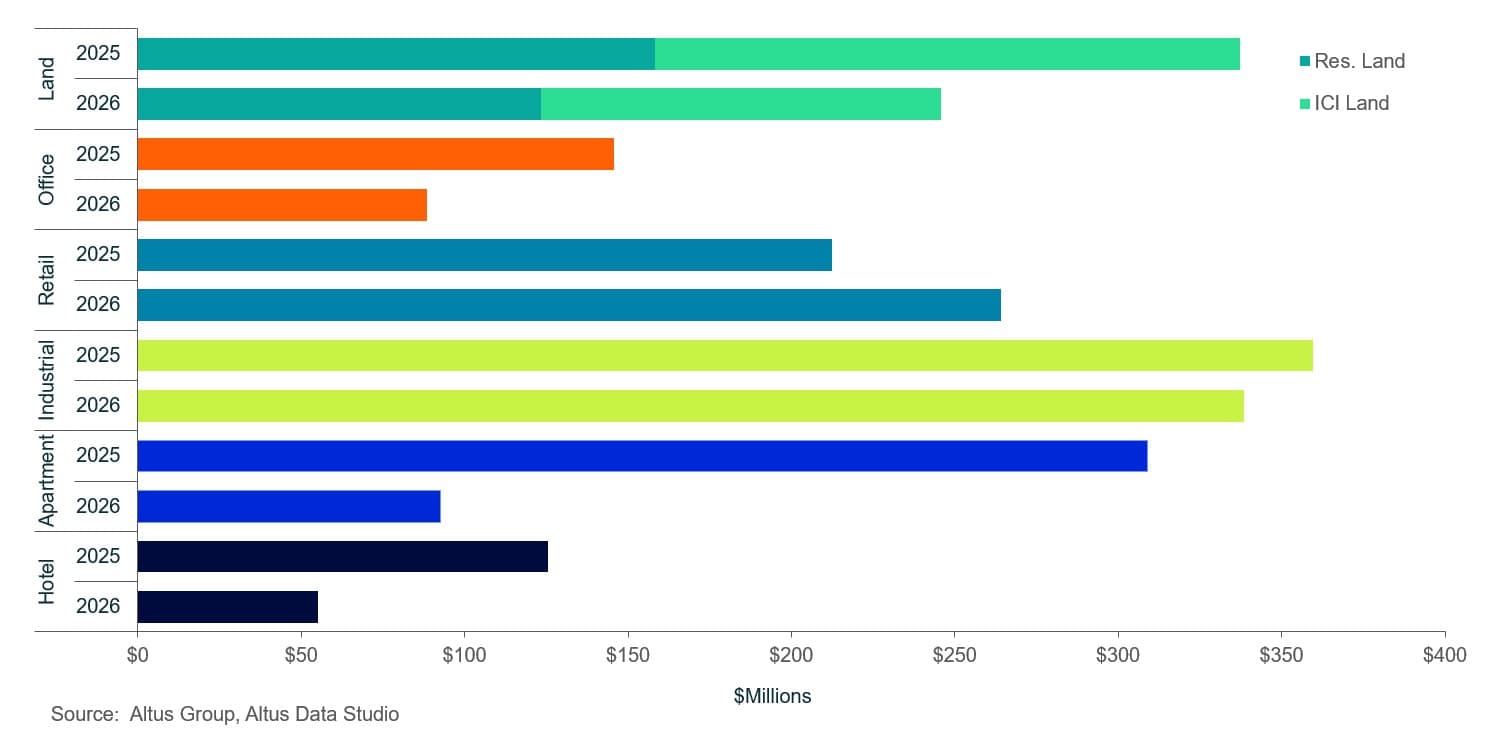
The retail sector saw positive momentum in investment activity, with $264 million in dollar volume transacted, representing a 24% increase year-over-year
The multi-family sector recorded nearly $93 million in dollar volume transacted, a significant 70% decrease year-over-year
In the first quarter of 2026, Calgary’s commercial real estate market moderated after a strong finish to 2025
According to an analysis of transactions based on Altus Data Studio data, in the first quarter of 2026, Calgary’s commercial real estate market recorded nearly $1.1 billion in total investment volume, reflecting a moderation in transaction activity following strong momentum in late 2025. Although quarterly volume declined 27% year-over-year, activity was supported by the market’s relative affordability, population-driven demand, and strategic position as a Western Canadian logistics and business hub. Investors maintained a disciplined approach to capital deployment amid stable but still restrictive financing conditions, trade uncertainty, and uneven national economic growth. Against this backdrop, Calgary’s market entered 2026 with resilient underlying fundamentals, though performance continued to vary by asset class as capital gravitated toward well-located, income-producing assets with durable demand drivers.
Figure 1: Calgary property transactions - All sectors by year
Macroeconomic drivers and geopolitical considerations
Calgary’s market stability in the first quarter of 2026 was supported by safeguards under the Canada-United States-Mexico Agreement (CUSMA), which helped reduce exposure to volatility from U.S. trade protectionism, particularly in the energy and emerging technology sectors. While sentiment remained cautious ahead of CUSMA’s mandatory 2026 joint review, Calgary’s core fundamentals continued to appeal to market participants who had largely accounted for these geopolitical risks by the start of the year.
National monetary policy and economic conditions also influenced the local investment climate. Following two consecutive rate cuts in late 2025 that brought the policy interest rate to 2.25%, the Bank of Canada maintained its benchmark rate in March 2026. The decision reflected the central bank's effort to balance sluggish national growth with inflation risks stemming from energy price volatility and ongoing Middle Eastern geopolitical conflicts.
Locally, Calgary’s economic fundamentals demonstrated resilience. According to Statistics Canada’s March 2026 Labour Force Survey, Calgary’s unemployment rate fell by 0.7 percentage points year-over-year to 6.7%, as sustained job creation successfully absorbed ongoing expansion in the local labour force. Furthermore, steady interprovincial migration into Alberta continued to support regional household spending and commercial demand, effectively insulating Calgary from broader national economic headwinds.
Calgary retail investment activity
Calgary’s retail sector recorded $264 million in transaction volume, a 24% increase year-over-year. The gain was largely driven by GWL Realty Advisors’ $133.5 million acquisition of Northland Village, which marked the firm’s largest retail acquisition in more than five years.
An enduring retail trend was demand for neighbourhood food-anchored retail and shopping centres with redevelopment potential. Investors favoured these assets for their defensive characteristics and stable cash flows, while tight financing conditions and the lack of new ground-up development limited new supply. As a result, competition for existing properties intensified, with capital focused on “inflation-resistant” retail formats serving the daily needs of Calgary’s growing population.
A key investment strategy involved adding multi-residential towers to existing shopping centre sites. While historically Albertans have preferred single-family homes on the city’s spacious suburban outskirts, strong population growth and shifting demographic preferences are accelerating the acceptance of high-density mixed-use living. Developers capitalized on this shift through major master-planned initiatives like Northland Village, as well as developments such as Midtown Station, Deerfoot City, Belmont Retail Plaza and Munro Apartments. By converting underused parking surfaces into high-density residential units, owners successfully unlocked land value, created a built-in retail customer base and mitigated investment risk in a supply-constrained market.
Calgary industrial investment activity
Calgary’s industrial sector recorded nearly $339 million in total transaction volume, down a modest 6% year-over-year due in part to comparison against a record-high first quarter in the prior year. Despite the decline, activity remained supported by momentum from 2025 and Calgary’s role as a leading inland port and Western Canadian distribution hub.
The robust demand for industrial space was evidenced by market data from Altus Group’s Data Studio, indicating Calgary’s industrial availability rate decreased by 150 basis points (bps) year-over-year, settling at 5.3% by the first quarter of 2026. This downward trajectory in availability created persistent upward pressure on net rental rates as the competition for modern logistics space intensified.
On the development front, the market saw the delivery of two new industrial buildings, totalling approximately 125,000 square feet, with only 25% of the space available for lease. By the end of the first quarter, the development pipeline remained robust, with 13 industrial buildings under construction. This future inventory totalled nearly 2.2 million square feet, of which 63% remained available for lease. Despite broader macroeconomic headwinds, Calgary continued to see strong speculative development activity. Developer confidence remained high, supported by the market’s long-term fundamentals and the city’s expanding role in the national supply chain.
Calgary multi-family investment activity
The multi-family sector experienced a notable contraction in investment volume, with total transactions amounting to approximately $93 million, a significant 70% decrease year-over-year. The steep contraction was driven by the compounding friction of recent regulatory changes, localized supply dynamics and a strong comparison baseline from early 2025.
On the policy front, tighter CMHC insurance qualification criteria, higher risk-based premium surcharges under the MLI Select framework and stricter debt service coverage requirements, compounded by Advice 268 guidance mandating fully executed leases prior to loan close, substantially increased equity requirements and compressed initial yield projections. Locally, a substantial wave of post-pandemic rental completions reached the market in early 2026, pushing vacancy higher and slowing rent growth in newly delivered assets.
This environment contrasted sharply with the elevated baseline of the first quarter of 2025, which was anchored by significant institutional capital deployment following a landmark year in 2024, alongside a rush to lock in maximum leverage before the CMHC’s mid-2025 program overhauls and peak interprovincial migration sentiment.
Calgary office investment activity
Calgary’s office sector recorded nearly $88 million in investment volume in the first quarter, a 39% year-over-year decline. Overall leasing performance was marked by a pronounced bifurcation, as capital and tenants overwhelmingly prioritized high-quality, amenity-rich Class A space over aging, un-amenitized inventory. Leasing data in the first quarter further illustrated this trend, with Class A transactions comprising 20 deals totalling nearly 703,000 square feet. In contrast, Class B transactions accounted for only seven deals and approximately 109,000 square feet, highlighting the growing functional obsolescence of buildings that failed to meet modern corporate standards. In response, property owners increasingly allocated capital to strategic building revitalizations to preserve competitiveness and combat obsolescence.
This flight to quality created a compelling market juxtaposition between the downtown core and suburban submarkets. While downtown availability rose 180 bps year-over-year to 24.4% despite continued rightsizing efforts, suburban and Beltline office space saw robust leasing demand, tightening availability by 440 bps year-over-year to 11.7%. In spite of broader downtown corporate contraction, suburban space demonstrated a distinct, enduring purpose by catering to price- and location-sensitive, user-driven sectors, such as healthcare, education and localized professional services, that prioritize regional accessibility, abundant surface parking and direct proximity to Calgary’s expanding suburban labour pools.
Market stabilization was further bolstered by municipal policy initiatives, specifically the City of Calgary’s Downtown Development Incentive program and the Housing Accelerator Fund. By March 2026, 21 office-to-residential conversion projects were approved, positioning 2.68 million square feet of underutilized office space for permanent removal from the commercial inventory and conversion into over 2,600 residential units. Combined with disciplined supply control, highlighted by zero new office completions and deferred construction on projects such as Westwind Business Campus III, these structural conversions helped lower overall office availability toward 19.6% by the first quarter, guiding the broader market toward a healthier long-term equilibrium.
Calgary land investment activity
Investment activity in the land sector, including residential and ICI land, contracted in the first quarter. Total transaction volume reached nearly $246 million, down 27% year-over-year, as developers and investors adopted a more cautious approach amid tighter financing conditions, trade uncertainty, shifting macroeconomic conditions and evolving federal immigration targets that softened long-term demand expectations.
Residential land volume declined 22% year-over-year to $123 million, as buyers became more cautious amid uncertainty around Calgary’s citywide upzoning framework. With the CMHC warning that a reversal could affect Housing Accelerator Fund allocations, infill and site-assembly buyers faced greater entitlement risk. The possibility of returning to longer parcel-by-parcel rezoning processes led some developers to delay acquisitions or apply larger risk discounts to prospective residential sites.
ICI land volume totalled approximately $122 million, down 32% year-over-year. While end-user demand for industrial space remained structurally sound, acquisition momentum slowed as local development costs and timelines became more challenging. Rising municipal off-site utility levies, reintroduced pre-application fees and extended permitting timelines increased upfront servicing costs and carrying expenses. In response, institutional developers deferred some speculative site acquisitions and focused instead on phased infrastructure commitments on existing land holdings and pre-leased projects.
Figure 2: Calgary property transactions by asset class (Q1 2025 vs. Q1 2026)
Notable Calgary property transactions
The following are the notable transactions for the Q1 2026 Calgary commercial real estate market update:
25 Clydesdale Avenue (Riverview Pointe) – Apartment
Riverview Pointe, a 209-unit multi-family complex located at 25 Clydesdale Avenue in Cochrane, was acquired by Federico Berloni, president of Montréal-based Ferrovia Capital, from Carlisle Group for approximately $67 million. The transaction represented a price of roughly $322,500 per unit and was completed through an off-market process brokered by Marcus & Millichap's IPA Division. The sale was the largest multi-family transaction recorded in Cochrane in the previous three years.
Completed in 2024, Riverview Pointe comprised three four-storey residential buildings situated near the Cochrane RCMP detachment and Mountain Ridge Plaza. The development offered a mix of one-, two-, and three-bedroom suites, along with amenities including a fitness centre, in-suite laundry, and indoor parking. The property carried a capitalization rate of approximately 5.0% and represented one of the few recently completed purpose-built rental developments in the community.
The acquisition expanded Ferrovia Capital's Alberta multi-family portfolio and reflected continued investor interest in newer rental assets within Calgary's surrounding growth markets.
5111 & 5235 Northland Drive NW (Northland Village Shopping Centre)– Retail
Northland Village and Northland Professional Centre in northwest Calgary sold for $154 million in December 2025, representing Calgary's largest retail investment transaction in more than five years. The 31.81-acre property was acquired by GWL Realty Advisors, an affiliate of Canada Life, at a reported capitalization rate of 6.25%.
The offering included the 383,000-square-foot Northland Village retail centre and the approximately 52,000-square-foot Northland Professional Centre located at 4600 Crowchild Trail NW. At the time of sale, the retail component was fully occupied and anchored by Walmart, Best Buy, Winners, and Dollarama. The professional centre was approximately 82% occupied, with existing leasing commitments expected to bring occupancy close to full capacity.
The asset featured a weighted average remaining lease term of approximately 7.5 years and an average in-place minimum net rent of $24.10 per square foot. Following a major $119 million redevelopment that transformed the former enclosed mall into an open-air shopping centre, the property offered significant long-term intensification and mixed-use redevelopment potential.
170 and 175 Glendeer Circle SE – Retail
Two Calgary automotive dealership properties located at 170 and 175 Glendeer Circle SE were included in a $287 million sale-leaseback portfolio transaction between Go Auto and New York-based REIT W. P. Carey. The portfolio comprised 14 automotive dealership properties across British Columbia, Alberta, and Manitoba, totalling approximately 574,854 square feet.
The Calgary assets comprised a 26,000-square-foot dealership at 170 Glendeer Circle SE and an 8,385-square-foot dealership at 175 Glendeer Circle SE. As part of the transaction, the properties were leased back to Go Auto under a 25-year triple-net lease agreement that included annual CPI-based rent escalations. According to W. P. Carey, the portfolio included several of Go Auto's highest-performing locations, situated along major commercial corridors.
The transaction enabled Go Auto to unlock capital tied to its real estate holdings and reinvest the proceeds into its operating business. The acquisition further expanded W. P. Carey's Canadian portfolio and reflected continued institutional investor interest in automotive dealership real estate supported by long-term tenancy and stable income streams.
Looking ahead
As the first quarter of 2026 concluded, investor sentiment across Calgary’s commercial real estate market shifted from initial regulatory disruption toward measured discipline and selective re-entry. While the market’s long-term economic fundamentals remained intact, total investment activity moderated from prior peak levels, signalling a slower transaction environment likely to persist through the first half of the year.
Looking ahead to the remainder of 2026, market participants are expected to continue navigating elevated borrowing costs and evolving market conditions. Capital allocation has shifted away from aggressive expansion toward risk mitigation, with buyers prioritizing defensively positioned, cash-flow-generating assets over speculative commitments. As investors adapt to recent policy changes and the market absorbs active pipeline inventory, improved visibility should support a more stable investment environment and a gradual rebuilding of confidence in the second half of the year.
Want to be notified of our new and relevant CRE content, articles and events?
Disclaimer
This publication has been prepared for general guidance on matters of interest only and does not constitute professional advice or services of Altus Group, its affiliates and its related entities (collectively “Altus Group”). You should not act upon the information contained in this publication without obtaining specific professional advice.
A number of factors may influence the performance of the commercial real estate market, including regulatory conditions and economic factors such as interest rate fluctuations, inflation, changing investor sentiment, and shifts in tenant demand or occupancy trends. We strongly recommend that you consult with a qualified professional to assess how these and other market dynamics may impact your investment strategy, underwriting assumptions, asset valuations, and overall portfolio performance.
No representation or warranty (express or implied) is given as to the accuracy, completeness or reliability of the information contained in this publication, or the suitability of the information for a particular purpose. To the extent permitted by law, Altus Group does not accept or assume any liability, responsibility or duty of care for any consequences of you or anyone else acting, or refraining to act, in reliance on the information contained in this publication or for any decision based on it. The distribution of this publication to you does not create, extend or revive a client relationship between Altus Group and you or any other person or entity. This publication, or any part thereof, may not be reproduced or distributed in any form for any purpose without the express written consent of Altus Group.
Authors
Jennifer Nhieu
Senior Research Analyst
Nhu Pham
Market Analyst
Resources
Latest insights