Altus Data Studio for Developers
De-risk every stage, from site to sell-out or stabilization
Development feasibility depends on understanding competitive pipeline, market absorption, and supply dynamics before committing capital to site assessment. Most developers piece together pipeline data from public records and market estimates. Data Studio consolidates development applications, comparable sales, and real-time vacancy data so you can assess opportunities and competitive risk with confidence.
Development application monitoring across Toronto and Vancouver. Track what's in the pipeline by submarket and project type
Transaction data for comparable land and building sales, reviewed by local market experts
Commercial listings data for current vacancy and supply conditions in your target submarket

The problem
You can't assess a site if you can't see the pipeline
Making good development decisions requires knowing what's already in motion in a submarket, competing projects in the approval process, recent land sales, and current supply conditions. Most of that information is hard to access in one place.

Competing projects aren't visible until they're announced
By the time a competing development is publicly announced, it may already be deep in the approvals process. Without visibility into application activity, you're making pipeline density assessments from incomplete information.

Land and building comparables are hard to verify
Informal market knowledge and broker relationships give you some indication of what sites have sold for but that's not the same as verified transaction data you can put into a feasibility model with confidence.

Monitoring multiple submarkets is manual work
Tracking pipeline activity across different submarkets, or across Toronto and Vancouver simultaneously, typically means maintaining your own tracking systems fed by fragmented public sources.
How it helps developers
Three capabilities for smarter site decisions
Each one addresses a specific decision point in a developer's assessment process, from pipeline review to feasibility preparation.
01
Development application monitoring
Track application activity in Greater Toronto and Greater Vancouver by submarket and project type. See what's been submitted, what's under review, and how pipeline density has changed over time in your target areas. Available in the development applications catalog.
WORKFLOW MOMENT
Pre-feasibility pipeline assessment, understanding competing project density before committing to site evaluation spend
02
Comparable land and building sales
Search the transactions catalog for commercial sales activity near a subject site. Records include details like sale price, price per square foot, product type, and building size, and where available, cap rate and financing structure. Useful for grounding site valuations in verified market data.
WORKFLOW MOMENT
Site valuation and feasibility modelling, replacing informal market estimates with verified transaction records
03
Supply and vacancy context
Use the commercial listings catalog to assess current availability and vacancy conditions in a target submarket. Understand what's on the market, at what asking rates, and how much space is available by product type. Useful for assessing demand conditions before committing to a project type.
WORKFLOW MOMENT
Market demand assessment, validating whether the submarket can absorb the proposed product type before feasibility begins
Inside a development application record
What you see in the pipeline catalog
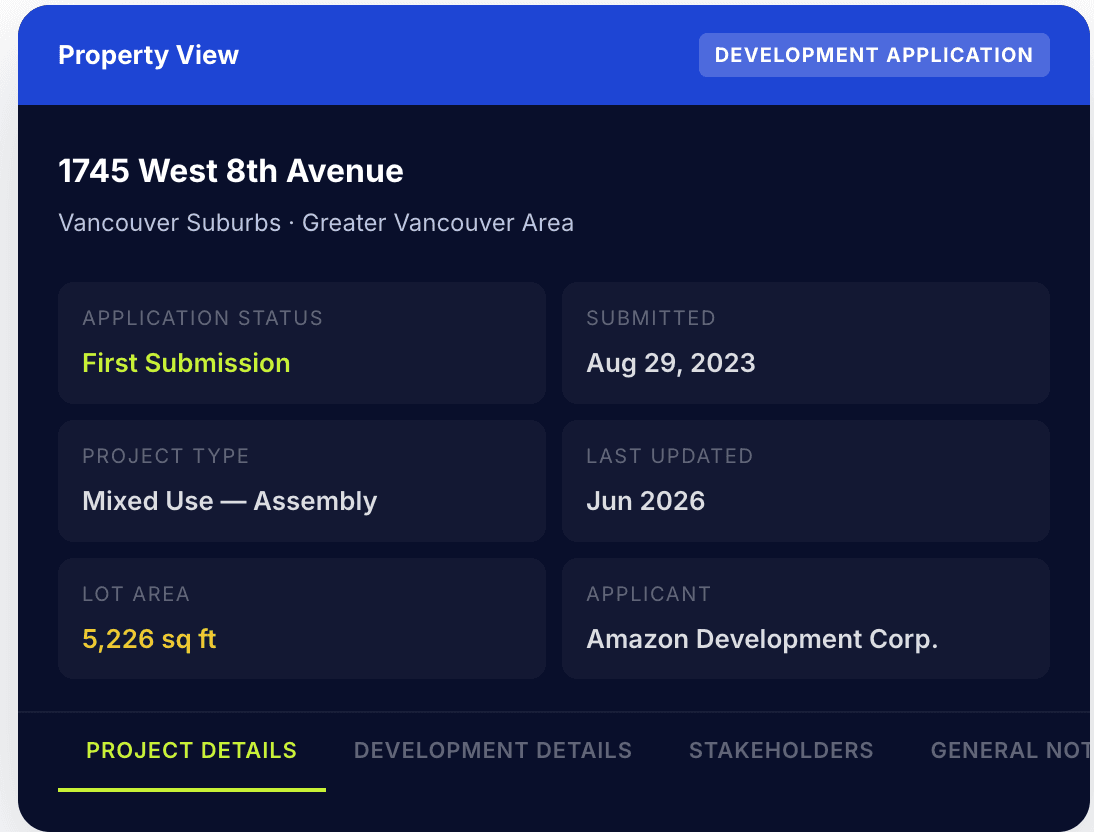
A development application record in Data Studio draws from municipal filing data and is maintained by the Altus research team. Depending on the record, you may find details like:
Property address, market, and submarket
Application status and submission date
Project type (e.g. residential high-rise, mixed use, industrial)
Date last updated
Applicant name (where available)
General summary and project notes (where available)
Market coverage
Where development intelligence is available
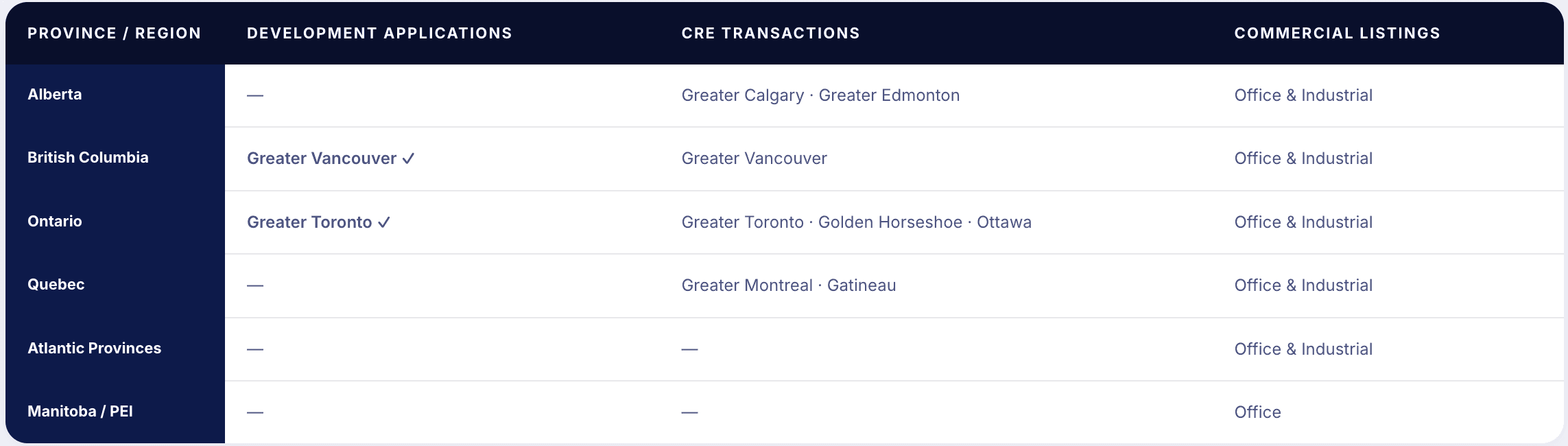
Development application monitoring is currently available in Greater Toronto and Greater Vancouver. Transaction and listings data covers a broader set of Canadian markets.
ℹ️ Development application monitoring is available in Greater Toronto and Greater Vancouver only. If your projects are in other Canadian markets, speak with our team. Transaction and listings data is available more broadly and may still support your site assessment work.
What development teams say
Teams that changed how they assess sites
From organizations already using Altus Data Studio to support development decisions in Canadian markets.
" Having development pipeline data alongside transaction records in one platform changed how our team approaches feasibility. It's not a nice-to-have anymore.

Turner Construction
Construction and development
" Altus Data Studio gives our team the transaction depth we need to advise clients confidently. We're not guessing at market direction, we're showing it with verified data behind every recommendation.

Colliers International
Commercial real estate services, Canada
$45K+
in annual research cost savings reported by customers
50%+
reduction in time spent monitoring competition and market trends
11K+
new home development projects tracked in the platform
How developers use it
From pipeline review to feasibility-ready
A typical site assessment session, from opening the platform to having a market picture for your feasibility brief.
Review pipeline activity
Open the development applications catalog and filter by submarket and project type. See what's been submitted and what's under review in your target area.
Find comparable sales
Switch to the transactions catalog. Filter by location, product type, and date range to find land and building sales near your subject site. Review available pricing and size details.
Assess supply
Open the commercial listings catalog and filter for your target submarket and product type. Review current availability and vacancy to assess how much competing supply is on the market.
Export for your brief
Export the relevant records from each catalog for use in your feasibility brief or internal presentation. Data comes out in a consistent structure across catalogs.
FAQ
Questions developers ask before booking a demo
These are the questions your sales contact will answer in the first call. Answered here so you can assess whether a demo is worth your time.
Which markets have development application data?
What types of development applications are tracked?
How far back does the development application data go?
Can I use transaction and application data together in the same session?
Looking for a different use case?
Data Studio is also built for three other teams in Canadian CRE.
See the pipeline for your target submarkets
Book a demo and we'll walk through the development application data and transaction records available for your markets.