Reonomy sales and loan data update: more history, clearer lenders
Summary
Sales and loan data is only as useful as the story attached to it. Reonomy's latest update connects mortgage and sale records to the right properties, with more thorough history and clearer lenders. We've also given every mortgage and sale a new ID in line with the updated Reonomy Knowledge Graph. If you use these IDs in your own systems, there is a short note below.
What changed
We've rebuilt how Reonomy matches mortgage and sale records to properties, building on the September release of the Reonomy Knowledge Graph enhancements. It is built on a rigorously tested, rebuilt pipeline, with one goal: the right record on the right property.
The update focuses on:
Stronger results for mortgage and sale records
One property, one identity
More mortgage and sale records for active, located properties
Stronger identification of lenders
What you'll notice
1. Stronger results on our test cases
We tested the rebuilt data on deals and loans that were checked against their source records, comparing the new build with the previous one. The rebuilt data delivered stronger results on both mortgage and sale cases.
2. One property, one identity
County records sometimes re-issue a parcel's number, so one property can appear under two IDs. The rebuilt pipeline recognizes the same parcel and merges the duplicates, behind the scenes. For most customers, there is no change in property counts.
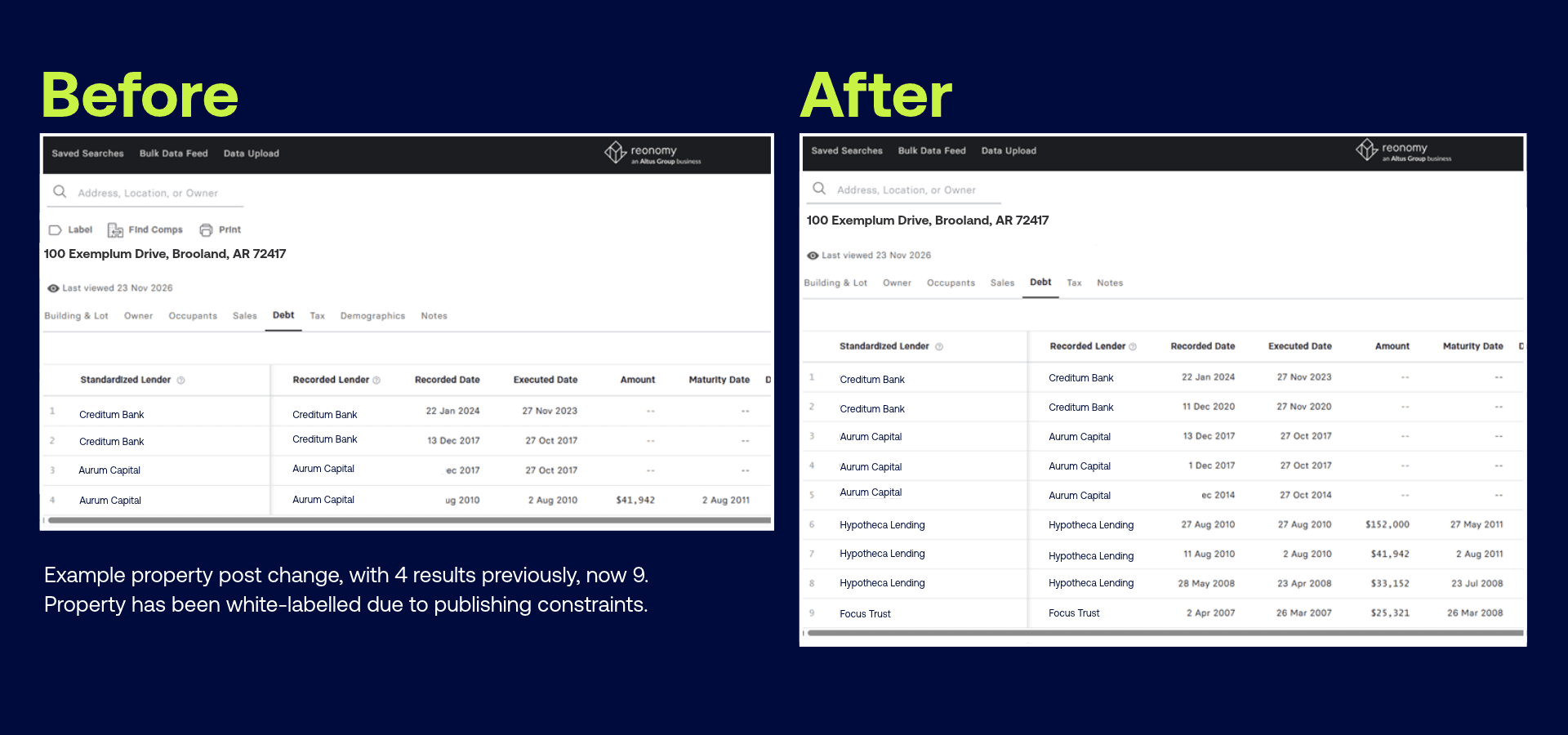
In this example, after a county revised the parcel number, the property's mortgage history grew from 4 mortgages to 9.
The same property, before and after: 4 mortgages (left), 9 mortgages (right).
3. More mortgage and sale records
For active, located properties, mortgage records are up 15.5% and sale records are up 3.3%, giving you more records to work with.
4. Stronger identification of lenders
Mortgage records now identify lenders more clearly, so it is easier to see who is behind a loan.
A fresh set of mortgage and sale IDs
As part of the rebuild, every mortgage and sale in Reonomy now has a new ID, built on the improved connections described above.
Reonomy is property based, so there is no mapping from the old mortgage and sale IDs to the new ones. If you use the API or bulk data feed, or store mortgage and sale IDs in your own systems, you will need to update your references to the new IDs.
Property IDs are largely unaffected: 99.45% of properties keep the same ID.
The API and bulk data feed keep the same overall structure, with a few format updates:
Mortgage interest rates are now shown in thousandths of a percent, so a 6% rate appears as 6000. Some field names in the entity table also change.
Book and page now appear as book/page, replacing the legacy 12-character string.
Unknown sale amounts now show as blank rather than $0, so price-based property searches return only recorded prices.
If you use the API or bulk data feed, you may receive a much larger delta than usual, because underlying company information has been refreshed. However, because the property ID is unchanged, each record is an update to an existing entity, and updates are included rather than charged as additional unique records.
Also new: easier access to the in-app guides
Reonomy's in-app guides walk through each feature, but until now they have been easy to miss. We're making them more accessible by adding them to the Reonomy landing page, so help is there when you need it, without having to hunt for it. You can also open them any time from the Reonomy Discovery Center icon, next to Help Center at the top right.

Visit the Altus support community
Get technical, software and licence support from the community. Ask questions, give answers, submit suggestions and learn more about your software solutions – with your commercial real estate colleagues.
Product releases