Day 2 at Altus Connect: Built for this moment
The Altus Connect product showcase brought the roadmap to life with new ARGUS Intelligence capabilities across the full CRE lifecycle.

Key highlights:
Research leaders from QuadReal and Heitman opened the day with a candid assessment of the market forces reshaping CRE decision-making in 2026
Three new ARGUS Intelligence capabilities were showcased across asset and portfolio workflows: Scenario Simulation, Summary of Assumptions, and Tenant Analytics, each targeting a different source of manual effort
Investment Manager was introduced as a new ARGUS Intelligence capability, replacing the manual lease-to-fund reporting process with a single connected workflow
ARGUS Workbook by Forbury was presented as a hybrid solution bridging purpose-built valuation logic with the flexibility of a connected spreadsheet environment
Debt Manager was introduced, bringing real-time cash flow scheduling, live covenant tracking, and scenario modeling to debt and covenant management
Breakout sessions on Data and AI Governance, Product Use, and AI in the CRE Research Function gave attendees space for candid peer conversation on adoption and decision-grade data
A market in motion
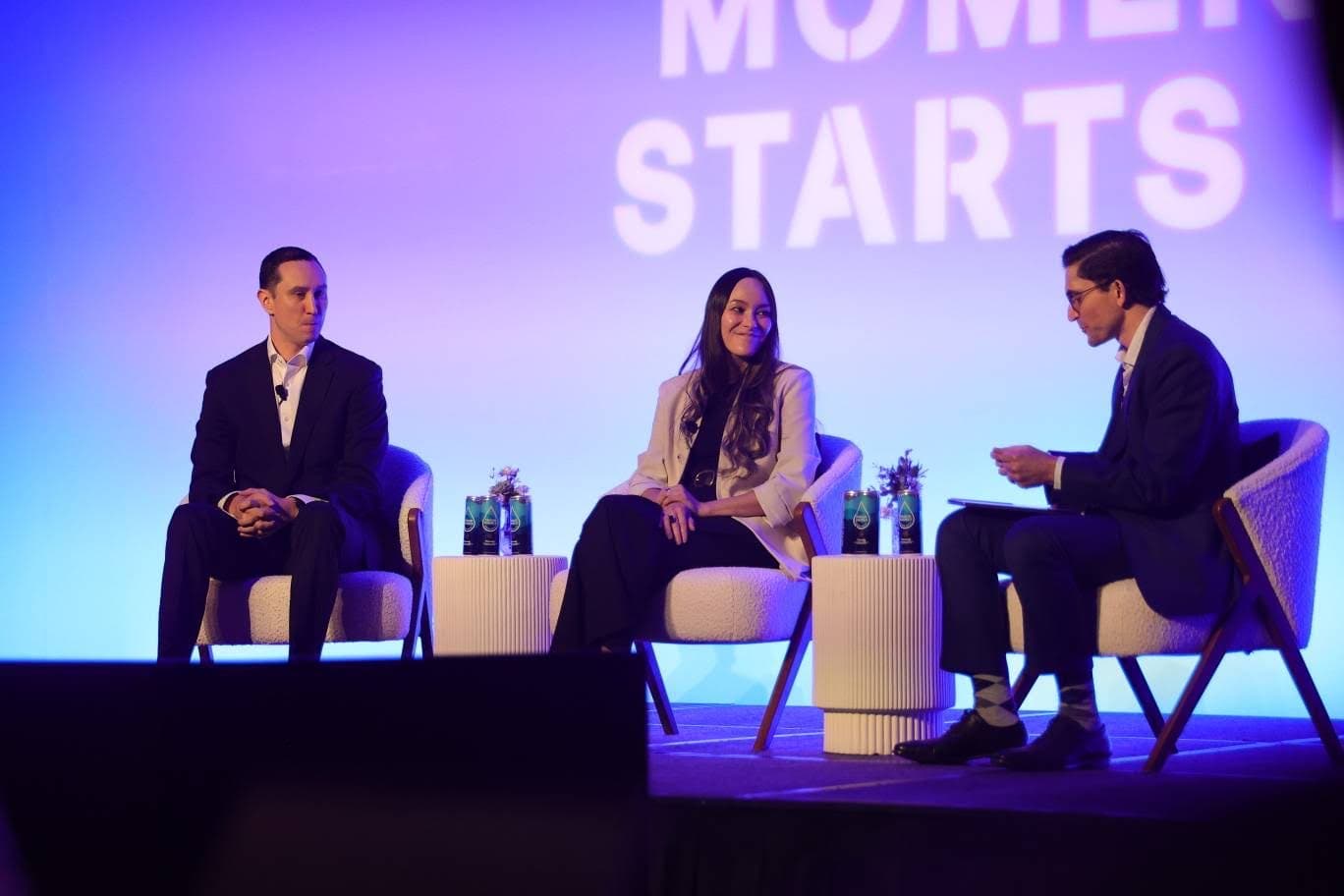
The commercial real estate industry has been navigating near-constant volatility since the pandemic; rate swings, shifting capital, structural change across asset classes, and valuations under greater scrutiny than at any point in recent memory. Wednesday at Altus Connect was a day for addressing that reality directly: first in conversation, then in solutions. The day opened with a market outlook and research panel featuring Shawn Gilligan, SVP of North America Research and Strategy at QuadReal, Emi Adachi, Co-Head of Global Investment Research at Heitman, and moderator Omar Eltorai, Senior Director of Research at Altus, for a forward-looking conversation on the forces shaping CRE decisions in 2026. It provided an appropriate backdrop for the showcase of new capabilities across ARGUS Intelligence that followed; solutions built, in many cases, for exactly the conditions the panel had just described.
Omar Eltorai, Senior Director of Research at Altus, discussing the market outlook with Shawn Gilligan, SVP of North America Research and Strategy at QuadReal, Emi Adachi, Co-Head of Global Investment Research at Heitman
The platform working together
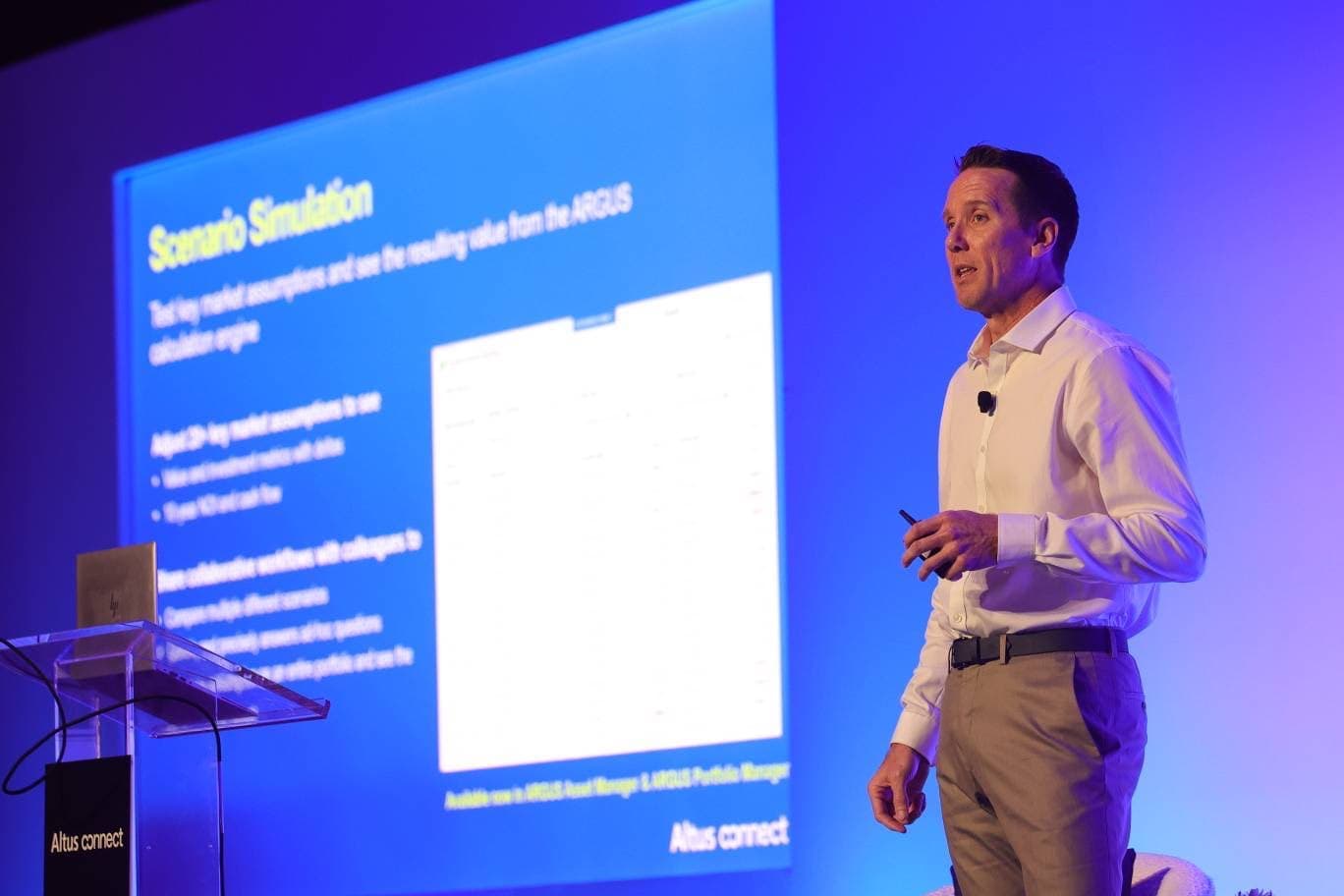
Mark Fitzgerald, Senior Director of Product Management at Altus, took the stage, picking up the thread Mike Gordon and Shubhra Srivastava had started on day 1. The pieces of the ARGUS Intelligence Platform are best-in-class on their own, he noted, but their value compounds the more they're used together.
Fitzgerald walked the room through three pieces of new functionality across the platform's three primary modules: Scenario Simulation in Asset Manager, Summary of Assumptions across asset and portfolio workflows, and Tenant Analytics in Portfolio Manager.
Mark Fitzgerald, Senior Director of Product Management at Altus, shares new functionality across ARGUS Intelligence's core and add-on modules during Altus Connect 2026
The value of the platform compounds the more you use it. The power is in the connections between the modules and the resulting connections within your organization.

Mark Fitzgerald
Director of Product Management
Each demo addressed a different workflow, but they were unified in their ability to reduce the manual effort it takes to get to the insights that teams need to be decisive:
Scenario Simulation drives team-wide accessibility of portfolio-level "what if" modeling, making it possible to run a scenario across an entire portfolio in a few clicks, with the ARGUS calculation engine doing the work in the background
Summary of Assumptions reduces what had been a roughly 35-minute-per-report process for valuation teams to a single click, with side-by-side comparisons available across up to five models at once
Tenant Analytics surfaces tenant concentration risk at scale, standardizing tenant names and rolling up parent-company exposure across portfolios with hundreds of properties and thousands of leases, work that would otherwise take weeks to compile manually
Fitzgerald also offered an update on Benchmark Manager, which has been live for a year and shipping updates every two to three weeks since its launch. Subtype filtering, expanded CBSA coverage, and a significant expansion of the benchmark datasets are all targeted to launch in the coming months.
From asset to fund: Investment Manager
Charlotte Boncour, Product Manager at Altus, introduced Investment Manager, a new component of ARGUS Intelligence, that extends the platform from the asset and property layer up to the fund, the investor, and the LP. The problem it's designed to solve is a familiar one: across most of North American commercial real estate, the process of moving from a lease schedule to a fund-level NAV to an investor statement is still done manually; in uncontrolled and disconnected spreadsheets, over email, through weeks of reconciliation each quarter. Investment Manager is being built to replace that process with a single connected workflow.
Her live demo moved through simple fund vehicle setup, unified asset cash flows with tenant exposure surfaced at the fund level, automated forecasts of cash flow and NAV, real-time KPI monitoring, and scenario planning that updates fund-level NAV, IRR, and LP distributions in real time. The throughline was the same as day 1 of Altus Connect: one platform, one source of truth, every decision traceable to it.
Charlotte Boncour, Product Manager at Altus, introducing Investment Manager during Day 2 of Altus Connect 2026
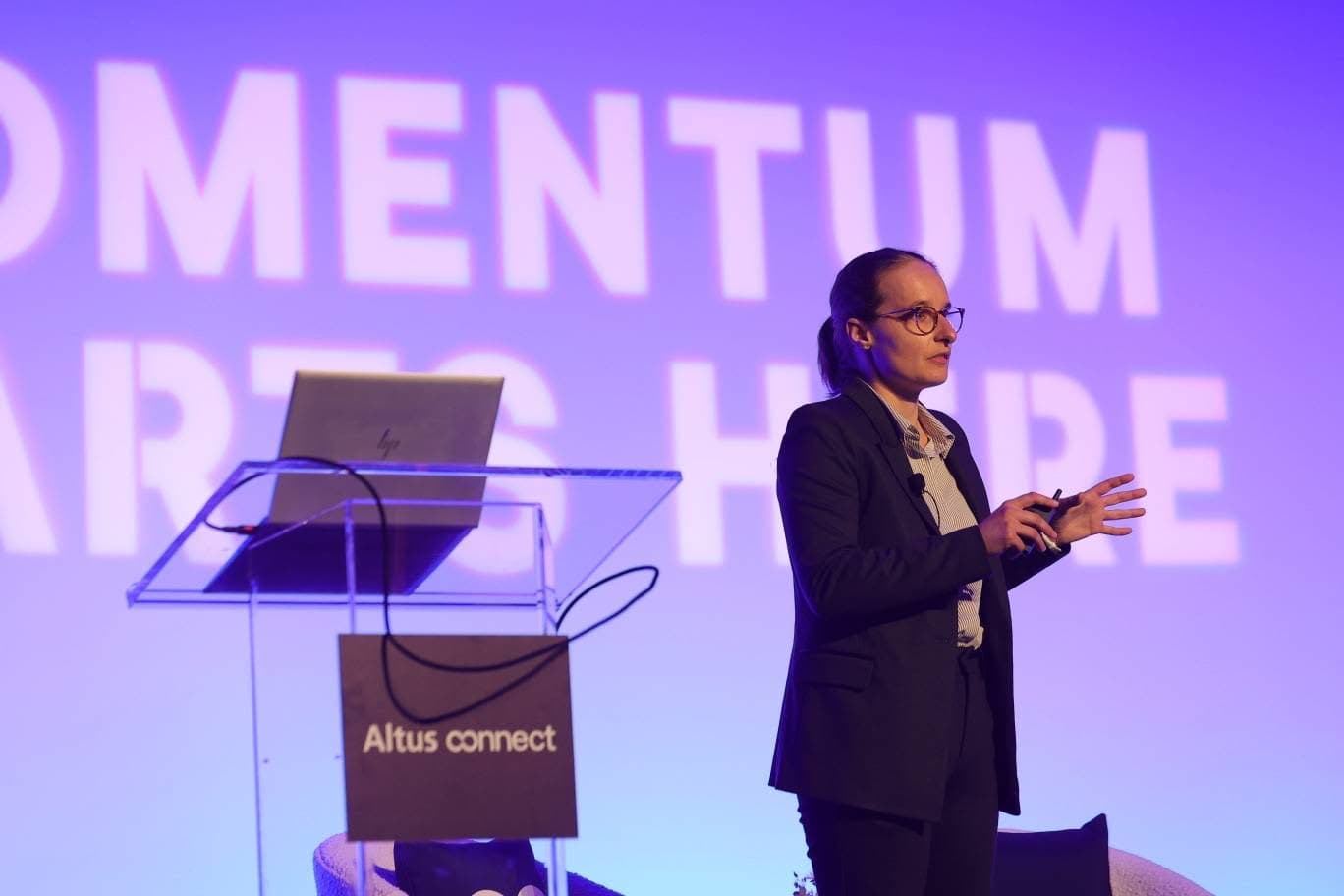
That journey from a lease schedule to a fund-level NAV to an investor statement is entirely manual. It is spreadsheets. It is email. It is weeks of reconciliation every quarter. We are building Investment Manager to change that.
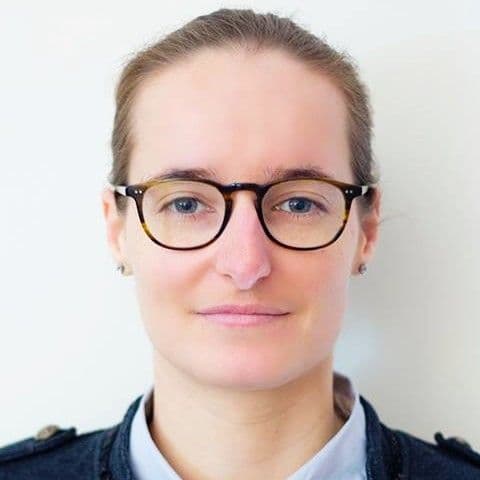
Charlotte Boncour
Senior Business Manager, Altus Group
Acquisition modeling: ARGUS Workbook by Forbury
Cameron Gray, Product Manager at Altus, presented ARGUS Workbook by Forbury (ARGUS Workbook), and for an audience of ARGUS Enterprise users, it brings together two things they’ve long kept in separate tools. ARGUS Enterprise is purpose-built valuation software, and it handles much of what acquisition teams need. But acquisition modeling has a particular demand for speed and flexibility, especially early in a deal when assumptions are still moving. That's where teams tend to reach for a spreadsheet, not because the purpose-built tools aren't good, but because a spreadsheet gives them room to work. That early-stage work happens outside the platform and rarely makes it back in. ARGUS Workbook is designed to close that gap, not by replacing the spreadsheet, but by building purpose-built valuation logic on top of a connected spreadsheet environment. The flexibility stays. The disconnection doesn't. Gray demoed ARGUS Workbook’s multifamily acquisition model live, going from blank workbook to investment-ready output in roughly 15 minutes, and noted that the commercial model for office and industrial is also now available in the US.
Cameron Gray, Product Manager at Altus presents ARGUS Workbook by Forbury at Altus Connect 2026
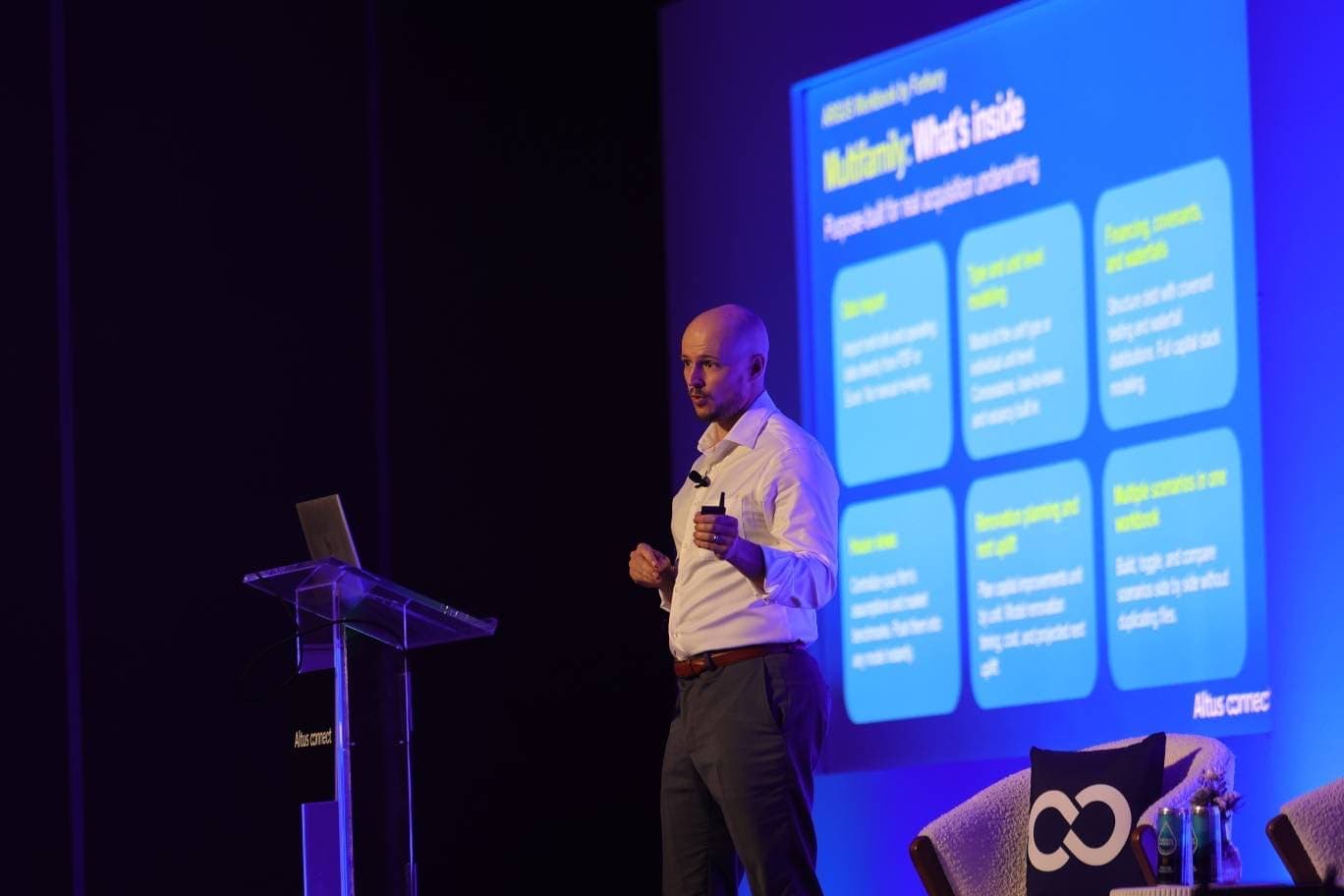
When your complete acquisition model lives inside the platform, you can track against it. Two or three quarters after you close a deal, you can compare against your original underwriting to identify exactly where the assumptions deviated from reality. That's the lifecycle value of having your modeling connected to the platform from day one.

Cameron Gray
Product Manager
Bringing debt into the platform: Debt Manager
Jean-Sebastien Py, General Manager and Senior Director of Commercial Strategy and Debt at Altus, closed the showcase with Debt Manager: built on Fairways Debt, the European market leader in debt and covenant management, being brought into the ARGUS Intelligence platform.
Where debt management has traditionally relied on approximations and spreadsheets, Debt Manager delivers exact, real-time cash flow schedules that recalculate whenever an index shifts or a spread changes. Covenants are tracked live and forward-looking, with scenarios applied directly against covenant calculations to flag a potential breach if rates move. And refinancing strategies, hedging plans, and interest rate stress tests can be modeled in near real time while preserving the integrity of the underlying loan data.
Jean-Sebastien Py, Genearl Manager and Senior Director of Commercial Strategy and Debt at Altus, showcases Debt Manager at Altus Connect 2026
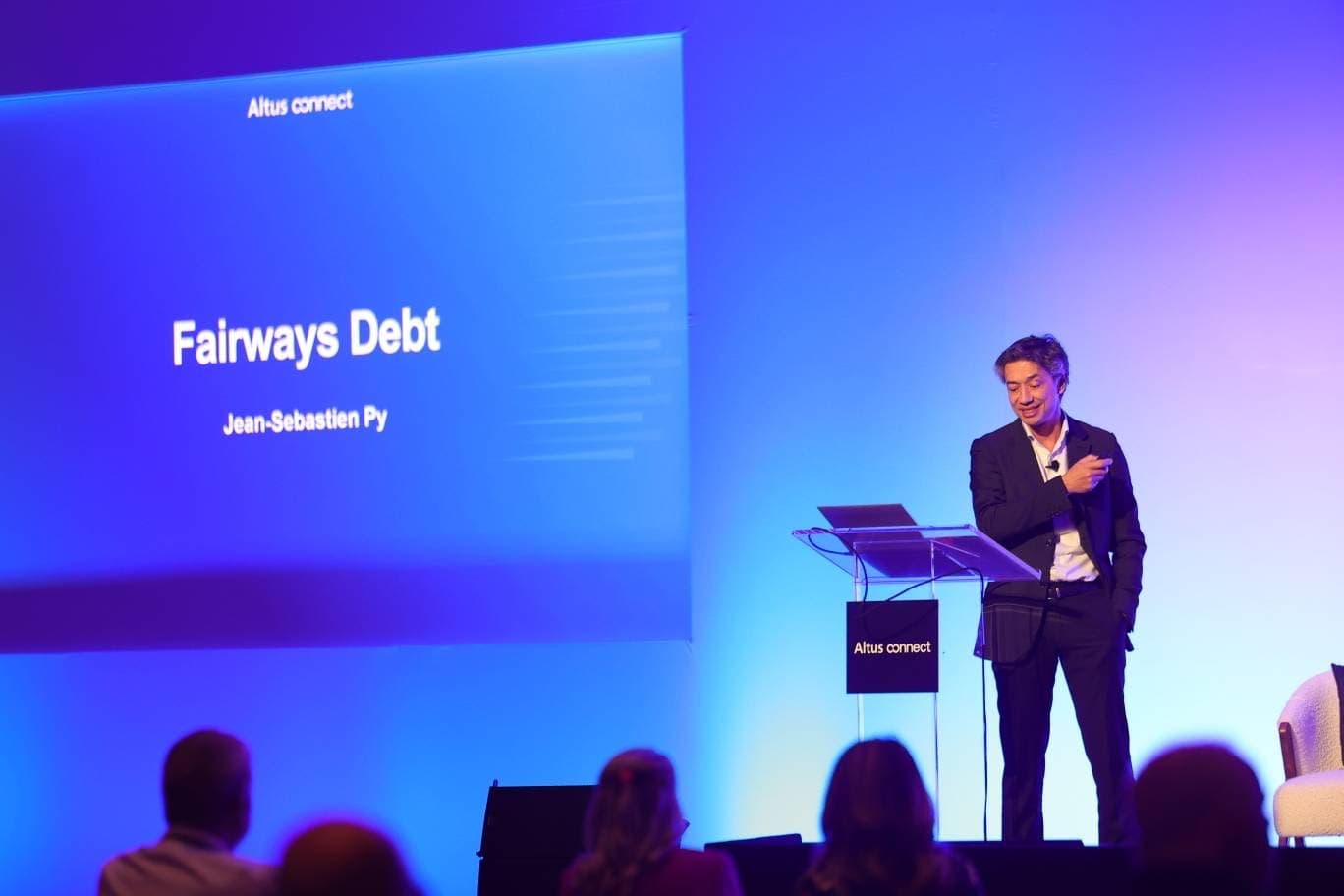
That distinction, real-time and exact versus approximation, matters more than people realize, especially in a volatile rate environment where the window to act is short.

Jean-Sebastien Py
Senior Director, Stratégie Commerciale, Opérations Debt & France, Altus Group
The industry weighs in
The breakouts took the day's themes into smaller, peer-led conversations. Data & AI Governance, hosted by Matt LaHood and Aditya Dharne, gathered the room for an honest discussion of how to build confidence in data when it drives high-stakes decisions. Product Use, hosted by Shubhra Srivastava and Christina Gratrix, opened the floor on what's working, what's harder than expected, and what adoption actually looks like inside firms. And AI in the CRE Research Function, hosted by Omar Eltorai, made space for research teams to compare notes on what's working, what's failing, and where the real opportunities lie. To everyone who joined those rooms and shared honestly: thank you. The depth of those conversations is what makes Connect what it is.
If day 1 provided the promise, day 2 provided the proof. By the end of the showcase, the platform Mike, David, and Shubhra had described in the abstract on Tuesday was something attendees had watched move in real time: from asset to portfolio, from fund to debt, from a roadmap to working software on a screen. But Altus Connect has always been about more than product updates. It's where customers connect with the teams building their tools, and with peers across the industry who are navigating the same challenges. That combination of platform progress and genuine community is what keeps people coming back.
Author

Altus Group
Author
Altus Group
Resources
Latest insights