AI in CRE valuation: Separating the hype from what actually works
Not all AI in CRE valuation is created equal, learn what separates transformative solutions from costly shortcuts that introduce more risk than they resolve.

Accelerating insight without elevating risk
As artificial intelligence (AI) has become firmly embedded in mainstream corporate strategy, the commercial real estate (CRE) industry has increasingly found itself at the heart of the AI conversation. An undercurrent of intense pressure has emerged as CRE owners and operators seek to vet, adopt, and effectively leverage the AI-powered tools that promise to change the way we do business.
What has followed, however, looks less like a measured transition and more like a gold rush. Solution providers are staking claims at every turn, promising transformative productivity gains and competitive advantages that few have yet to deliver. For every solution built on genuine innovation, there are countless others that amount to little more than a general-purpose AI model layered over a dataset with nothing defensible underneath.
The CRE industry, particularly when it comes to valuations, has historically trailed behind others in AI adoption, and for good reason. In our space, the stakes are simply too high for guesswork. The bar for trust, defensibility, and explainability is exceptionally high – and in CRE valuation, accurate and auditable, trusted data are non-negotiable. What the industry needs is not more prospectors making bold claims, but a reliable way to tell real gold from fool’s gold, to separate the solutions built on rigorous, purpose-designed foundations from those that merely look the part.
With the right technology, decision velocity and market responsiveness become core competitive differentiators, and in today’s market, the two are increasingly inseparable. Market volatility is no longer an occasional disruption to plan around; it is the baseline condition that valuation processes must be built to handle. Firms that get this right are not just making faster decisions; they are making better-informed ones because their valuation models can be quickly picked back up and calibrated to take into consideration what the market is actually doing. By shifting valuations from a rigid compliance task into strategic, on-demand recalibration, firms can dramatically shorten their business planning cycles, respond to market shifts with confidence, and gain a tangible competitive edge.
Unpacking the risks of "bad AI" in CRE valuation workflows
Understanding why over-the-counter AI falls short in CRE valuation requires looking past the surface of what these tools produce. The risks are real, and they are often invisible until it’s too late.
It has no reliable sense of what reasonable looks like: Before a valuer can apply their expertise, someone (or something) has to set up the workbench. A generic AI can approximate a starting point — but approximation isn't the same as credibility. Without grounding in a specific asset type, sub-market, or current conditions, the outputs it produces may look plausible while quietly encoding assumptions that won't survive scrutiny from a lender, auditor, or LP. That means the valuer's first task becomes validating the foundation rather than building on it, which defeats the purpose entirely.
It wasn’t built for the way valuers actually work: Valuation is an iterative process; assumptions get challenged, scenarios get tested, models get refined. A generic AI produces a static output. It has no ability to surface its reasoning in a way that a valuer can meaningfully navigate, question, and build on.
It makes risk harder to see, not easier: A generic AI produces output that looks complete and professional regardless of what’s underneath it. It’s an easily cracked veneer of credibility when a lender, auditor, or regulator starts asking hard questions and there’s no defensible chain of reasoning to follow.
"When evaluating AI, it ultimately comes down to two questions: Can I trust the output, and can I explain it? There is always a risk that you can't really explain the output when AI is done badly,” notes Matt Tordoff, Chief Information Officer at Altus Group. "It may be okay to use generic models for light search, but there are a lot of decisions made on the back of valuations where that approach simply wouldn't hold water. You have to build a trustworthy workflow to deliver those results."
Powering better decisions: Altus Group’s approach to AI
The answer to bad AI isn't no AI — it's a fundamentally different approach to how it's built, grounded, and governed. At Altus Group, that means three things working together: data precise enough to power investment-grade decisions, workflows designed around how valuation actually happens across stakeholders, and outputs held to a standard of defensibility that can withstand real scrutiny.
Data on the platform
Any AI model is only as good as the data behind it. Generic models draw on broad, publicly available sources built for breadth rather than precision. Altus Group’s curated dataset is different: purpose-built for commercial real estate, drawing on decades of investment-grade property data across asset types, sub-markets, and market cycles. This isn’t a general dataset with a proprietary label – it’s the kind of granular, asset-specific intelligence that valuation work actually demands. Where generic AI approximates, ours is calibrated to perform.
Collaborative workflows
CRE valuation is not a solo activity. Investors, lenders, owners, appraisers, asset managers, and auditors are all active participants in the same process – each contributing to, reviewing, and acting on valuation information from different vantage points. Altus Group functions as the connective tissue of this ecosystem: a platform that facilitates the creation, review, and use of valuation information across multiple stakeholders in the CRE industry. Domain expertise isn’t just packaged into the software; it’s embedded into the collaborative logic of how the platform functions. Every additional participant reinforces the value of the platform for all others – and that kind of embedded, multi-stakeholder utility is not something a point solution can replicate.
AI-driven insights
At the output layer, the standard we hold ourselves to is straightforward: every insight our AI produces has to hold up. That means valuations, business planning outputs, and scenario analyses that aren’t just plausible, but proven, traceable, and reliable enough to stake a real decision on. Our AI doesn’t just generate a number – it generates one you can defend to a lender, explain to an LP, and build a business plan around. That’s the difference between AI that impresses and AI that earns trust.

Establishing the standard: Assisting valuation work through AI
Through the lens of CRE valuations, AI should not be viewed as a standalone feature to replace human judgment, but as an embedded solution designed to augment (and accelerate) professional expertise.
Central to our approach at Altus Group is our investment in powerful new intelligent automation accelerating your valuation workflows. Designed as a user-centric solution for CRE professionals, it provides the confidence needed to act boldly through three core capabilities:
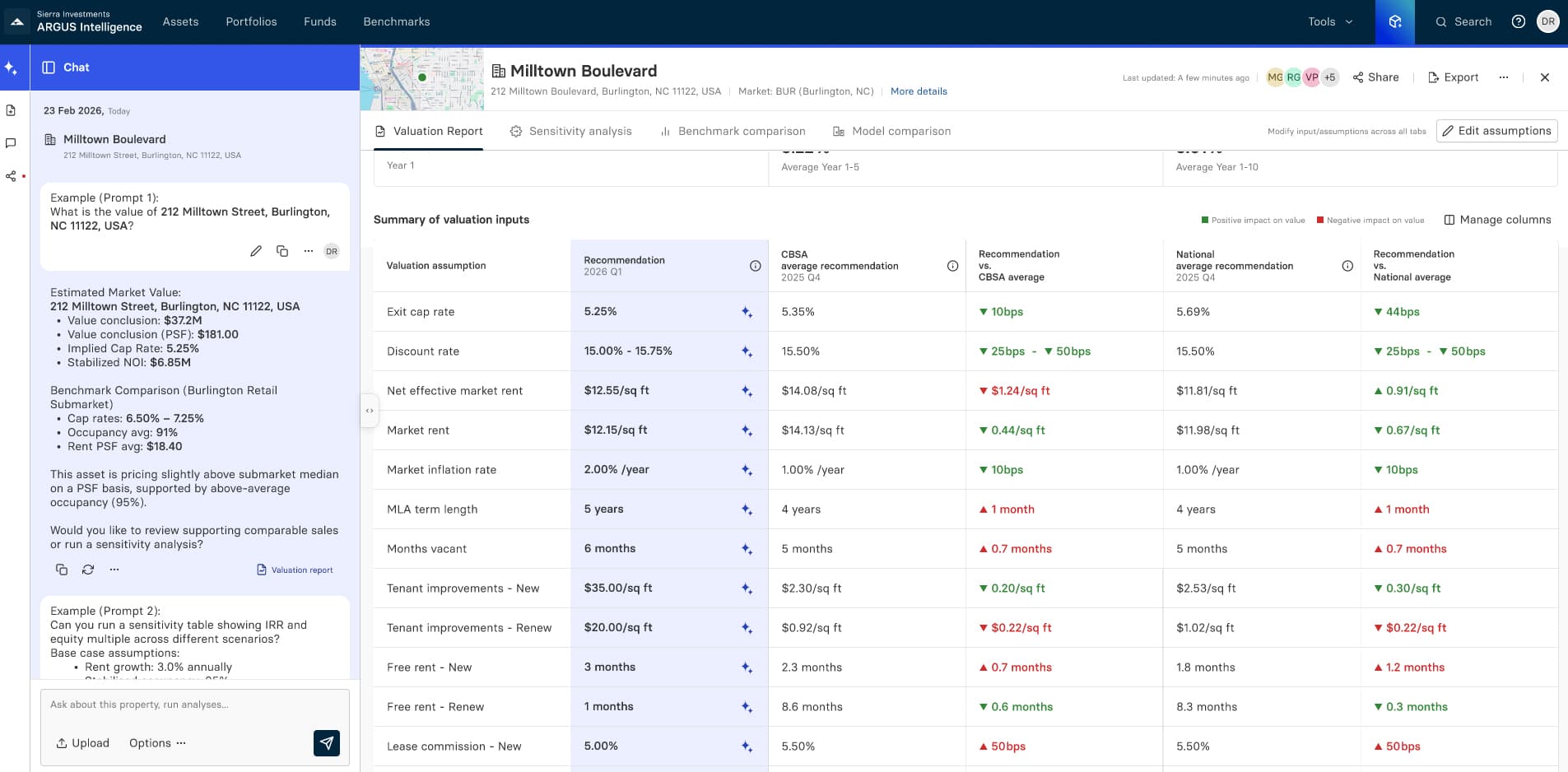
The ultimate "gopher": Our valuation assistant acts as a high-speed data retriever, gathering the precise intelligence needed to run a valuation model and considerably cutting data collection time for human valuers
Granular fine-tuning: Users collaborate with the agent to execute a valuation, followed by granular fine-tuning via a detailed interface; this provides a crystal-clear summary of the assumptions utilized, alongside all inputs and calculated outputs
Live collaboration: A conversational chat interface allows the user to carry out live, intuitive collaboration with the data, seamlessly adjusting scenarios and testing sensitivities
ARGUS under the hood: Our valuation assistant doesn’t just support the modeling of a valuation, it runs the model through the same calculation engine that institutional CRE investors already rely on, meaning the output isn’t just compatible with ARGUS Intelligence, it’s compatible with the counterparties you’re already transacting with
What organizations stand to gain with our valuation assistant
Altus Group’s valuation assistant reduces the time valuers spend manually compiling a standard valuation by 70% on new property valuations, and 50% on repeat property valuations, condensing data collection and aggregation into a single, unified view. “The strategic impact of this time savings cannot be overstated,” explains David Ross, Chief Product & Technology Officer at Altus Group. “Major investment firms are currently running on annual business planning cycles that can take up to 17 months to fully execute. By automating the data ingestion and valuation analytics, the goal is to compress that cycle so dramatically that firms can update their planning on a monthly basis.”
Figure: Preview of Altus Group’s valuation assistant in ARGUS Intelligence, commercially available in Q3 2026
When you free valuation professionals from manual data processing, they are empowered to act as true strategic advisors — shifting their focus toward higher-value tasks like estimating cap rates, benchmarking expenses, and advising on portfolio risk composition.
Built by valuers, for valuers
The distinction between a generic AI and a purpose-built one to support valuation modeling ultimately comes down to who shaped it. Our valuation assistant was developed under the guidance of our own Valuation Advisory Services (VAS) team. These practitioners manage complex valuation workflows for thousands of property valuations every quarter. Through a rigorous supervised learning process, these experts trained the AI model against thousands of real-world valuation test cases – interrogating its outputs, correcting its reasoning, and refining the user interface until the assistant could genuinely support the valuer the way valuers think and work.
"Our internal Valuation Advisory Services team is acting as our champion,” adds Shubhra Srivastava, VP of Product Management at Altus Group. “They're testing and hardening every capability. We aren't building this in a vacuum or borrowing generic tech. We don't view AI as a disruption to our model, but as an acceleration — one that is constantly coached and validated by the people who know CRE valuation best."
AI governance is not optional
Every output our AI generates carries transparency, traceability, and accountability. To ensure outcomes are defensible and grounded in high-quality data.
Unmatched governance: Altus Group is pursuing ISO 42001 certification before the end of 2026, applying the exact same rigorous governance framework to our AI that we established for information security with our ISO 27001 certification
Investment-grade consistency: When paired with our proprietary, investment-grade data, our AI enhances consistency and benchmarking across entire portfolios
Empowering decisive action: By grounding decisions in investment-grade data, teams reduce ambiguity and move from cautious validation to decisive action
"We’re helping our clients amplify and infuse their process with better information and better insight so they can get to that decision faster,” adds Ross.
Turning vision into action: Build your AI blueprint at Altus Connect
At Altus Connect, you have the unique opportunity to sit down with experts who are building the future of assistive AI for CRE valuation. Instead of generic advice, you can expect to walk away with a concrete, customized blueprint for your specific portfolio or fund.
Book a dedicated 1:1 or small group consultation at Altus Connect to:
Audit your AI readiness: Pinpoint exactly which data sets and workflows within your current ecosystem are primed to benefit from our agentic technology
Quantify your decision velocity: Map out exactly how much our solutions can compress your planning cycles, improve valuation accuracy, and accelerate your time-to-insight
Future-proof your tech stack: Gain an exclusive, under-the-hood look at our software product roadmap to ensure your firm is positioned ahead of the curve
Don't let data fragmentation, AI anxiety, or outdated workflows slow your momentum. With our help, you can transform your valuation process from a routine compliance task into your firm's most powerful strategic asset.
Book your consultation at Altus Connect.
Want to be notified of our new and relevant CRE content, articles and events?
Contributors

Shubhra Srivastava
Vice President, Product Management

David Ross
Chief Technology Officer

Matt Tordoff
Chief Information Officer
Contributors
Shubhra Srivastava
Vice President, Product Management
David Ross
Chief Technology Officer
Matt Tordoff
Chief Information Officer
Resources
Latest insights