Why scenario analysis for CRE modeling needs new infrastructure
Volatile markets demand more scenario analysis, but fragmented tools and manual processes are keeping most CRE teams from scaling up.

Key highlights:
Persistent volatility across capital markets, leasing conditions, and operating costs has made rigorous scenario analysis a necessity, not just a best practice
For most CRE portfolio teams, scenario analysis still means exporting from valuation software, manipulating assumptions in spreadsheets, and manually consolidating results; a process that is slow, fragile, and impossible to scale
Inconsistent assumptions across analysts and assets produce outputs that look complete but undermine the very investment decisions they are meant to support
When scenario work lives in siloed models and spreadsheets, assumptions go unchallenged, and strategy misalignment persists across the teams that need to be aligned most
The firms pulling ahead are replacing fragmented workflows with a shared analytical environment where scenario analysis becomes a continuous strategic capability instead of a periodic exercise
Most teams know scenario analysis matters, but few have the infrastructure to do it well
For much of the last decade, commercial real estate (CRE) investment teams could afford to anchor decisions to a single base-case scenario. Compressing cap rates, predictable rent growth, historically low interest rates, and liquid capital markets meant the range of plausible outcomes for a given asset was relatively narrow. The base case wasn’t just a starting point, for many, it was the entire analysis.
"For many, prior to the pandemic, scenario analysis was often a perfunctory exercise. Informative, though limited, sensitivity tables of cap rates and other key assumptions generally were enough to satisfy investment committees and allocation decisions,” recalls Omar Eltorai, Senior Director of Research at Altus Group.
That era is over. The post-pandemic market has introduced a fundamentally different risk landscape:
Interest rates moved faster than most models had stress-tested
Leasing behavior shifted structurally in key sectors
Operating costs spiked in ways that annual escalators never anticipated
Capital markets became decidedly more selective
What emerged was not a temporary correction but a sustained widening of the gap between a base case and a realistic downside.
“The distribution of potential outcomes has widened considerably,” adds Eltorai. “This isn’t just cyclical volatility; it’s the result of concurrent structural shifts and macroeconomic shocks that have fundamentally altered refinancing prospects and exit assumptions. An overreliance on a single base-case scenario is more risky than ever.”
Making investment decisions without rigorous stress-testing now carries significantly more risk than it did even five years ago. Portfolio teams already know this; scenario analysis is widely recognized as a fundamental part of sound investment management. The bottleneck isn’t awareness, it’s infrastructure.
How portfolio teams run scenario analysis today
For most CRE investment firms, the scenario analysis workflow follows a well-worn but deeply inefficient path. Teams build property-level models in valuation software such as ARGUS Enterprise, export results into spreadsheets, manipulate assumptions manually, and then consolidate outputs across assets to get a portfolio-level view. Some supplement this with general-purpose business intelligence tools for visualization, while larger institutions may rely on proprietary internal builds, but these remain out of reach for the majority of teams.
"The complexity of traditional valuation software means senior asset and portfolio managers typically aren't the ones running the analysis, the analysts are,” explains Mark Fitzgerald, Senior Director of Product Management at Altus Group. “That creates a disconnect between the person who has the knowledge and the person running the numbers, and it adds time at every step."
The result is a process that goes deep at the property level or broad at the reporting level, but rarely connects the two.
Where the process breaks down
That disconnect – between who holds the knowledge and who runs the numbers – doesn't just slow teams down. It creates a cascade of compounding pain points across the organization, including:
Manual effort and disjointed tools: Scenario building in manual spreadsheets means model duplication, manual version management, and fragile formulas that are slow to build and impossible to scale across a portfolio. Each additional scenario request compounds the workload.
Slow decision-making: Multi-day turnaround times to build, consolidate, and communicate scenario results delay the go/no-go and price-adjustment decisions that often matter most in the moments when the market is moving. Analysis that can’t keep pace with decisions is analysis that arrives too late to be useful.
Unreliable and incomparable outcomes: When different analysts stress-test without a unified library of assumptions and methodologies, portfolio-level aggregation can end up being built on misaligned inputs. The resulting analysis may look complete, but it undermines the very decisions it was meant to support.
Unclear risk exposure: Without side-by-side scenario comparisons and data-driven performance attribution, teams know broadly that they have exposure, but they can’t quickly pinpoint which specific assets and assumptions are driving the most impact. This is compounded by how most models are built; operating costs are often captured as one aggregate assumption rather than individual line items, which dilutes their impact through the NOI line in ways that make them harder to isolate and stress-test than revenue-side or exit assumptions. As Eltorai notes, this makes operating costs "the most consistently underestimated variable in downside scenarios today."
Limited collaboration: When scenario work lives in individual spreadsheets and siloed models, assumptions go unchallenged, strategy misalignment persists, and teams redo work that has already been done elsewhere in the organization.
What leading teams are moving toward
The most forward-thinking portfolio teams are not simply trying to run more scenarios faster. They are rethinking the infrastructure around scenario analysis entirely. That starts with running scenarios within the same environment as valuations thus eliminating model duplication and version sprawl at the source. It means standardizing stress-testing inputs through organization-approved assumption sets, so outputs are comparable across analysts and assets. It means making performance attribution a standard output, where every scenario comparison surfaces what's driving the differences, not just what the outcome is. And it means treating scenarios as shared, living artifacts that are stored centrally, accessible across the team, and iterated on over time.
This shift reflects a broader recognition: even the most skilled teams are constrained by infrastructure that can't move at the speed, consistency, or scale their decisions demand.
Built for the way portfolio teams actually work
Figure 1: Side-by-side scenario comparison in ARGUS Intelligence
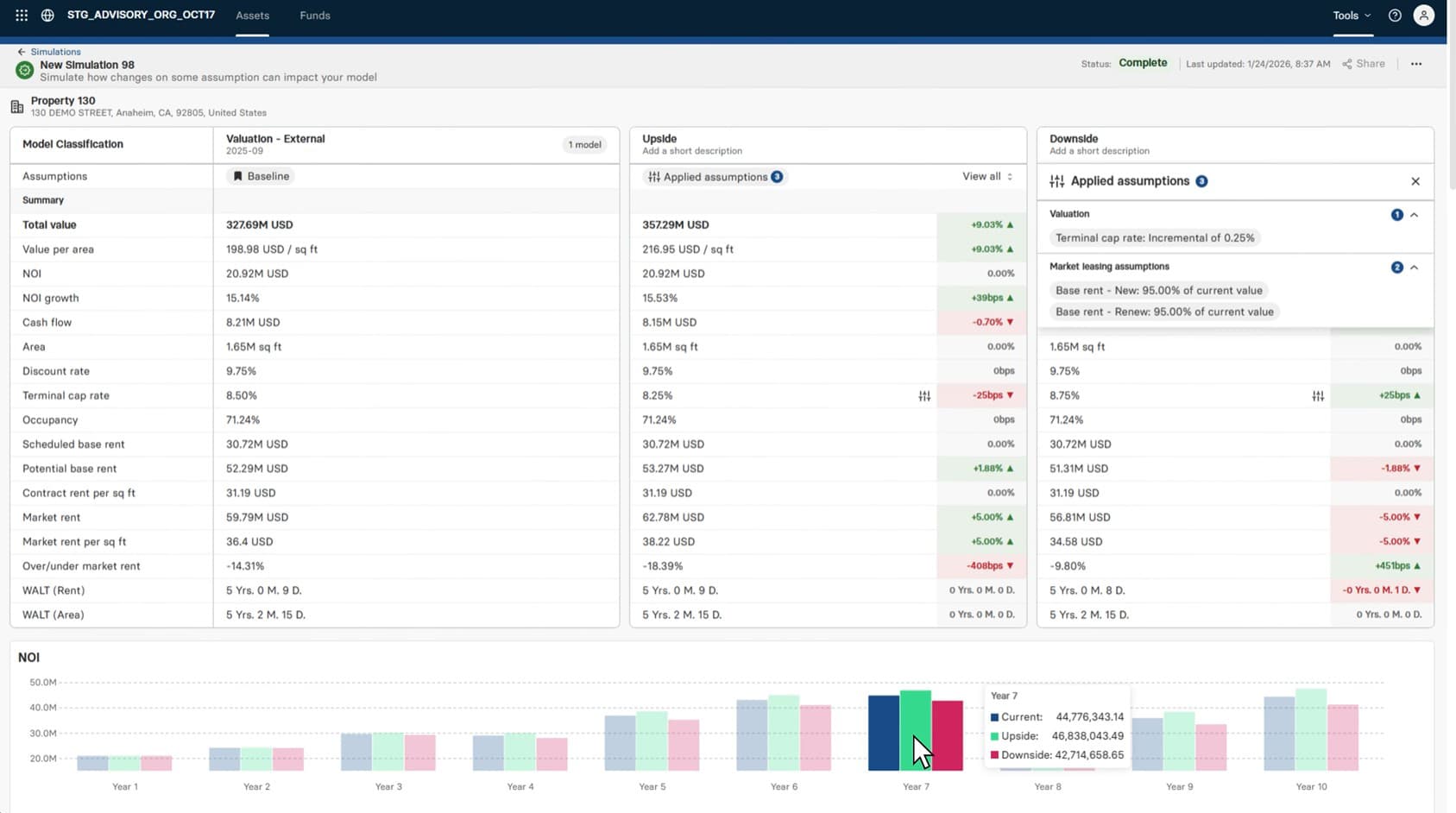
The practices outlined above represent where the most forward-thinking portfolio teams are headed. What has historically made them difficult to achieve consistently isn't intent, it's infrastructure. The scenario analysis capabilities within ARGUS Intelligence were built to close that gap, making each of these practices operationally accessible versus just aspirational:
Dynamic simulations within a single model: Instead of duplicating models and managing versions across spreadsheets, teams work within a single environment where new scenarios are created instantly without generating additional models or clutter. "No good deed goes unpunished," notes Fitzgerald. "An analyst's reward for building a good scenario used to be an ask for more scenarios, which could take hours. This lets you do that in seconds."
Multi-variable scenario building: Teams can layer exit pricing, leasing, and expense assumptions together rather than testing variables in isolation, producing scenarios that reflect how risk actually behaves in the real world, where multiple assumptions move at once. The twenty most commonly adjusted market assumptions are available to manipulate directly, with value changes calculating in seconds.
Up to four side-by-side scenario comparisons with built-in performance attribution: No more toggling between tabs or file versions, teams can see multiple outcomes simultaneously, and identify exactly which assumptions are driving the differences. Opaque exposure becomes specific, actionable insight, including for operating cost assumptions that tend to get buried in aggregate ratios in traditional models.
A shared, organization-approved assumption library: Teams draw from a centralized set of vetted assumptions applied consistently across properties, assets, and portfolios; this replaces the ad hoc inputs that make portfolio-level aggregation unreliable. The result is scenario outputs that are genuinely comparable, governance standards met without additional overhead, and a foundation built upon over time as market conditions change.
A centralized scenario workspace: Scenarios are stored, shareable, and available to be challenged and refined by portfolio managers, asset managers, and executives working from the same view at the same time. The work doesn't disappear when the decision is made.
The cumulative impact on day-to-day operations is significant. Previously, running a scenario across a portfolio meant performing analysis at each individual property, exporting results one by one, and manually constructing aggregation formulas, all while waiting on computation time at every step. Today, that entire workflow is centralized. “A portfolio manager can now do in a few clicks across an entire portfolio of hundreds of properties what previously required individual, property-by-property analysis,” adds Fitzgerald. “It enables quick answers to ad-hoc queries and decisions that are based on data rather than opinions.”
Closing the infrastructure gap
For CRE portfolio teams today, volatility isn't a phase the market is passing through, it's the environment they're permanently operating in, and scenario analysis is how leading firms manage within it. The firms pulling ahead are the ones investing in infrastructure: the tools, the processes, and the shared analytical environment required to turn scenario analysis from a periodic exercise into a continuous strategic capability. In a market with wider distributions and fatter tails, the distance between reactive risk management and proactive decision-making has never carried higher stakes.
That shift starts with having the right foundation. As Fitzgerald puts it: "Scenario analysis allows portfolio managers to make buy/sell/hold decisions based on real numbers. When it's built on existing valuation models in ARGUS Intelligence, teams are leveraging work that's already been done; this improves their decision-making process and accurately quantifies decisions rather than acting on instinct."
Stress-test assumptions. Simulate outcomes. Understand performance impact.
Learn how to run multi-variable scenario simulations across your CRE portfolio
Contributors

Omar Eltorai
Senior Director of Research, Altus Group

Mark Fitzgerald
Director of Product Management
Contributors
Omar Eltorai
Senior Director of Research, Altus Group
Mark Fitzgerald
Director of Product Management
Resources
Latest insights





Mar 12, 2026
CRE valuation has outgrown traditional processes: Is it time for a new approach?